


In the latest release of the National Trends in Disability Employment (nTIDE) report for May 2026, significant insights have emerged regarding the employment dynamics for people with disabilities, set against a backdrop of continuing economic fluctuations and the evolving post-pandemic labor market. Researchers from the Kessler Foundation and the University of New Hampshire’s Institute on Disability (UNH-IOD) have meticulously analyzed data that reveal subtle yet telling shifts in employment and labor force participation rates, providing a nuanced understanding of how this demographic is navigating the current economic landscape.
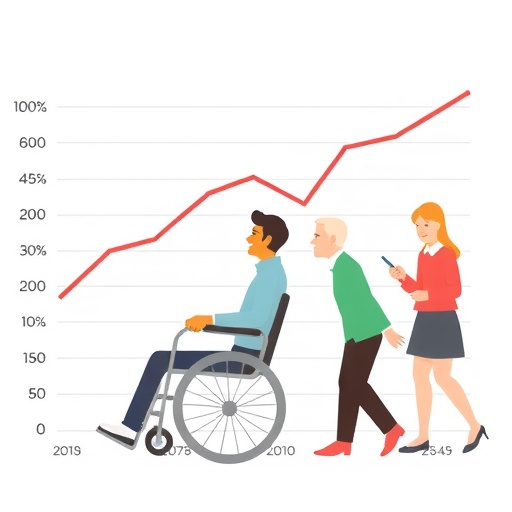
Central to the report is the employment-to-population ratio, a critical labor market metric that quantifies the proportion of working individuals within the overall population, adjusted for the working-age group of 16 to 64 years. The month-to-month data from March to April 2026 depict a decline in this ratio for people with disabilities, dropping from 38.5 percent to 37.9 percent. Contrarily, the same period saw a marginal increase in employment for people without disabilities, rising from 74.8 percent to 74.9 percent. This divergence, although slight, underscores a continuing challenge in achieving employment parity and reflects the complex socio-economic pressures unique to people with disabilities.
The labor force participation rate further contextualizes these trends by measuring the percentage of individuals either actively employed or seeking employment relative to the total working-age population. Notably, this rate for people with disabilities declined more sharply from 41.9 percent to 41.1 percent between March and April 2026, indicating potential barriers or discouragement in workforce engagement. Meanwhile, people without disabilities exhibited a minor decrease from 78.0 percent to 77.9 percent. These rates, while encapsulated within what researchers describe as a post-pandemic employment plateau, highlight ongoing vulnerabilities and signal the need for targeted interventions.
Dr. John O’Neill, director of the Center for Employment and Disability Research at Kessler Foundation, emphasized the importance of viewing these figures through a long-term lens. Despite the April dip, the employment-to-population ratio for people with disabilities remains historically elevated compared to previous decades, suggesting that sustained efforts since the pandemic have yielded progress. Such resilience indicates that structural changes and policy initiatives implemented in recent years have had a lasting positive effect, although challenges persist in maintaining momentum.
In a complementary perspective, Dr. Andrew Houtenville, professor of economics and director of UNH-IOD, contextualizes the labor force participation decline as part of a stabilization phase following unprecedented highs in late 2025. He projects that external economic factors, such as elevated oil prices, may catalyze a rebound in participation by increasing the necessity for employment among households with disabilities reliant on income to meet rising living costs. This intersection of macroeconomic forces and demographic-specific vulnerabilities underlines the complex ecosystem affecting employment outcomes.
Examining the year-over-year data yields a more optimistic narrative. From April 2025 to April 2026, the employment-to-population ratio for people with disabilities improved modestly from 37.4 percent to 37.9 percent, reflecting a 1.3 percent increase. In contrast, the ratio for people without disabilities slightly decreased, signaling nuanced shifts in economic inclusion rates. The labor force participation rate for people with disabilities also saw a subtle uptick from 41.0 percent to 41.1 percent, reinforcing the idea of gradual recovery and adaptation within this community.
Statistical analysis reveals that among the approximately 151 million workers aged 16 to 64 in the United States in April 2026, around 6.45 million, or 4.3 percent, identified as having disabilities. This demographic representation matters significantly for both policy formulation and economic models, highlighting the necessity of an inclusive approach in addressing workforce disparities and designing employment support mechanisms tailored to the needs of people with disabilities.
The nTIDE report also underscores its commitment to transparency and public engagement by hosting monthly Lunch & Learn webinars, which serve as a dynamic forum for stakeholders to delve into the latest findings, discuss methodological approaches, and consider policy implications. Recent sessions have featured diverse experts discussing themes such as employment barriers, accessibility, and innovative workplace accommodations, fostering a collaborative environment for advancing disability employment research.
Behind the data lies a growing consensus among disability economists and labor market analysts recognizing that while post-pandemic recovery has solidified a new employment baseline for people with disabilities, significant systemic challenges remain. Barriers such as discrimination, insufficient workplace accommodations, and socioeconomic inequities continue to limit full workforce integration. These persistent issues necessitate multifaceted solutions combining legislation, social support, and employer engagement.
The efforts of institutions like the Kessler Foundation and UNH-IOD, supported by federal and private funding, demonstrate the vital role of evidence-based research in informing public policy and advocacy. By refining data collection techniques, customizing analysis to working-age populations, and disseminating findings broadly, these organizations contribute to a more comprehensive understanding of the labor market and foster progress toward equitable employment opportunities.
Contextually, the inflationary pressures that disproportionately impact families of people with disabilities—who are statistically more likely to live below the poverty line—introduce an additional layer of complexity. Economic strains may simultaneously motivate increased workforce participation for financial necessity while also exacerbating barriers due to increased care responsibilities, health concerns, or transportation challenges. Balancing these factors remains a critical area of concern.
Ultimately, the nTIDE report and its ongoing analytical work provide an indispensable tool for stakeholders committed to advancing disability inclusion in the labor force. As economic conditions evolve and policymakers calibrate responses, continued vigilance and adaptive strategies will be paramount in ensuring that employment gains for people with disabilities are not only sustained but accelerated, contributing to broader social and economic equity.
News Publication Date: May 8, 2026
Web References:
- nTIDE reports and archives: ResearchonDisability.org/nTIDE
- Bureau of Labor Statistics Jobs Report: www.bls.gov/news.release/empsit.nr0.htm
- Kessler Foundation: kesslerfoundation.org
- University of New Hampshire Institute on Disability: researchondisability.org
Cite Scienmag News
Courtney Benton. (May 8, 2026). Employment of people with disabilities dips slightly but stays close to record levels. Scienmag. https://scienmag.com/employment-of-people-with-disabilities-dips-slightly-but-stays-close-to-record-levels/
Courtney Benton. "Employment of people with disabilities dips slightly but stays close to record levels." Scienmag, 8 May 2026, https://scienmag.com/employment-of-people-with-disabilities-dips-slightly-but-stays-close-to-record-levels/. Accessed 4 September 2026.
Courtney Benton. "Employment of people with disabilities dips slightly but stays close to record levels." Scienmag. May 8, 2026. https://scienmag.com/employment-of-people-with-disabilities-dips-slightly-but-stays-close-to-record-levels/


