


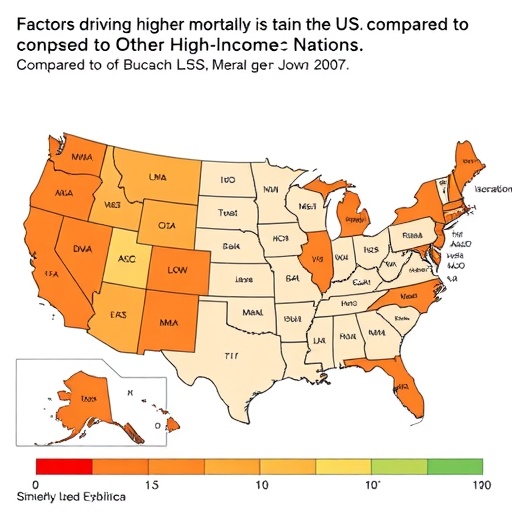
A recent extensive study, published in the prestigious JAMA Network Open, has brought to light a stark and troubling reality: the United States continues to experience significantly higher mortality rates compared to other affluent nations. Covering the years from 1999 to 2022, this rigorous cross-national analysis draws upon repeated cross-sectional methodologies to provide a comprehensive overview of death rates across high-income countries. The findings underscore a paradox—despite the United States’ expansive access to sophisticated medical technologies and advanced healthcare infrastructure, it nevertheless endures a disproportionately elevated number of deaths.
This persistent mortality disparity invites critical scrutiny of the underlying factors beyond mere healthcare access. The study suggests that health outcomes are not solely dictated by technology availability but are deeply influenced by broader social determinants and public policy frameworks. According to the researchers, many of the avoidable excess deaths in the U.S. could be mitigated through the implementation of health and social policies that have been demonstrably successful in other high-income contexts. The implication is profound: mortality is a multifaceted issue, requiring interventions that transcend clinical care, encompassing a holistic approach to social welfare, preventive health, and economic equity.
An important consideration highlighted by the study involves the limitations and challenges inherent in multinational data comparability. Cross-country analyses often contend with variable death coding standards, data completeness issues, and reporting inconsistencies, all of which can introduce uncertainties in interpreting mortality figures. The researchers caution that these methodological nuances must be carefully weighed when drawing conclusions. However, even with these caveats, the overarching trend of excess mortality in the U.S. remains robust and calls for urgent attention.
Embedded within the mortality figure disparities are possible contributions from social inequalities pervasive in American society. Income inequality, in particular, emerges as a critical social determinant potentially exacerbating health outcomes. Whereas many peer countries have instituted social safety nets and health policies that mitigate the impact of socio-economic disparities on mortality, the U.S. appears less effective at bridging these gaps. The interplay between socio-economic status and access to preventive health services likely exacerbates the observed mortality differentials.
Furthermore, legislative frameworks and government policies are instrumental in shaping health trajectories on a population level. The investigation points to the necessity of evaluating the efficacy of existing U.S. legislation related to public health, social welfare, and economic support. Comparative policy analyses reveal that other high-income nations’ regulatory environments may afford protective factors that reduce mortality by addressing root causes such as poverty, education inequalities, and healthcare access barriers.
From a methodological standpoint, the study’s use of repeated cross-sectional data allows for temporal tracking of mortality trends, thus enabling identification of persistent patterns as well as emergent issues. This approach provides a dynamic perspective on mortality, contrasting with static snapshots often seen in previous research. The longitudinal design strengthens the validity of findings by demonstrating consistent excess mortality over more than two decades.
Technological advancements in information processing and data analysis have empowered this kind of rigorous cross-national mortality research. Utilizing sophisticated statistical tools and harmonizing international datasets requires meticulous attention to detail and an interdisciplinary approach. The study exemplifies the integration of epidemiology, demography, social sciences, and health informatics, setting a benchmark for future comparative mortality research.
The study also emphasizes human health implications, illustrating that mortality metrics are not just abstract statistical outcomes but reflections of real-world lived experiences. High death rates in the U.S. translate into millions of premature deaths, diminished quality of life, and substantial socio-economic costs. Public health stakeholders, policymakers, and society at large must reckon with these findings as a clarion call for systemic change.
Moreover, this research aligns with growing recognition within the scientific community that tackling mortality disparities requires inclusive and equitable public policy initiatives. Health interventions cannot be siloed within clinical settings but must integrate social, economic, and environmental factors. Initiatives such as expanding access to affordable healthcare, addressing food insecurity, improving education, and reducing income inequality could collectively shift the trajectory of U.S. mortality rates.
In conclusion, the comprehensive analysis conducted by Jacob Bor, PhD, and colleagues provides an urgent narrative about mortality in the United States compared to its high-income peers. Despite technological prowess, social and policy inadequacies perpetuate unacceptable mortality differentials. The study paves the way for developing evidence-based policies that, if adopted, could save hundreds of thousands of lives annually. It is a critical scientific contribution demanding both national introspection and international collaboration to close the mortality gap.
Cite Scienmag News
Courtney Benton. (May 8, 2026). Factors Driving Higher Mortality Rates in the US Compared to Other High-Income Nations. Scienmag. https://scienmag.com/factors-driving-higher-mortality-rates-in-the-us-compared-to-other-high-income-nations/
Courtney Benton. "Factors Driving Higher Mortality Rates in the US Compared to Other High-Income Nations." Scienmag, 8 May 2026, https://scienmag.com/factors-driving-higher-mortality-rates-in-the-us-compared-to-other-high-income-nations/. Accessed 4 September 2026.
Courtney Benton. "Factors Driving Higher Mortality Rates in the US Compared to Other High-Income Nations." Scienmag. May 8, 2026. https://scienmag.com/factors-driving-higher-mortality-rates-in-the-us-compared-to-other-high-income-nations/


