


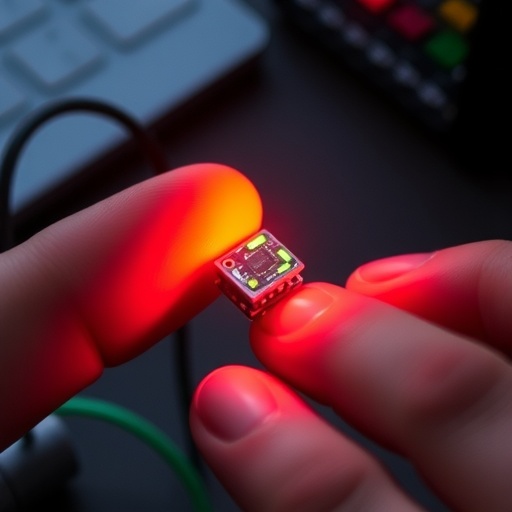
In a groundbreaking advancement that promises to redefine tactile sensing in miniature machines and medical devices, researchers from Shanghai Jiao Tong University have engineered an optical force sensor scarcely larger than a grain of rice. This innovative device is capable of measuring forces and torques in all spatial directions using light rather than conventional electronic signals, heralding a new era in robotics and minimally invasive surgical tools. At a diminutive size of just 1.7 millimeters, this sensor could endow robotic systems with the ability to ‘feel’ and respond to their physical environment with unprecedented precision, enabling delicate interactions in confined and sensitive spaces.
Traditional force sensors often face challenges related to bulkiness, complexity, and the necessity for multiple sensing elements, which makes miniaturization difficult and integration into tiny tools cumbersome. The newly developed optical sensor sidesteps these obstacles by harnessing light within an optical cavity embedded in a deformable elastomer tip, attached to an optical fiber. When the tip contacts an object, even minuscule deformations alter the pattern of light within this cavity, modulating an optical signal transmitted through a coherent fiber bundle to a high-resolution camera. The camera captures these subtle changes as images, which sophisticated data-driven algorithms then analyze to interpret the complex force and torque states acting on the sensor.
What sets this sensor apart from conventional force measurement technologies, such as fiber Bragg grating (FBG) systems, is its ability to operate via a single optical channel rather than relying on discrete sensing elements distributed around the device. This design not only simplifies the structure but also reduces fabrication complexity and potential points of failure. Moreover, the coherent fiber bundle acts like a fiber-optic ‘fiber optics fiber,’ preserving spatial information in light patterns while significantly reducing wiring and cabling requirements — a crucial advantage in miniaturized robotic applications.
The implications for minimally invasive surgery are profound. Robotic surgical systems often operate through narrow pathways and limited access points inside the human body, such as the eye or delicate vascular channels. The capacity to detect force direction, magnitude, and torque with such a tiny sensor can enhance surgeons’ ability to maneuver instruments safely without causing unintended tissue damage. Additionally, this enhanced tactile feedback could allow robotic systems to adjust their movements dynamically, reducing procedural risks and optimizing outcomes where millimeter-scale precision is mandatory.
Experimental validation of the sensor was conducted under a range of complex loading conditions, encompassing both forces and twisting torques, using a precision reference sensor and motorized stages. The sensor demonstrated exceptional repeatability and low hysteresis, maintaining consistent readings even during loading and unloading cycles. It also showed robustness against variations in temperature and bending stresses, which are common challenges in practical deployment, indicating strong potential for real-world applications that demand operational stability.
The research team further explored the sensor’s capabilities in biomedical contexts by simulating tumor palpation. Using gelatin phantoms embedded with stiff spherical inclusions mimicking subsurface tumors, the sensor reliably detected and localized these hidden structures beneath the surface. This mechanical mapping capability can be transformative for tactile-guided interventions, providing critical information beyond what traditional imaging methods offer. Surgeons may one day employ such sensors to palpate tissues and identify abnormalities non-invasively, augmenting diagnostic capabilities during minimally invasive procedures.
The sensor’s design evolution addresses a fundamental limitation of current miniaturized force sensors by shifting from component-wise measurement to sensing the overall contact state holistically. Beyond simplifying sensor fabrication, this approach enables the seamless integration of force sensing with optical imaging, potentially leading to multifunctional tools that can visualize and feel simultaneously. Such dual-capability instruments would represent a formidable advance in surgical robotics and industrial automation alike.
Moving forward, the researchers aim to transition the sensor from laboratory prototypes to commercially viable products. This transition will involve optimizing consistency during manufacturing, streamlining calibration processes, and developing compact, user-friendly packaging suitable for clinical and industrial deployment. Integration into robotic platforms and surgical instruments remains an essential phase, requiring extensive testing under realistic, long-duration operating conditions to validate durability and reliability at scale.
The innovation emanates from a broader initiative to revolutionize optical sensing methods by replacing electrical components prone to interference and failure with purely photonic approaches. By utilizing light patterns modulated by physical interactions, the device avoids electromagnetic interference issues and potentially offers faster response times with higher sensitivity. This approach also paves the way for sensors capable of operating in extreme environments where electronics may malfunction, including inside magnetic resonance imaging (MRI) machines or under high radiation.
Optical fibers’ intrinsic biocompatibility and small footprint present another advantage, facilitating direct integration into implantable or wearable health monitoring systems. Future iterations of this sensor technology could be embedded into smart prosthetics, robotic exoskeletons, or haptic interfaces, providing users with tactile sensations that closely mimic natural touch. Such capabilities would greatly advance assistive devices and human-machine interfaces, enhancing quality of life for people with sensory impairments.
The research team published their work in Optica, a high-impact journal by the Optica Publishing Group, signaling the importance and novelty of their contribution to the photonics and robotics communities. Their findings have ignited considerable interest in both academic and industrial sectors focused on next-generation sensing technologies. As the field evolves, this light-based approach to force and torque sensing stands to redefine how machines perceive and interact with their environments on microscopic and macroscopic scales alike.
By effectively turning touch into light, this novel optical force sensor bridges a daunting technological gap, offering a solution where traditional electronics fall short. Its integration into robotic tools and medical systems is poised to bring a paradigm shift in precision, safety, and functionality, potentially saving lives and expanding the operational capabilities of machines tasked with navigating and manipulating the smallest of spaces with delicate finesse.
News Publication Date: Not explicitly mentioned in the content
Web References:
References:
Yang, Jianlong, et al. “Optical fiber sensor for multi-axis force and torque measurement.” Optica. DOI: 10.1364/OPTICA.582941
Keywords
Optical force sensor, photonic sensing, minimally invasive surgery, robotic tactile feedback, optical fiber sensor, multi-axis force measurement, elastomer tip deformation, coherent fiber bundle, torque sensing, biomedical sensing, tumor palpation, optical imaging
Cite Scienmag News
Bethany Barker. (May 8, 2026). Miniature Sensor Uses Light to Detect Touch. Scienmag. https://scienmag.com/miniature-sensor-uses-light-to-detect-touch/
Bethany Barker. "Miniature Sensor Uses Light to Detect Touch." Scienmag, 8 May 2026, https://scienmag.com/miniature-sensor-uses-light-to-detect-touch/. Accessed 4 September 2026.
Bethany Barker. "Miniature Sensor Uses Light to Detect Touch." Scienmag. May 8, 2026. https://scienmag.com/miniature-sensor-uses-light-to-detect-touch/


