


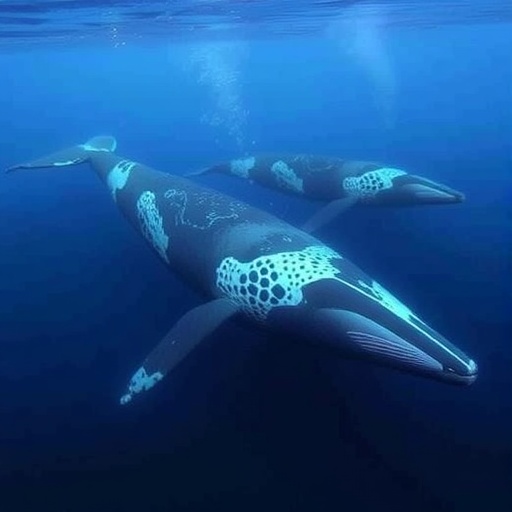
The Mediterranean fin whale, a majestic and endangered marine giant, has long intrigued scientists due to its unique ecological role and enigmatic population dynamics. Recent groundbreaking research published in Genome Biology and Evolution has unveiled critical insights into the genetic architecture of this elusive group, demonstrating that it is not entirely isolated from its Atlantic counterparts. This revelation carries profound implications for the conservation management of fin whales amid escalating human-induced and environmental pressures.
Whales, particularly fin whales (Balaenoptera physalus), are ecological linchpins in marine ecosystems worldwide. Their immense size contrasts with the fragility of their populations, which have been imperiled by centuries of hunting, habitat degradation, and climate change. These cetaceans contribute critically to nutrient cycling through their migratory behaviors — a process termed the “whale pump” — which facilitates the redistribution of nutrients, thereby sustaining diverse marine food webs. Leveraging contemporary genomic methodologies, researchers are now poised to dissect population structures and evolutionary trajectories with unprecedented resolution, a necessity as climatic shifts accelerate.
The fin whale ranks second only to the blue whale in terms of sheer body size, yet the Mediterranean Sea population remains poorly characterized at the genomic level despite its endangered status. Prior studies primarily utilized acoustic monitoring and satellite tagging, indicating a degree of behavioral segregation from the North Atlantic populations. The existence of both resident and migratory subgroups within the Mediterranean added complexity to their population dynamics, but genetic analyses remained fragmented and inconclusive until this recent study employed whole-genome sequencing.
Utilizing whole-genome data from individuals sampled across the Mediterranean, North Atlantic, North Pacific, and the relatively understudied Sea of Cortez populations, the researchers pursued a comprehensive interrogation of population genetic structure. This approach enabled the detection of subtle genetic differentiation, identification of gene flow events, and reconstruction of demographic histories that span hundreds of millennia. Notably, the Mediterranean whales formed a genetically distinct cluster, yet crucially, they exhibited signs of ongoing gene exchange with adjacent Atlantic populations, challenging previous assumptions of complete reproductive isolation.
Within the Mediterranean cohort, further genetic heterogeneity emerged. Some individuals demonstrated genetic signatures consistent with exclusively local ancestry, suggesting the presence of somewhat isolated, possibly sedentary groups. Others showed admixture patterns, indicative of recent or ongoing migration and interbreeding with North Atlantic whales. This genetic admixture reveals a nuanced population landscape shaped by both isolation and connectivity, fostering adaptive potential amid ecological pressures.
Demographic reconstructions indicated a persistent decline in both Mediterranean and Atlantic fin whale populations over the past 200,000 years. This long-term trend likely reflects historical climatic fluctuations, prey availability shifts, and perhaps anthropogenic influences that have compounded in recent centuries. Overlaying this ancient demographic context with the genomic variability observed provides a critical framework for assessing the resilience and adaptive capacity of these populations in the face of rapid modern environmental change.
The detection of genomic variability within the Mediterranean population holds substantial relevance for conservation biology. Genetic diversity underpins evolutionary potential, equipping populations with the capacity to adapt to pathogens, climate fluctuations, and habitat alterations. The limited but non-negligible gene flow with Atlantic populations suggests that conservation efforts should transcend political boundaries, fostering international cooperation to maintain connectivity corridors essential for genetic exchange and demographic stability.
The study’s lead author, Roberto Biello, emphasizes the indispensable role these cetaceans play within the Mediterranean marine ecosystem. By generating the first complete genomes for multiple Mediterranean fin whales, the research not only illuminates their unique genetic identity but also establishes a crucial resource for future studies aimed at monitoring adaptive responses to specific environmental stressors. This genomic baseline is pivotal for designing targeted conservation strategies, prioritizing both the prevention of population decline and the preservation of ecological connectivity.
Importantly, this research exemplifies how cutting-edge genomic technologies can redefine our understanding of marine megafauna population dynamics. It highlights the interplay between evolutionary history and recent ecological pressures, prompting a reevaluation of conservation paradigms that traditionally focused solely on population size or geographic ranges. Integrating genomic insights advances the capacity to predict population responses to ongoing environmental challenges, including climate-induced habitat shifts and anthropogenic noise pollution.
Moreover, the identification of subpopulations within the Mediterranean fin whales underscores the complex social and reproductive structures that could influence conservation outcomes. Such fine-scale genetic distinctions advocate for nuanced management approaches that consider intra-population diversity rather than treating the Mediterranean whales as a homogeneous unit. This precision in conservation genomics paves the way for adaptive management strategies that align with ecological realities.
The broader evolutionary context provided by comparing the Mediterranean population to those in the North Atlantic, North Pacific, and Sea of Cortez elucidates the fin whale’s remarkable dispersal capabilities and historical biogeography. These findings contribute to the growing body of evidence that marine species, while often exhibiting locale-specific adaptations, remain connected through gene flow that sustains genetic diversity across ocean basins.
Finally, as anthropogenic pressures continue to mount — from shipping traffic and fishing activities to climate change effects — the Mediterranean fin whale faces an increasingly precarious existence. This study’s integrative genomic approach offers a blueprint for monitoring and bolstering the resilience of this population. It reinforces the necessity of sustaining genetic connectivity and informs marine spatial planning and protected area designation to secure viable habitats and migration corridors.
In conclusion, the genomic dissection of the endangered Mediterranean fin whale population unravels a complex tapestry of isolation and connectivity, demographic decline, and evolutionary resilience. The insights obtained underscore the importance of holistic, genomics-informed conservation strategies that incorporate both local protection and international collaboration. As humanity’s footprint extends across the world’s oceans, these majestic cetaceans serve as vital sentinels for ocean health — their survival intricately linked to the genetic bridges that connect seas and scientists alike.
News Publication Date: 28-Apr-2026
Web References:
https://academic.oup.com/gbe/article-lookup/doi/10.1093/gbe/evag084
http://dx.doi.org/10.1093/gbe/evag084
Cite Scienmag News
Juliet Wilcox. (April 28, 2026). Study finds two whale populations divided by seas are genetically connected. Scienmag. https://scienmag.com/study-finds-two-whale-populations-divided-by-seas-are-genetically-connected/
Juliet Wilcox. "Study finds two whale populations divided by seas are genetically connected." Scienmag, 28 April 2026, https://scienmag.com/study-finds-two-whale-populations-divided-by-seas-are-genetically-connected/. Accessed 1 September 2026.
Juliet Wilcox. "Study finds two whale populations divided by seas are genetically connected." Scienmag. April 28, 2026. https://scienmag.com/study-finds-two-whale-populations-divided-by-seas-are-genetically-connected/


