


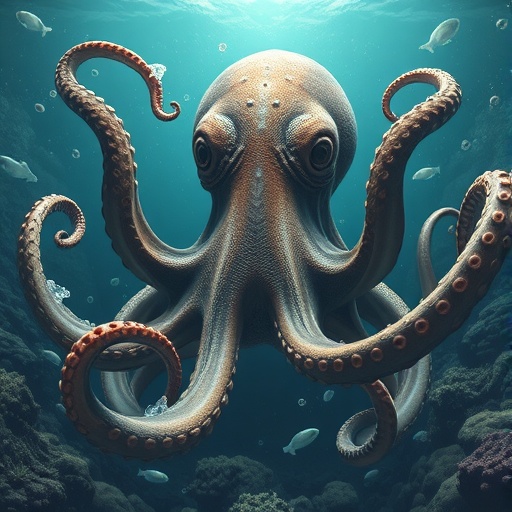
For decades, the Late Cretaceous oceans were perceived as dominions ruled by formidable marine reptiles and apex sharks. These vertebrate predators epitomized the highest trophic levels in the marine food web, overshadowing invertebrates primarily as their prey. However, a groundbreaking investigation conducted by Shin Ikegami and his team challenges this long-standing paradigm by unveiling the presence of colossal octopus-like cephalopods that once patrolled these ancient seas. These creatures, with lifespans dating back roughly 100 to 72 million years ago, showcased astonishing sizes—some specimens potentially exceeding 19 meters in total length, rivaling the giant mosasaurs and other marine giants of their time.
This study revolutionizes our understanding of cephalopod evolution and their ecological roles. Octopuses, unlike their heavily armored mollusk counterparts, exhibit an evolutionary path characterized by the loss of protective shells, which paradoxically conferred locomotor agility, heightened sensory capabilities, and advanced neural sophistication. Their soft-bodied architecture allowed for unprecedented environmental interaction, enhancing their predatory prowess and making them formidable hunters. Despite this, their ecological impact during the Mesozoic has been obscured, mainly due to the inherently poor fossilization potential of soft tissues, leaving a significant gap in paleobiological knowledge.
To remedy this knowledge deficit, Ikegami and his colleagues meticulously analyzed fossilized jaw elements—specifically the beaks—of ancient octopods, remnants which endure better in the fossil record due to their chitinous composition. The wear patterns on these jaws are especially revealing. In extant cephalopods, incisions and abrasions on the beak arise from repeated interactions with hard-shelled prey such as crustaceans and mollusks. These distinctive signs provide a reliable proxy for assessing dietary habits and behavioral ecology. By comparing such micro-damage patterns on fossil specimens to modern analogues, the researchers reconstructed predation strategies and functional morphology with high fidelity.
Using advanced non-destructive digital fossil mining methodologies, the team expanded the dataset by uncovering 12 additional finned octopus jaws. These specimens, extracted from Late Cretaceous sedimentary deposits, belong predominantly to two species: Nanaimoteuthis jeletzkyi and N. haggarti. The latter stands out for its remarkable grandeur, with size estimates reaching nearly 19 meters, a scale unprecedented for invertebrates. Such gigantism places them unequivocally among the largest marine organisms of their epoch, suggesting they held pivotal ecological niches formerly attributed solely to dominant vertebrate predators.
Detailed morphometric analyses and allometric scaling applied to the jaw elements allowed researchers to approximate the overall body sizes with unprecedented precision. The evolutionary implications are manifold: gigantism in cephalopods likely conferred substantial predatory advantages, facilitating the capture and subjugation of sizeable prey. The observed jaw wear from juveniles to massive adults signals a lifelong diet composed primarily of hard-bodied fauna, hinting at an ecological role beyond mere scavenging or opportunistic feeding.
Behavioral inferences drawn from these data underscore advanced predatory tactics, including the utilization of flexible arms equipped with numerous suckers to grasp and immobilize prey items before manipulation with robust, crushing beaks. Such capabilities indicate a high degree of neuromuscular control and cognitive function, known in modern octopuses for complex problem-solving and hunting strategies. This nexus of physical adaptation and behavioral sophistication suggests these ancient giants were apex predators, capable of both competition with and predation upon mosasaurs and similar marine reptiles.
The presence of large cephalopod predators during the Cretaceous opens new conversations on marine trophic dynamics. Previous food web models, heavily skewed toward vertebrate dominance, must now be recalibrated to incorporate these invertebrate titans as influential ecosystem engineers. Their role in shaping biodiversity, prey population structures, and even nutrient cycling warrants reexamination under this novel framework. Such an integrative perspective enriches our understanding of Mesozoic marine ecology and evolution.
This discovery also provides a fresh lens through which to investigate the evolutionary drivers promoting gigantism in soft-bodied invertebrates. While the loss of a protective shell introduced vulnerabilities, the concomitant increase in mobility and intelligence may have offset these costs considerably. The extraordinary size of Nanaimoteuthis species implies a successful evolutionary strategy, potentially shaped by ecological pressures such as interspecific competition and predation avoidance, alongside availability of diverse prey resources.
In light of the limited fossil record of soft tissues, the utilization of beak morphology and wear analysis emerges as a powerful proxy for reconstructing behavioral ecology in extinct cephalopod lineages. This methodological advancement not only sheds light on Cretaceous ecosystems but also establishes new avenues for future paleontological research targeting other enigmatic taxa with soft, rarely fossilizing body parts.
As the scientific community digests these revelations, the conceptualization of ancient marine food webs undergoes a paradigm shift. The inclusion of giant cephalopods as apex predators compels the reassessment of Mesozoic marine biotic interactions, prompting questions about coevolutionary arms races, predator-prey dynamics, and the evolutionary pressures that sculpted the trajectories of marine vertebrates and invertebrates alike.
These findings, published in a leading journal, exemplify how cutting-edge technology can extract profound insights from sparse and fragmented fossil evidence, transforming fragments into comprehensive narratives of life’s past grandeur. The synergistic integration of paleontology, evolutionary biology, and advanced imaging heralds a new era of understanding the ancient biosphere’s complexity and the multifaceted roles played by organisms once thought peripheral.
Ultimately, the giant Cretaceous octopuses emerge not as mere anomalies in the fossil record but as keystone predators that shaped marine ecosystems in ways previously unappreciated. Their legacy, imprinted in the microscopic damage patterns of fossil jaws, rewrites a crucial chapter in the evolutionary saga of marine life and invites future multidisciplinary research to unravel the mysteries of prehistoric oceanic life.
News Publication Date: 23-Apr-2026
Web References: DOI: 10.1126/science.aea6285
Cite Scienmag News
Gavin Prescott. (April 23, 2026). Cretaceous Oceans Dominated by Giant Kraken-Like Octopus Apex Predators. Scienmag. https://scienmag.com/cretaceous-oceans-dominated-by-giant-kraken-like-octopus-apex-predators/
Gavin Prescott. "Cretaceous Oceans Dominated by Giant Kraken-Like Octopus Apex Predators." Scienmag, 23 April 2026, https://scienmag.com/cretaceous-oceans-dominated-by-giant-kraken-like-octopus-apex-predators/. Accessed 3 September 2026.
Gavin Prescott. "Cretaceous Oceans Dominated by Giant Kraken-Like Octopus Apex Predators." Scienmag. April 23, 2026. https://scienmag.com/cretaceous-oceans-dominated-by-giant-kraken-like-octopus-apex-predators/


