


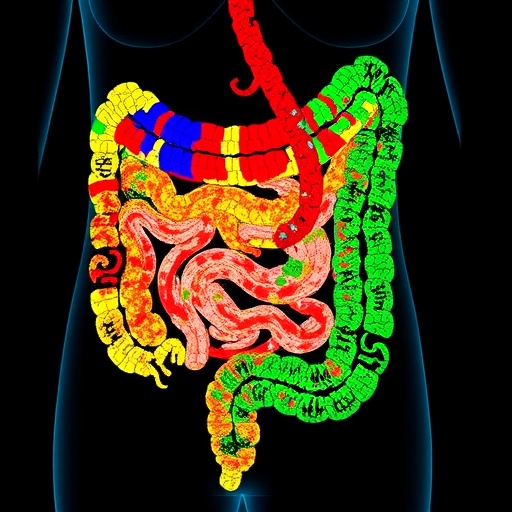
In a groundbreaking advance set to reshape the understanding and treatment of inflammatory bowel disease (IBD), a multinational team of researchers has unveiled a comprehensive spatial transcriptomics atlas that maps the intricate cellular landscape of this complex disorder. Published in Nature Communications, this pioneering study harnesses cutting-edge spatially resolved gene expression technologies to illuminate the dynamic interplay between immune cells, epithelial cells, and the gut microenvironment in unprecedented detail. The implications for research consortiums and clinical trials are profound, promising more precise stratification of patient subtypes and targeted therapeutic interventions.
Inflammatory bowel disease, an umbrella term primarily encompassing Crohn’s disease and ulcerative colitis, affects millions globally, manifesting as chronic inflammation and debilitating gastrointestinal symptoms. Despite extensive genetic and immunological studies, the heterogeneous nature of IBD has confounded consistent treatment approaches and biomarker identification. Leveraging spatial transcriptomics—an emergent method that integrates gene expression profiling with spatial context—researchers overcome limitations of bulk and single-cell RNA sequencing by preserving tissue architecture and cell-cell interactions.
The atlas developed by Li, Wei, Yang, and colleagues incorporates hundreds of tissue samples from diverse IBD patients, capturing the complexity of inflamed and non-inflamed regions. Their methodology combines high-resolution imaging with RNA sequencing data at near single-cell resolution, enabling them to spatially localize transcriptional signatures within histological niches. This granular insight reveals how pathogenic immune cell clusters colocalize with disrupted epithelial barriers and mesenchymal cells, outlining previously uncharted inflammatory microenvironments that drive disease progression.
Beyond cataloging cell types, the investigators applied advanced machine learning algorithms to decode the intricate gene regulatory networks underlying immune activation and tissue remodeling. This unraveling of cell-state heterogeneity discovers novel subsets of T cells, macrophages, and stromal cells exhibiting distinct spatial patterns and functional programs linked to disease severity. For example, regulatory T cells in proximity to epithelial crypts express unique markers suggestive of localized immunomodulation, a feature potentially exploitable for precision therapy.
The atlas also highlights the spatial reorganization of extracellular matrix components and vascular niches within inflamed tissues. This remodeling appears tightly coupled with fibrotic changes and angiogenesis, processes integral to chronicity and symptom persistence in IBD patients. By correlating spatial gene expression with histopathological scoring, the study identifies molecular phenotypes predictive of clinical trajectories, opening avenues for biomarker-driven patient stratification in clinical trials.
Perhaps most striking is the atlas’s utility in guiding therapeutic development and implementation. The defined spatial maps facilitate identification of microenvironmental signatures that predict response or resistance to biologics such as anti-TNF agents. This precision profiling may overcome prior challenges in IBD drug development, where heterogeneous trial populations yielded inconsistent efficacy outcomes. The atlas lays the foundation for integrating spatial biology into multicenter consortium protocols and real-world clinical settings.
Technical refinements in this study include the novel integration of cryosection spatial transcriptomics data with immunofluorescence and multiplexed imaging mass cytometry. This multimodal approach supplements transcriptomic data with proteomic and morphological context, offering a holistic view of inflamed gut tissue. Furthermore, robust computational pipelines developed by the team enable rapid alignment and interpretation of spatial gene expression patterns, a leap forward for scalability and reproducibility in large cohort studies.
The consortium-based model employed by the authors illustrates the power of collaborative science, uniting expertise in gastroenterology, molecular biology, computational genomics, and pathology. Such interdisciplinary synergy is crucial to unravel the multifactorial nature of IBD and accelerate translation of these spatial insights into innovative diagnostics and therapies. The study sets a precedent for future investigations into other complex inflammatory conditions where tissue architecture dictates disease course.
As spatial transcriptomics technologies continue to evolve—improving in resolution, throughput, and multimodal integration—the atlas represents a critical stepping stone toward personalized medicine in inflammatory bowel disease. By bridging molecular phenotypes with spatial context, it becomes possible to conceive targeted interventions that precisely modulate pathogenic niches while sparing homeostatic tissues, minimizing side effects and enhancing efficacy.
This research also emphasizes the importance of capturing temporal dynamics alongside spatial data. Although the current atlas provides a static snapshot, integrating longitudinal sampling could further elucidate mechanisms of disease flare and remission. The authors advocate for coordinated efforts to generate temporal-spatial datasets that might reveal how cellular ecosystems adapt or persist in chronic inflammatory states.
Moreover, the atlas creates opportunities for novel biomarker discovery based on spatially resolved transcriptomic signatures. Such biomarkers could enable noninvasive disease monitoring through surrogate sampling methods or aid in patient enrollment by identifying molecular phenotypes linked to therapeutic response. Stratification criteria refined by spatial biology stand to optimize trial design and reduce attrition rates.
In sum, the spatial transcriptomics atlas of inflammatory bowel disease unveiled by Li et al. represents a transformative resource that enhances molecular resolution and spatial understanding of this heterogenous disorder. It heralds a new era of precision gastroenterology, where integration of spatial data into research and clinical workflows promises more coherent disease definitions, improved patient stratification, and rational design of targeted therapeutics.
This monumental work exemplifies the convergence of advanced omics, imaging, and computational methods necessary to decode complex tissue microenvironments. Its success not only provides a roadmap for studying chronic inflammatory diseases but also underscores the vital role of collaborative research consortia in tackling biomedical grand challenges. As spatial technologies become increasingly accessible, such atlases will be instrumental in guiding translational efforts and navigating the next wave of personalized medicine.
The study represents a call to action for the biomedical community to adopt spatially informed frameworks in disease investigation and therapeutic development. Embracing these transformative tools can unravel the spatial heterogeneity that underpins disease mechanisms, ultimately enabling interventions tailored to individual tissue architectures and molecular states—a true leap forward in combating inflammatory bowel disease and related disorders on multiple fronts.
Cite Scienmag News
Brooke Gardner. (April 28, 2026). Mapping Inflammatory Bowel Disease with Spatial Transcriptomics. Scienmag. https://scienmag.com/mapping-inflammatory-bowel-disease-with-spatial-transcriptomics/
Brooke Gardner. "Mapping Inflammatory Bowel Disease with Spatial Transcriptomics." Scienmag, 28 April 2026, https://scienmag.com/mapping-inflammatory-bowel-disease-with-spatial-transcriptomics/. Accessed 4 September 2026.
Brooke Gardner. "Mapping Inflammatory Bowel Disease with Spatial Transcriptomics." Scienmag. April 28, 2026. https://scienmag.com/mapping-inflammatory-bowel-disease-with-spatial-transcriptomics/


