


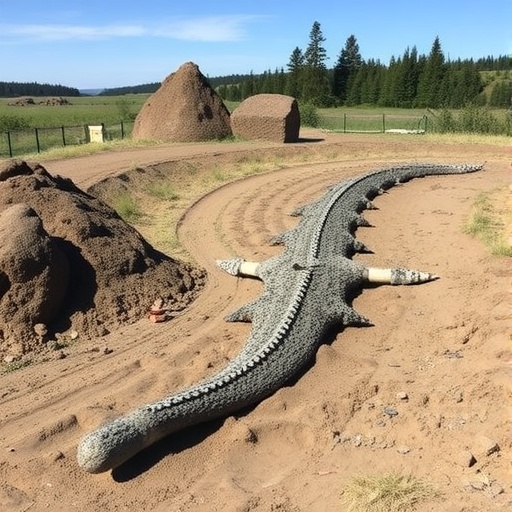
Scientists have recently unveiled a remarkable discovery from the Mistelgau clay pit near Bayreuth, Germany—a partial skeleton of the ichthyosaur Temnodontosaurus cf. trigonodon exhibiting extraordinary three-dimensional bone preservation. This finding provides profound new insights into the anatomy, survival adaptations, and ecological context of these colossal marine reptiles that thrived during the Early Jurassic period, approximately 180 million years ago. The Mistelgau site has long been renowned for its exceptional fossil assemblages, particularly those of marine reptiles, but this specimen represents one of the youngest and most detailed of its genus to date, expanding our understanding of ichthyosaur evolution and resilience in the Jurassic seas.
Ichthyosaurs were marine reptiles that, despite their reptilian lineage, convergently evolved body forms highly reminiscent of modern dolphins, allowing them to dominate marine ecosystems worldwide. The newly analyzed Temnodontosaurus fossil comprises several skeletal components, including fragments of the skull and lower jaw, the shoulder girdle, forefins, vertebrae, and over 100 teeth. What makes this specimen particularly invaluable is its exceptional three-dimensional preservation—a rarity in ichthyosaur fossils—which permits detailed examinations of intricate anatomical regions such as the palate, orbital area, and fin structures. Such fine preservation allows paleontologists to assess subtle morphological characteristics previously difficult to study.
The discovered Temnodontosaurus is comparably close in morphology to the giant species Temnodontosaurus trigonodon, known for being among the largest ichthyosaurs ever documented. Based on the preserved skull fragments, scientists estimate the entire animal measured approximately 6.6 meters in length, revealing it as a formidable predator in Early Jurassic marine environments. This size estimation rests on robust comparisons with related specimens and highlights the grandeur of these ancient sea reptiles that effectively occupied apex predatory niches during their era.
Interestingly, this specimen’s geochronological context marks it as one of the most recent representatives of its genus, found in the upper Toarcian strata—a discovery that challenges previous assumptions regarding the temporal range of Temnodontosaurus. Prior well-studied populations mostly originated from older deposits, such as the Posidonia Shale of Holzmaden. Thus, this fossil indicates the persistence of large temnodontosaurids in the Southwest German Basin longer than formerly understood. This extended temporal range necessitates a reevaluation of Jurassic marine reptile diversity and their response to changing paleoenvironmental conditions.
A particularly striking facet of the fossil is the evidence of multiple skeletal modifications likely resulting from traumatic injuries. These pathologies, which affect critical anatomical areas including the shoulder and jaw joints, suggest the animal endured significant physical trauma during its lifetime. Paleontologists hypothesize that such injuries would have severely compromised the ichthyosaur’s hunting efficiency, yet the fossil’s evidence implies the animal managed to survive despite these challenges, attesting to remarkable biological resilience.
Support for the animal’s survival despite debilitating injuries comes from several lines of evidence. The teeth recovered from the specimen display significant wear, hinting at prolonged feeding activity. Additionally, researchers identified gastroliths—stomach stones—within the abdominal region. Gastroliths are exceptionally rare in ichthyosaurs such as Temnodontosaurus, and their presence here may indicate dietary shifts potentially adopted by the injured individual to accommodate physical limitations. These adaptations demonstrate remarkable behavioral plasticity and provide a new window into the survival strategies of marine reptiles in the Jurassic seas.
The anatomical preservation of areas rarely documented before, including the complex palatal and orbital regions, allows for new comparative analyses within ichthyosaur taxonomy and functional morphology. Such data enrich our understanding of sensory adaptations and feeding mechanics in Temnodontosaurus, shedding light on how these predators might have interacted with their environment and prey. The specimen’s forefin morphology also offers clues to locomotion and maneuverability, essential factors in the dynamic Early Jurassic marine ecosystems.
This fossil was excavated as part of a long-term research project led by the Urwelt-Museum Oberfranken in Bayreuth, under the Bavarian State Collections of Natural History. Beginning in 1998, this team has systematically explored the Mistelgau clay pit, enabling the steady accumulation of valuable fossil material. The post-excavation preparation and meticulous scientific analysis conducted at the museum have been vital in revealing this specimen’s exceptional detail and scientific importance, illustrating the value of sustained paleontological field campaigns.
Ongoing and future analyses aim to delve further into the ecology of the Jurassic Sea in Upper Franconia by investigating dental microwear patterns, bone microstructure, and isotopic signatures. These methodologies will help reconstruct the dietary habits, growth rates, and environmental conditions that influenced the life histories of Temnodontosaurus and its contemporaries. Such interdisciplinary approaches are vital for contextualizing this fossil within broader evolutionary and paleoecological frameworks.
The discovery not only contributes to paleontological knowledge but resonates with the broader scientific community by highlighting the complexity of Mesozoic marine ecosystems. It reveals how large marine reptiles like Temnodontosaurus adapted to injuries and environmental stresses, underscoring evolutionary persistence at a time marked by significant ecological fluctuations. These insights deepen our appreciation of ancient biodiversity and ecosystem dynamics during a critical interval of Earth’s history.
In summary, the Temnodontosaurus cf. trigonodon fossil from Mistelgau is a landmark find, bridging chronological gaps, unveiling rare anatomical features, and illustrating survival strategies through pathological evidence and behavioral inference. It invites a reevaluation of Jurassic marine reptile paleoecology, providing a vivid snapshot of life and adaptation in ancient seas. The continued investigation promises to refine our understanding of these iconic ichthyosaurs and their roles within prehistoric marine food webs, inspiring renewed scientific and public interest worldwide.
This exciting research is detailed in the upcoming publication in Zitteliana, promising to be a seminal article for scholars and enthusiasts of marine vertebrate paleontology alike. As investigations proceed, the scientific community eagerly anticipates further revelations stemming from this exceptional three-dimensional skeleton, one of the finest preserved ichthyosaur fossils uncovered in recent decades.
News Publication Date: 23-Apr-2026
Web References: 10.3897/zitteliana.100.172724
Cite Scienmag News
Violet Maxwell. (April 24, 2026). Injured Giant Ichthyosaur Unearthed in Northern Bavaria, Germany. Scienmag. https://scienmag.com/injured-giant-ichthyosaur-unearthed-in-northern-bavaria-germany/
Violet Maxwell. "Injured Giant Ichthyosaur Unearthed in Northern Bavaria, Germany." Scienmag, 24 April 2026, https://scienmag.com/injured-giant-ichthyosaur-unearthed-in-northern-bavaria-germany/. Accessed 6 September 2026.
Violet Maxwell. "Injured Giant Ichthyosaur Unearthed in Northern Bavaria, Germany." Scienmag. April 24, 2026. https://scienmag.com/injured-giant-ichthyosaur-unearthed-in-northern-bavaria-germany/


