


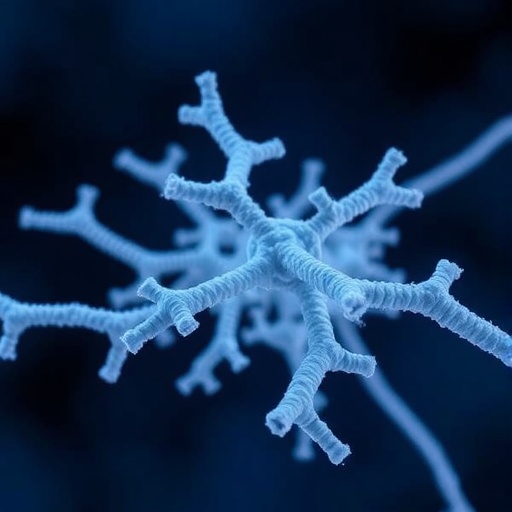
In a groundbreaking development that promises to revolutionize wastewater treatment in cold climates, researchers have unveiled a sophisticated biohybrid system that enables anaerobic ammonium oxidation (anammox) bacteria to thrive at near-freezing temperatures. This advance tackles one of the most persistent challenges in environmental biotechnology: the severe disruption of microbial nitrogen removal processes at low temperatures. By ingeniously integrating low-crystallinity covalent organic frameworks (LC-COFs) to inject photoelectrons into anammox bacteria, the study achieves unprecedented enhancement of intracellular ATP generation, thereby revitalizing protein synthesis essential for bacterial survival and function.
Anaerobic ammonium oxidation, a crucial biological pathway for nitrogen removal, has long been plagued by diminished efficiency under low temperature conditions. The root cause has been identified as ATP limitation within anammox bacteria (AnAOB), which severely weakens the activity of cold shock proteins (Csps). These proteins are vital for maintaining appropriate mRNA structures necessary for accurate translation and overall proteostasis. Without sufficient ATP to sustain Csp function, AnAOB experience impaired protein synthesis, resulting in drastically reduced nitrogen removal under chilly environments.
The innovative strategy presented harnesses the unique photochemical properties of LC-COFs, a class of porous, organic crystalline materials known for exceptional light harvesting and photoelectronic capabilities. Upon self-assembly within the biohybrid system, LC-COF-derived photoelectrons are efficiently transferred into AnAOB cells. This electron injection stimulates metabolic pathways leading to a remarkable 1.9-fold increase in intracellular ATP production. Elevated ATP levels alleviate the transcriptional repression imposed by DNA structural rigidity on cold shock protein genes, particularly enhancing the expression of CspB by 1.5 times.
This upregulation of CspB is pivotal; CspB acts as a molecular guardian during cold stress by safeguarding mRNA translatability and promoting the synthesis of ribosomal subunit-associated proteins. Additionally, CspB synergistically interacts with critical molecular chaperones such as DnaK and GroEL, which facilitate proper protein folding and prevent aggregation under stressful low temperature conditions. This multifaceted support of proteostasis preserves cellular function and peptide synthesis, enabling anammox bacteria to maintain robust metabolic activities.
More specifically, the photoelectron injection disrupts the usual DNA conformational hindrances to cold shock protein gene expression. By enhancing ATP-driven chromatin remodeling and transcriptional activation, the system reverses the typical cold-induced genetic silencing of Csps. This breakthrough not only widens the operational temperature range for anammox bacteria but also stabilizes their enzymatic machinery involved in nitrogen metabolism, including hydrazine synthase and nitrite reductase enzymes critical for the anammox process.
The practical outcomes of this research are striking. The engineered anammox biohybrid system performs with exceptional stability and efficiency at 4 °C—temperatures that previously crippled nitrogen removal capacity. Experiments demonstrated a nitrogen removal efficiency reaching 87.2%, alongside a nitrogen loading rate of 1.66 kg m⁻³ d⁻¹, metrics that represent a significant leap forward relative to conventional methods under comparable conditions. Such performance holds transformative implications for wastewater treatment plants located in cold regions, where maintaining biological nitrogen removal is notoriously difficult and energy-intensive due to heating requirements.
This advancement is timely given the increasing global emphasis on sustainable water treatment technologies capable of operating resiliently amid extreme climate conditions. Traditional nitrogen removal techniques rely heavily on mesophilic microbial communities that suffer from poor metabolic activity at low temperatures. The biohybrid platform leveraging LC-COF photoelectrons and cold shock protein-mediated proteostasis offers a blueprint for overcoming these ecological and engineering hurdles, reducing operational costs and environmental footprint.
Beyond applied environmental microbiology, the study sheds new light on the fundamental interactions between photoresponsive materials and microbial cellular machinery. The ability of an organic framework to modulate gene expression and protein homeostasis within bacteria underlines the potential of integrating synthetic materials with living cells to create next-generation biohybrid systems. It opens new exploratory pathways in microbial electrogenesis, synthetic biology, and adaptive microbial engineering for diverse bioremediation and bioenergy applications.
Moreover, the systematic elucidation of CspB’s role in coordinating translational recovery and proteostasis at low temperatures underscores the sophistication of bacterial cold adaptation mechanisms. The coaction of CspB with molecular chaperones reflects an evolved network that balances mRNA stability, ribosome assembly, and protein-folding fidelity under temperature stress. Understanding these finely tuned molecular responses provides guiding principles for designing microbial strains and consortia with bespoke stress tolerance tailored to specific environmental contexts.
On the methodological front, the investigation employed advanced spectroscopic and transcriptomic analyses to quantitatively assess intracellular ATP levels, gene transcription profiles, and protein expression patterns. Self-assembly of the LC-COFs was meticulously characterized, revealing low crystallinity as a key structural feature that facilitates efficient photoelectron transfer to the bacterial cells. This approach contrasts with highly crystalline frameworks where electron mobility might be restricted, highlighting the nuanced role of material properties in biohybrid design.
Experimentally, the implementation of LC-COF–AnAOB biohybrids was scaled to simulate practical wastewater treatment conditions. The observed maintenance of nitrogen conversion efficiency over prolonged periods at cold temperature highlights the system’s durability and potential for integration with existing treatment infrastructures. The biohybrid concept aligns well with decentralized wastewater management trends and circular economy principles promoting resource recovery and energy savings.
Looking forward, this discovery invites further exploration into optimizing material compositions and configurations to amplify photoelectron delivery and metabolic stimulation. It also prompts investigation into broader microbial communities and consortia that could similarly benefit from photoelectron-assisted bioenergetics under environmental stressors. Potential exists for expanding this technology to other bioprocesses impaired by temperature or energy deficits, such as methane oxidation or sulfate reduction.
Crucially, this research bridges the gap between material science, microbiology, and environmental engineering to solve a pressing ecological challenge. The photosynthetic electron transfer mechanism provides a controllable, sustainable energy input to cold-stressed bacteria, replacing or augmenting natural biochemical limitations. Such cross-disciplinary innovations are poised to redefine microbial biotechnology applications worldwide, especially in a warming yet unpredictably variable climate.
To summarize, the innovative low-crystallinity COF–anammox biohybrid system harnesses photoelectron injection to eliminate cold-induced ATP limitations, rescuing the pivotal cold shock protein-mediated proteostasis in anammox bacteria. This restoration enables stable, highly efficient nitrogen removal at temperatures as low as 4 °C, opening new frontiers for wastewater treatment in challenging climatic zones. The convergence of engineered materials with microbial physiology exemplifies the transformative potential of hybrid living systems for global sustainability goals in water management and beyond.
Cite Scienmag News
Violet Maxwell. (June 4, 2026). Cold Shock Proteins Boost Nitrogen Removal at Freezing Temperatures. Scienmag. https://scienmag.com/cold-shock-proteins-boost-nitrogen-removal-at-freezing-temperatures/
Violet Maxwell. "Cold Shock Proteins Boost Nitrogen Removal at Freezing Temperatures." Scienmag, 4 June 2026, https://scienmag.com/cold-shock-proteins-boost-nitrogen-removal-at-freezing-temperatures/. Accessed 4 September 2026.
Violet Maxwell. "Cold Shock Proteins Boost Nitrogen Removal at Freezing Temperatures." Scienmag. June 4, 2026. https://scienmag.com/cold-shock-proteins-boost-nitrogen-removal-at-freezing-temperatures/


