


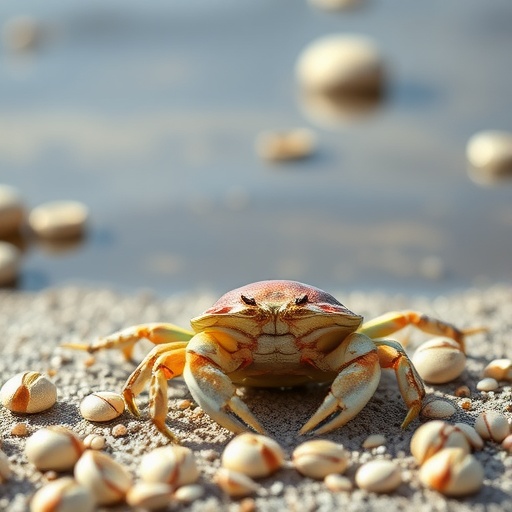
In the ongoing battle against marine plastic pollution, biodegradable plastics have emerged as a promising alternative, yet their swift degradation in seawater severely limits their practical applications. Recent groundbreaking research from Gunma University, Japan, unveils a novel approach to prolong the lifespan of these biodegradable materials by harnessing crustacean by-products, specifically crab shells. This innovative discovery not only offers a strategic pathway to engineer the durability of marine plastics but also unlocks new potentials for sustainable circular uses of seafood waste, marking a significant leap in environmental technology.
The deteriorative nature of plastic pollution in marine environments is a critical global concern, exacerbated by the sheer volume of non-degradable plastic debris that endangers marine fauna and ecosystems. Biodegradable polymers, such as poly(3-hydroxybutyrate-co-3-hydroxyvalerate) (PHBV), are increasingly favored for their ability to decompose through microbial activity. However, a paradox exists wherein these materials degrade too rapidly under marine conditions, failing to sustain their mechanical integrity during their intended use period, which is especially problematic for marine applications like fishing gear that demand durability prior to breakdown.
The team from Gunma University, led by Professor Ken-ichi Kasuya, alongside collaborators from the Japan Agency for Marine-Earth Science and Technology (JAMSTEC), embarked on a meticulous investigation into the modification of PHBV degradation dynamics. This study centers on the integration of chitin-rich crab shell by-products—a waste product from the seafood industry, abundant and environmentally problematic in its own right—as a biological modulator that influences the colonizing microbial community on the plastic’s surface, referred to as the plastisphere. Their findings, soon to be published in Polymer Degradation and Stability, demonstrate a viable method to balance the lifespan of PHBV in seawater by harnessing this natural biopolymer.
To systematically evaluate the effects of crab shell constituents on PHBV degradation, researchers subjected three variants of PHBV films to controlled marine conditions: standalone PHBV, PHBV combined directly with crushed crab shells (PHBV_SrCh), and PHBV films immersed in seawater with crab shell material added but physically separated (PHBV_AddSrCh). Remarkably, both scenarios involving crab shell presence exhibited a substantial reduction of approximately 20% in mass loss after four weeks compared to PHBV alone, an effect that persisted even after extended exposure of eight weeks, clearly indicating that crab shell by-products retard the biodegradation process.
Crucially, the persistence of this retardation in the PHBV_AddSrCh setup, where direct physical contact was absent, implies that the crab shells do not merely act as a physical barrier shielding the plastics but rather induce biochemical interactions that remodel the microbial ecosystem on the plastic surface. This remodeling of the plastisphere alters the microbial composition in a way that significantly influences the polymer’s degradation pathway. Chemical compounds leached from the crab shells appear to selectively nurture certain microbial populations while suppressing others involved in aggressive polymer degradation.
Microbial community analysis showed a dominance of Oceanospirillum and Bowmanella species on conventional PHBV surfaces, bacteria known for their active enzymatic breakdown of bioplastics through depolymerase expression. However, within crab shell-conditioned environments, the microbial profile shifted prominently toward Marinobacter species, which do not express the exPhaZ gene encoding extracellular depolymerase enzymes critical to PHBV degradation at early stages. This shift results in a measurable slowdown in the degradation kinetics of the polymer films, effectively extending their functional lifespan in seawater.
The central bioactive agent within crab shells driving this ecological modulation is chitin, a natural polysaccharide composing the exoskeleton of crustaceans. Chitin’s presence provides a readily available nutrient source for bacteria, diverting their metabolic activity from the PHBV substrate to the preferential degradation of chitinaceous compounds. This biological competition creates a temporal stability where the plastics remain relatively intact while microbial populations focus on the shell-derived organic material, demonstrating an elegant example of ecosystem engineering mediated by biopolymer interaction.
Professor Kasuya emphasizes the transformative potential of their findings, noting that the goal surpasses simply accelerating biodegradability to align with the environmental imperative of rapid breakdown. Instead, their approach enables the design of biodegradable plastics with tunable degradation rates tailored to the lifecycle requirements of their specific marine applications. Such control supports the development of robust fishing nets, ropes, and other durable marine equipment that can safely degrade after fulfilling their functional roles, mitigating the environmental burden post-use.
This innovative research introduces a paradigm shift in sustainable plastic design, proposing an engineered lifespan guided by the plastisphere’s microbiota manipulation via natural biopolymer additives. By co-opting seafood industry by-products, it simultaneously addresses the dual environmental issues of plastic pollution and organic waste management. Crab shells—often discarded and considered waste—are repurposed as a low-cost and sustainable feedstock to strategically control polymer degradation, fostering an integrative approach to resource recovery and pollution mitigation.
Looking forward, such findings pave the way for further explorations into compositional and ecological tuning of biodegradable polymers using other naturally derived biopolymers and microbial consortia modulation. The combination of marine biology, materials science, and environmental engineering epitomized by this study promises to refine biodegradable plastic technology, ultimately facilitating the broader application of eco-friendly materials in sensitive oceanic environments without compromising performance or environmental safety.
The significance of this discovery lies not only in extending the usability of biodegradable plastics but also in its implications for circular economy frameworks. Utilizing crab shell waste as a functional additive exemplifies valorizing by-products within a zero-waste philosophy, aligning with global sustainability goals. As marine pollution remains a daunting challenge, such science-backed innovations provide urgently needed, scalable solutions that can be integrated into commercial practices, policy frameworks, and environmental stewardship initiatives.
In conclusion, the collaborative research led by Gunma University reveals a sophisticated interplay between biodegradable plastics and marine microbial ecosystems influenced by chitin-rich crab shell by-products. This interaction modulates the plastic’s surface microbiota to extend degradation timelines, reconciling the demands of durability and environmental degradability. This breakthrough attests to the power of biomimicry and nature-inspired engineering in addressing persistent ecological challenges and heralds a new era where plastics are not only biodegradable but also smartly designed to exist in harmony with their ecosystems.
News Publication Date: 1-Jul-2026
Web References: http://dx.doi.org/10.1016/j.polymdegradstab.2026.112075
References: Polymer Degradation and Stability, Volume 249, July 2026
Cite Scienmag News
Violet Maxwell. (April 24, 2026). Crab Shell By-Products May Enhance the Marine Durability of Biodegradable Plastics. Scienmag. https://scienmag.com/crab-shell-by-products-may-enhance-the-marine-durability-of-biodegradable-plastics/
Violet Maxwell. "Crab Shell By-Products May Enhance the Marine Durability of Biodegradable Plastics." Scienmag, 24 April 2026, https://scienmag.com/crab-shell-by-products-may-enhance-the-marine-durability-of-biodegradable-plastics/. Accessed 3 September 2026.
Violet Maxwell. "Crab Shell By-Products May Enhance the Marine Durability of Biodegradable Plastics." Scienmag. April 24, 2026. https://scienmag.com/crab-shell-by-products-may-enhance-the-marine-durability-of-biodegradable-plastics/


