


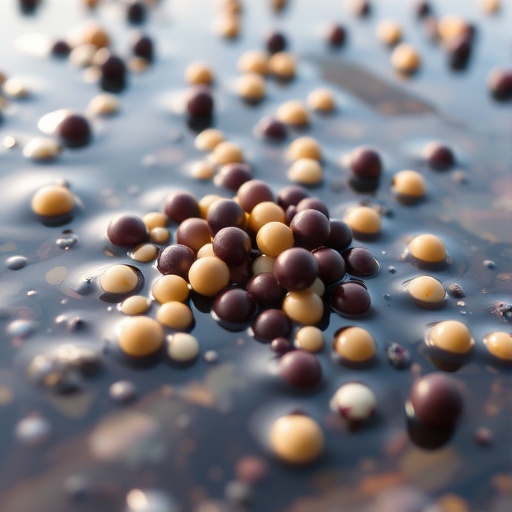
In a groundbreaking stride toward combating the environmental menace of oil spills, researchers at Hiroshima University have engineered a novel floatable sorbent composed of chitosan and cellulose acetate, augmented with bentonite clay. This innovative composite material, fashioned into beads, presents a promising and cost-effective solution for cleaning crude oil contamination from ocean surfaces. With global oil consumption exceeding 100 million barrels daily, the risk of accidental oil spills remains a persistent threat to marine ecosystems, demanding efficient and sustainable remediation techniques. Traditional methods, hampered by high costs, ecological side effects, or operational complexities, have struggled to provide a comprehensive solution.
The new composite beads marry natural polymers and inorganic clay in a synergistic configuration, leveraging the biocompatibility and biodegradability of chitosan and cellulose acetate while enhancing mechanical and thermal stability through bentonite incorporation. Bentonite, a clay mineral noted for its fine particle size and high surface area, acts as a structural stabilizer, optimizing the pore architecture within the beads and bolstering their surface roughness. This structure promotes superior oil adsorption by facilitating the penetration and retention of hydrocarbon molecules throughout the bead matrix.
Fabricated via a carefully controlled process involving calcium carbonate as a pore-forming agent, these beads exhibit a mesoporous network with pore sizes ranging from 2 to 50 nanometers. This porous framework plays a pivotal role in the rapid absorption kinetics observed, as it increases the accessible surface area for oil uptake. The use of calcium carbonate leads to the formation of stable, interconnected pores, ensuring the beads maintain their structural integrity while floating on seawater. This inherent floatability allows the beads to swiftly encounter and adsorb oil slicks directly at the water-air interface, significantly enhancing removal efficiency.
Two variations of the composite were synthesized, differing in bentonite content: 7.69% w/w (CS/CA@BT1) and 14.29% w/w (CS/CA@BT2). Analytical techniques including Fourier Transform Infrared Spectroscopy (FTIR) confirmed the chemical composition and successful incorporation of bentonite within the polymer matrix. Thermogravimetric Analysis (TGA) and Differential Scanning Calorimetry (DSC) revealed enhanced thermal stability attributable to bentonite’s role as a thermal barrier. Moreover, Scanning Electron Microscopy (SEM) imaging unveiled that bentonite fortifies the porous network, increasing accessibility and surface roughness conducive to oleophilic interactions.
X-ray Diffraction (XRD) patterns distinguished the two composite types, with the lower bentonite content sample (CS/CA@BT1) displaying optimal polymer-clay intercalation, whereas the higher content (CS/CA@BT2) demonstrated partial clay restacking and a shift towards amorphous characteristics. Interestingly, the CS/CA@BT2 exhibited greater oleophilicity, correlating to increased oil adsorption capacities. Tests conducted in artificial seawater environments showcased equilibrium in oil sorption within 60 minutes for the composites, a marked acceleration compared to 300 minutes for the control chitosan/cellulose acetate beads devoid of bentonite.
Adsorption trials under various conditions further underscored the performance resilience of the composite beads. pH optimization revealed a peak oil uptake efficiency at pH 8, aligning closely with typical seawater pH levels. Additionally, stirring at 50 rpm maximized adsorption without causing bead disintegration. The influence of environmental parameters such as temperature and salinity was methodically evaluated; adsorption capacity diminished with rising temperature, consistent with reduced oil viscosity and volatilization effects, while salinity positively influenced adsorption up to thresholds of 10‰ for composites, beyond which the effect plateaued.
Performance-wise, CS/CA@BT2 achieved an impressive maximum oil adsorption capacity of 454.2 mg/g under optimal conditions, outperforming unmodified beads and the lower-bentonite variant. This superior uptake is crucial when considering the practical application scenarios involving medium-heavy crude oils, which present significant challenges due to their density and viscosity. The composites’ ability to selectively absorb oil, retain floatability, and maintain environmental compatibility marks a substantial advancement in sorbent design tailored to marine oil spill remediation.
Beyond the technical performance metrics, the composite beads exhibit compelling advantages in sustainability and operational practicality. Both chitosan and cellulose acetate are derived from abundant natural sources, offering eco-friendly degradation paths post-use and mitigating secondary pollution risks. The inclusion of bentonite, a low-cost mineral, maintains economic feasibility at scale. Furthermore, the beads’ floatable nature simplifies recovery post-adsorption, potentially reducing labor intensity and hazards associated with conventional skimming or chemical dispersant methods.
Comparative analyses position the chitosan/cellulose acetate@bentonite composite beads favorably against existing polymer-based and natural sorbents. While some materials may surpass adsorption capacities for lighter oils, the present composite excels with medium-heavy crude types under environmentally realistic parameters, underscoring its applicability for real-world spill scenarios. This balance of efficiency, cost-effectiveness, and environmental friendliness positions the technology as a compelling addition to the toolkit for marine environmental protection.
Looking forward, the research team advocates for further optimization of bead formulation and scaling methodologies to facilitate wide deployment. Real-world testing across diverse marine conditions and oil types is essential to fully validate performance and durability. Integration into existing oil spill response frameworks could revolutionize cleanup operations by providing a rapid, effective, and sustainable alternative to conventional methods, ultimately contributing to safer oceans and enhanced ecological stewardship.
This innovative work is the culmination of collaborative research involving Hiroshima University’s Research Institute for Synchrotron Radiation Science, the National Institute of Oceanography and Fisheries (NIOF) in Egypt, Alexandria University, the City of Scientific Research and Technological Applications (SRTA-City) in Egypt, and the Slovak Academy of Sciences. It exemplifies the global imperative and scientific ingenuity dedicated to addressing one of the most pressing environmental crises of our time.
News Publication Date: 17-Mar-2026
Web References: Polymers for Advanced Technologies DOI: 10.1002/pat.70560
Cite Scienmag News
Violet Maxwell. (April 21, 2026). Biodegradable Floatable Composite Beads Offer Breakthrough in Large-Scale Oil Spill Cleanup. Scienmag. https://scienmag.com/biodegradable-floatable-composite-beads-offer-breakthrough-in-large-scale-oil-spill-cleanup/
Violet Maxwell. "Biodegradable Floatable Composite Beads Offer Breakthrough in Large-Scale Oil Spill Cleanup." Scienmag, 21 April 2026, https://scienmag.com/biodegradable-floatable-composite-beads-offer-breakthrough-in-large-scale-oil-spill-cleanup/. Accessed 4 September 2026.
Violet Maxwell. "Biodegradable Floatable Composite Beads Offer Breakthrough in Large-Scale Oil Spill Cleanup." Scienmag. April 21, 2026. https://scienmag.com/biodegradable-floatable-composite-beads-offer-breakthrough-in-large-scale-oil-spill-cleanup/


