


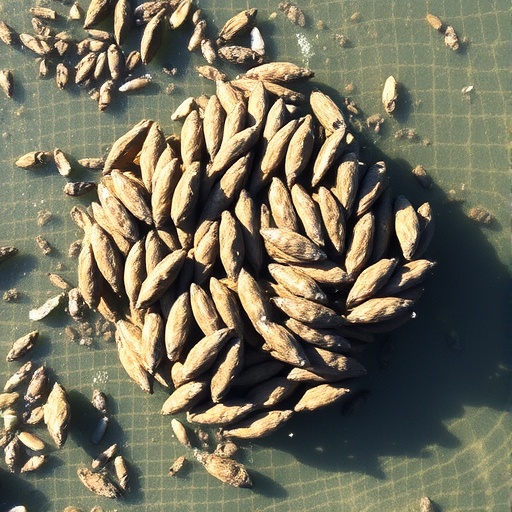
Oyster reefs, once a dominant feature of the North Sea and other marginal seas bordering continental shelves, have suffered catastrophic declines, vanishing from as much as 97% of their historic habitats. These benthic ecosystems once supported vast biodiversity, contributed to water purification through filtration, and provided coastal protection. Despite their ecological and environmental value, efforts to restore oyster reefs have been met with mixed success. Recent research conducted in deep offshore wind farm sites sheds critical light on the intricate physical challenges that oysters face, advancing our understanding of reef restoration feasibility beyond traditional environmental considerations.
The study took place within the Gemini wind park, located approximately 85 kilometers north of the Wadden Islands, where researchers deployed oysters at a depth of 32 meters—a site representative of deeper marginal seas with complex hydrodynamics. The experimental design included placing oysters both elevated above the seabed on a rack and directly on the soft sediment floor, as well as within controlled mesocosms that simulated sediment burial scenarios. Continuous monitoring over time assessed oyster survival, physiological health indicated by gaping behavior (a proxy for filtering activity), and the physical dynamics influencing their fate.
Oysters situated on elevated racks half a meter above the seabed demonstrated robust survival even under storm conditions. Their persistent gaping behavior suggested sustained filtration activity, indicating good physiological fitness. This elevation likely allowed oysters to avoid direct physical disturbance from sediment accrual and strong near-bottom currents, maintaining optimal access to oxygenated water and food particles. These findings underscore the importance of microscale habitat structure in promoting oyster viability in offshore restoration.
Conversely, oysters placed directly on the sediment experienced considerable challenges. The seabed environment in these marginal seas is characterized by dynamic hydrodynamics that include turbulent near-bed flows and episodic sediment deposition events. These factors caused displacement of oysters and, in many cases, burial beneath sediments beyond the capacity of the oysters to survive. The interaction between hydrodynamic forces and sediment dynamics emerges as a critical limiting factor, one that is often overlooked when evaluating potential restoration sites based primarily on water quality or chemical parameters.
This research reveals a crucial insight: physiological health alone does not guarantee successful reef establishment. Oysters may be in good condition in terms of metabolic and filtering activity but can still fail to persist if physical environmental stresses lead to mechanical dislodgement or irreversible burial. This decouples the traditional focus on biological viability from abiotic physical dynamics, emphasizing the need for a holistic approach in restoration ecology that integrates physical oceanography with marine biology.
The study provides actionable thresholds and criteria for evaluating site suitability, identifying critical limits where the risk of hydrodynamic-induced loss or sediment burial surpasses oyster resilience. Such risk-informed frameworks are essential for guiding restoration practitioners in selecting sites where oysters have a reasonable probability of survival and reef formation. For example, in locations with high sedimentation rates, deploying oysters above the sediment surface or incorporating prefabricated reef structures can mitigate burial risks and reduce dislodgement.
Engineered reef frameworks, such as racks or artificial substrates, could serve as physical stabilizers, allowing oysters to avoid the worst effects of sediment dynamics and enhancing the likelihood of reef persistence. This approach represents a shift from trial-and-error methods toward strategic, evidence-driven restoration planning. Conservation designers must consider localized hydrodynamic regimes alongside biological factors in order to maximize restoration success in these complex environments.
Moreover, this research has broader implications as offshore oyster restoration efforts expand globally, particularly in areas impacted by coastal development, eutrophication, and changing sediment regimes due to climate change. The integration of physical environmental monitoring with biological metrics will become increasingly vital to anticipate and mitigate stressors that threaten marine ecosystem recovery.
The study’s insights call for a reassessment of restoration methodologies to incorporate physical disturbance assessments during site selection and implementation phases. Specifically, measuring near-bed velocity profiles, sedimentation rates, and storm frequency can provide critical predictive power in evaluating restoration feasibility. These parameters now emerge as essential variables alongside traditional considerations such as salinity, temperature, and pollutant loads.
In conclusion, the fate of oyster reefs in marginal seas depends not only on oysters’ physiological capacity but also, critically, on the complex interplay of hydrodynamic forces and sediment transport at the seabed. Restoration strategies that ignore these physical dynamics risk failure, wasting resources and time. The innovative experimental approach conducted at the Gemini wind park sets a new standard for restoration science, advocating for a synthesis of biology with physical oceanography to design resilient oyster reef recovery programs.
With the increasing global recognition of oyster reefs as valuable ecological engineers, nutrient processors, and biodiversity hotspots, this research contributes nuanced, practical knowledge to overcome restoration hurdles. Future projects will benefit from adopting these lessons to enhance reef survivability and ecosystem rehabilitation under changing marine environmental conditions. By marrying science with applied restoration technologies, the revival of oyster reefs from the depths may yet become a reality.
News Publication Date: 17-Apr-2026
Web References: http://dx.doi.org/10.1016/j.oneear.2026.101679
References: Not provided.
Cite Scienmag News
Violet Maxwell. (April 17, 2026). To restore oyster reefs successfully, choose locations where they remain stable and aren’t washed away or buried by sand! Scienmag. https://scienmag.com/to-restore-oyster-reefs-successfully-choose-locations-where-they-remain-stable-and-arent-washed-away-or-buried-by-sand/
Violet Maxwell. "To restore oyster reefs successfully, choose locations where they remain stable and aren’t washed away or buried by sand!" Scienmag, 17 April 2026, https://scienmag.com/to-restore-oyster-reefs-successfully-choose-locations-where-they-remain-stable-and-arent-washed-away-or-buried-by-sand/. Accessed 5 September 2026.
Violet Maxwell. "To restore oyster reefs successfully, choose locations where they remain stable and aren’t washed away or buried by sand!" Scienmag. April 17, 2026. https://scienmag.com/to-restore-oyster-reefs-successfully-choose-locations-where-they-remain-stable-and-arent-washed-away-or-buried-by-sand/


