


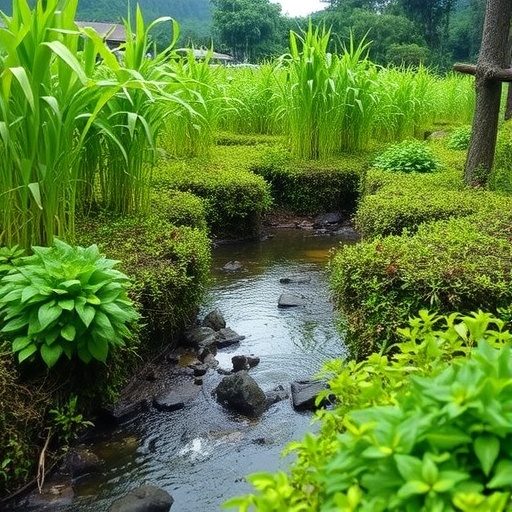
In recent decades, the widespread restoration of vegetation—commonly referred to as “greening”—has been heralded as a beacon for reversing ecosystem degradation, combating desertification, and enhancing biodiversity. Yet, a pervasive assumption has shadowed this optimism: the presumption that as vegetation cover increases, so too does evapotranspiration, subsequently diminishing streamflow and thereby impairing water availability. This traditional view posits a stark trade-off between ecosystem restoration efforts and water supply, particularly critical in semi-arid regions already strained by water scarcity. However, groundbreaking research has now challenged this paradigm, revealing a far more complex, and hopeful, interaction between vegetation greening and hydrological cycles.
This breakthrough stems from an extensive global analysis grounded in more than 4,000 catchments, combining empirical hydrological observations with advanced coupled land–atmosphere simulations. The comprehensive dataset spans diverse climatic zones and ecosystem types, providing an unprecedented view of how vegetation dynamics intertwine with water fluxes on a planetary scale. The study’s most striking revelation is that nearly half of the greening catchments do not conform to expectations. Instead of rising evapotranspiration being accompanied by decreased streamflow, these areas demonstrate simultaneous increases in both parameters. Remarkably, this phenomenon is most prevalent in semi-arid regions, where the stakes around water availability are highest.
At the heart of this counterintuitive result lies a deeper understanding of vegetation’s role in modulating energy budgets and feedback mechanisms within the coupled land-atmosphere system. For decades, hydrological models have predominantly employed offline approaches, which assess vegetation effects on water fluxes without accounting for crucial feedbacks involving atmospheric processes. Such models tend to underestimate the extent of evapotranspiration changes driven by greening by more than 50%, leading to misinterpretations of water availability trends—an oversight with sweeping implications for water resource management and ecological conservation.
The iconic Chinese Loess Plateau serves as a critical case study in this context. Often described as the biggest revegetation project in human history due to massive afforestation and soil conservation efforts, the region has experienced profound ecological transformations. When researchers rigorously integrated coupled land–atmosphere feedbacks into their hydrological models applied to the Loess Plateau, a far more nuanced narrative emerged. Vegetation greening reduces the surface albedo, meaning less solar radiation is reflected back into the atmosphere and more is absorbed by the Earth’s surface. This reduction ignites a cascade within the energy partitioning framework, intensifying net radiation and convective processes that drive the regional climate system.
This enhanced energy availability in turn amplifies atmospheric dynamics, boosting the efficiency with which atmospheric moisture converts into precipitation. In other words, the additional evapotranspiration from the greener landscape feeds back to the atmosphere, generating increased rainfall that can offset, or even exceed, water losses in vegetation transpiration. This heightened precipitation yield is particularly pivotal in semi-arid regions, which historically exhibit marginal balances between evaporation and incoming rainfall. The sustained or elevated streamflow observed in these regions underscores a critical, energy-mediated hydrological feedback that could reshape perspectives on sustainable land management.
Importantly, the phenomenon elucidated on the Loess Plateau is not an isolated anomaly. When examining four additional global hotspots of vegetation greening—ranging from North America to parts of Australia—the research team observed consistent patterns of albedo-driven, energy-mediated feedbacks influencing local precipitation and streamflow regimes. This cross-continental consistency strengthens the argument that such feedback mechanisms perform a dominant role in linking increasing vegetation productivity to water availability, challenging conventional wisdom that viewed vegetation growth as inherently detrimental to streamflow.
These findings have far-reaching implications for ecosystem restoration policies and water resource frameworks, particularly within regions vulnerable to drought and degradation. Any restoration endeavor must now reckon with more than just carbon sequestration and biodiversity enhancement; it must encompass atmospheric feedbacks that fundamentally alter regional hydrology. By embracing coupled models that authentically simulate vegetation-atmosphere interactions, policymakers and resource managers can better predict the hydrological outcomes of restoration projects, minimizing unintended consequences and maximizing synergistic benefits.
This research underscores an urgent need to pivot away from simplistic assumptions and toward integrated modeling frameworks that acknowledge and harness the complex feedbacks intertwining vegetation, energy fluxes, and precipitation patterns. Only through this holistic lens can restoration initiatives sustainably reconcile the dual objectives of ecosystem resilience and water security. The enhanced precipitation efficiency discovered here emerges as a game-changer, potentially transforming semi-arid regions from ecological deserts into thriving landscapes with robust water supplies.
Furthermore, the intimate link between albedo changes and atmospheric convective processes opens exciting avenues for future research. Understanding how different vegetation types and restoration intensities modulate surface albedo could guide the design of targeted greening strategies tailored to specific hydrological contexts. For example, selecting plant species or restoration methods that optimally balance evapotranspiration with positive albedo feedbacks may allow fine-tuning of precipitation responses, enhancing water yields without compromising ecosystem functions.
The intricate dance between land surface changes and atmospheric responses illuminated in this research transcends drylands alone. While semi-arid regions present the clearest expressions of the observed feedbacks, similar processes likely operate across temperate and tropical systems, albeit with varying magnitudes. As climate change accelerates, altering rainfall patterns and vegetation dynamics worldwide, integrated understanding of these feedbacks becomes even more essential for anticipating future water cycle trajectories and ecosystem stability.
In conclusion, the assumption that vegetation greening necessarily reduces water availability through increased evapotranspiration no longer holds universally true. By accounting for energy-mediated vegetation–atmosphere feedbacks, researchers reveal a more optimistic scenario where vegetation restoration can, counterintuitively, sustain or even boost streamflow by enhancing precipitation efficiency. These insights hold profound implications for the management of water resources and the design of ecological restoration projects worldwide, offering a promising pathway toward harmonizing environmental recovery with hydrological sustainability.
The work marks a paradigm shift in hydrological science and ecosystem management, signaling an era when interdisciplinary integration of ecology, climatology, and hydrology unlocks new potentials for solving some of the planet’s most pressing environmental challenges. By fostering a deeper appreciation of natural feedback loops, we move closer to achieving resilient landscapes that nurture both biodiversity and human needs in an era of unprecedented global change.
Cite Scienmag News
Violet Maxwell. (April 17, 2026). Vegetation Greening Boosts Rainfall, Sustains Water Supply. Scienmag. https://scienmag.com/vegetation-greening-boosts-rainfall-sustains-water-supply/
Violet Maxwell. "Vegetation Greening Boosts Rainfall, Sustains Water Supply." Scienmag, 17 April 2026, https://scienmag.com/vegetation-greening-boosts-rainfall-sustains-water-supply/. Accessed 4 September 2026.
Violet Maxwell. "Vegetation Greening Boosts Rainfall, Sustains Water Supply." Scienmag. April 17, 2026. https://scienmag.com/vegetation-greening-boosts-rainfall-sustains-water-supply/


