


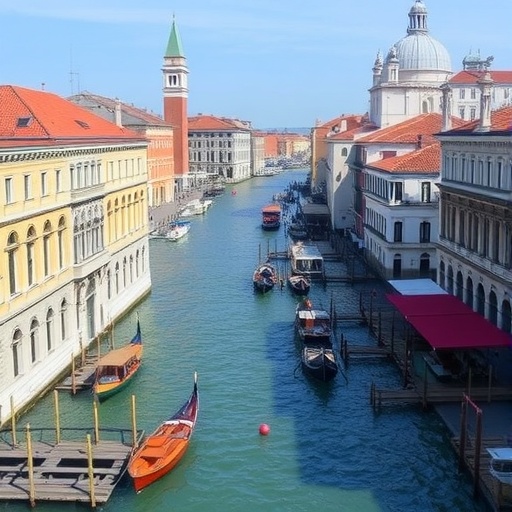
The historic city of Venice faces unprecedented challenges as rising sea levels threaten its existence over the coming centuries. A recent groundbreaking study published in the journal Scientific Reports explores long-term adaptation strategies for Venice and its unique lagoon, providing a detailed analysis of potential paths forward amid accelerating climate change impacts. The research, led by Professor Piero Lionello of the University of Salento alongside Professor Robert Nicholls from the University of East Anglia’s Tyndall Centre for Climate Change Research, critically evaluates multiple engineering and policy options that range from incremental defenses to radical relocation.
Venice’s distinctive setting within the Venetian Lagoon has made it particularly vulnerable to flooding, with historically frequent inundations becoming more severe and regular over the past 150 years. The city’s current primary defense system relies on a network of movable barriers strategically positioned at the lagoon’s entrances. These barriers, deployed during high tide surges, serve as Venice’s frontline protection against rising water. However, projections indicate that under even optimistic future emissions scenarios, sea levels combined with land subsidence will likely surpass the barrier system’s operational capacity within this century.
In their meticulous assessment, the researchers model sea-level projections based on the IPCC Sixth Assessment Report scenarios. They estimate the movable barriers could remain effective up to about 1.25 meters of sea-level rise, a threshold that may be approached or exceeded by 2300 under low-emission scenarios. This forecast gives a critical timeframe within which planners must contemplate supplementary or alternative adaptation measures to maintain Venice’s habitability and preserve its cultural heritage.
Alternative strategies analyzed in the study extend beyond upgrading existing barriers. One such option involves constructing ring dikes to physically isolate the historic city center from the broader lagoon. By creating a fortified perimeter around Venice itself, authorities might bolster defenses against moderate sea-level increases. However, this measure interferes with the lagoon’s ecological dynamics and raises significant concerns about disrupting centuries-old marine habitats integral to the region’s biodiversity.
More ambitious proposals include the concept of erecting a “super levee” to enclose and effectively close off the Venetian Lagoon from the sea. This engineering feat would protect Venice from up to 10 meters of sea-level rise, though it carries tremendous financial costs and profound environmental consequences. Closing the lagoon could permanently alter water circulation patterns, impact sediment transport, and jeopardize the health of marine ecosystems, necessitating exhaustive environmental assessments before implementation.
The most radical proposition highlighted in the study involves relocating Venice inland, a measure that experts suggest might become essential beyond a sea-level rise of approximately 4.5 meters. This approach recognizes the profound limits of engineering solutions in the face of extreme climate trajectories and the inexorable rise of the waters. Relocation entails monumental logistical challenges, including moving residents, historic landmarks, and the complex infrastructure that defines the city’s unique urban fabric.
From a fiscal perspective, the researchers draw on cost data from previous engineering initiatives, adjusted to 2024 economic conditions, to provide rough estimates for each adaptation pathway. The initial construction of Venice’s current flood barrier system cost approximately €6 billion. Building dikes around the city could vary from €500 million to €4.5 billion, contingent on scale and materials. In contrast, closing the lagoon with a super levee might exceed €30 billion in upfront expenditure, while relocating the entire city presents a staggering cost potentially reaching €100 billion.
Prof. Nicholls emphasizes the multifaceted nature of decision-making in this context, underscoring that no single adaptation strategy offers an optimal solution. Rather, policy must strike a delicate balance among preserving the safety and well-being of Venice’s residents, sustaining economic vitality, conserving the lagoon’s ecological character, protecting cultural heritage, and respecting long-standing traditions. The complexity of these trade-offs highlights the importance of inclusive and multidisciplinary planning frameworks.
One critical insight of this study is the imperative for proactive and early intervention. Large-scale infrastructure projects, especially those involving permanent barriers or extensive urban relocation, typically require several decades to design, finance, and construct. Delays in initiating these processes could result in irreversible damages or intolerable social disruptions as sea levels continue their upward trend. Therefore, stakeholders must begin long-term strategic planning without postponement to anticipate the environmental reality ahead.
Beyond Venice, this research serves as a sobering exemplar of challenges faced by numerous low-lying coastal regions worldwide, including island nations like the Maldives and deltaic zones in the Netherlands. The scientific community increasingly advocates for comprehensive adaptation strategies that are anticipatory rather than reactive to future sea-level rise, with Venice providing a microcosm for wider global lessons.
The study concludes with a compelling message: safeguarding Venice’s future in the face of climate change demands an integrated adaptive approach informed by robust scientific modeling, environmental stewardship, cultural sensitivity, and economic pragmatism. While the iconic city’s heritage cannot be entirely preserved in its present form indefinitely, the proposed adaptation pathways offer avenues to extend its resilience into the centuries to come, provided decisive action begins promptly.
As sea level forecasts become clearer and technological advancements emerge, Venice’s response strategies could evolve, merging engineering innovation with nature-based solutions. These multidisciplinary efforts will be crucial in balancing human needs with ecological integrity, ensuring that Venice remains not only a treasured cultural monument but also a living city confronting the realities of a changing world.
- https://www.nature.com/articles/s41598-026-39108-z
- http://dx.doi.org/10.1038/s41598-026-39108-z
References:
Lionello, P., Nicholls, R., et al. (2026). Long-term adaptation pathways for Venice and its lagoon under sea level rise. Scientific Reports.
Keywords: Venice, sea-level rise, climate adaptation, flood barriers, lagoon ecosystem, urban relocation, dikes, super levee, environmental impact, cultural heritage, engineering costs, IPCC projections
Cite Scienmag News
Thomas Green. (April 16, 2026). Exploring Venice Relocation as a Solution to Combat Sea-Level Rise. Scienmag. https://scienmag.com/exploring-venice-relocation-as-a-solution-to-combat-sea-level-rise/
Thomas Green. "Exploring Venice Relocation as a Solution to Combat Sea-Level Rise." Scienmag, 16 April 2026, https://scienmag.com/exploring-venice-relocation-as-a-solution-to-combat-sea-level-rise/. Accessed 4 September 2026.
Thomas Green. "Exploring Venice Relocation as a Solution to Combat Sea-Level Rise." Scienmag. April 16, 2026. https://scienmag.com/exploring-venice-relocation-as-a-solution-to-combat-sea-level-rise/


