


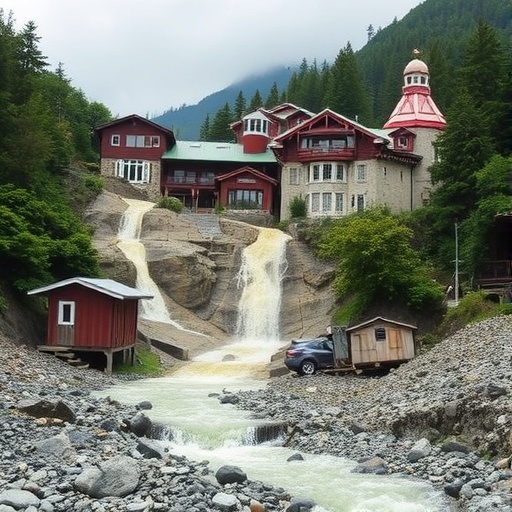
Landslides are traditionally associated with heavy rainfall, a concept deeply ingrained in both scientific understanding and public awareness. It is widely believed that torrential downpours saturate mountain slopes, destabilizing soil and rock, which then catastrophically slide downhill. However, recent research spearheaded by Professor Chen Ningsheng and his international team challenges this conventional wisdom by unraveling the mysterious mechanisms behind landslides that occur without heavy rain, illuminating the critical role early strong runoff plays in conjunction with weak geological materials.
Contrary to popular belief, a surprising majority of landslides—approximately 75.7%—happen during periods of minimal or no rainfall. The Baige landslide in Tibet, which occurred on October 10, 2018, with no precipitation, serves as a dramatic example. Similarly, the colossal Attabad landslide in Pakistan in January 2010 also took place in the absence of rainfall. These phenomena highlight an urgent need to rethink how we monitor and mitigate landslide hazards that defy traditional rainfall-based warning models.
Through an exhaustive analysis of over 1,100 disastrous landslide cases worldwide, the team utilized cutting-edge methodologies such as big data analytics and machine learning algorithms to identify patterns and triggers of these atypical landslides. Their findings illustrate that these destructive events often manifest with a delay caused by complex runoff dynamics, where water infiltrates the slope not immediately through direct rainfall but via surface flow, interflow through gullies, and stream supply mechanisms.
The runoff reaches the sliding surface in a delayed fashion, influenced by factors such as the amount of early-stage rainfall, the Topographic Wetness Index (TWI)—which quantifies how water accumulates in specific landscapes—and the size of the landslide itself. This nuanced understanding sheds light on why early small volumes of rain, seemingly insufficient to trigger a landslide, can initiate a process that culminates in slope failure days or even weeks later.
Fundamentally, the mechanism driving these landslides revolves around the interaction between high water pressures and inherently weak geomaterials. Interflow within the slope softens loose soil deposits, while subsurface slip-surface flow undermines the interface between bedrock and overlying materials. This hydromechanical interaction progressively deteriorates soil and rock stability until the slope inevitably fails. The subtle return flow within the slip zone exacerbates weakening, a phenomenon previously underestimated in landslide hazard assessments.
This refined mechanistic insight has profound implications for landslide monitoring and early warning systems. Traditional reliance on rainfall thresholds as indicators for issuing alerts is insufficient for these atypical cases. Instead, the researchers emphasize the need to monitor deformation acceleration and vibration signals caused by the synergistic effect of water pressure and rock/soil weakness. These geophysical precursors can herald impending landslides even in the absence of heavy rainfall, providing a critical window for timely intervention.
The study further advocates for comprehensive mass monitoring programs integrated with public education campaigns. Raising awareness among local populations about the prevalence and danger of rainfall-free and low-rainfall landslides can empower communities to recognize early warning signals. Education efforts focusing on the interpretation of deformation and vibration data will foster resilience, reducing casualties and economic losses resulting from these stealthy hazards.
From an engineering perspective, the research suggests augmenting traditional stabilizing structures with enhanced drainage systems specifically designed to handle subsurface and interflow water. Reinforcing weak rock and soil formations with retaining structures remains vital, but without adequate drainage, these measures alone may prove insufficient. By actively managing water pressure within slopes, engineering interventions can more effectively mitigate landslide risks.
The emergence of this new paradigm in landslide science also calls for revisiting risk models and hazard maps, incorporating hydrological subsurface processes and geomaterial characterization. Incorporation of these complex parameters will yield more accurate predictive tools. Future studies leveraging advancements in remote sensing and sensor networks will be instrumental in refining the understanding and management of these sophisticated slope failures.
The investigation’s implications extend beyond academia, influencing policy frameworks and emergency preparedness strategies globally. Regions previously considered low-risk due to scant rainfall records must now reassess their vulnerability to landslides triggered by alternative hydrological phenomena. International cooperation and resource allocation toward monitoring infrastructures are critical for mitigating the impacts of rainfall-free landslides in mountainous and hilly regions worldwide.
As landslide science evolves, this study published in the respected journal Geology shines a spotlight on the nuanced interplay between hydrology and weak geological materials, challenging entrenched assumptions. By elucidating the underpinnings of landslides without heavy rainfall, it opens doors to revolutionary approaches in hazard detection, public safety, and geotechnical engineering.
In light of these findings, societies living in landslide-prone areas are urged to refine their understanding of natural hazards. This paradigm shift highlights that the absence of heavy rain does not equate to safety and that proactive monitoring of early runoff effects combined with geological weakness is paramount for disaster risk reduction. The future of landslide science and risk management lies in embracing these complex, coupled processes and fostering multi-disciplinary collaborations.
Cite Scienmag News
Violet Maxwell. (April 16, 2026). Landslides Triggered by Early Intense Runoff and Fragile Geomaterials, Even Without Heavy Rainfall. Scienmag. https://scienmag.com/landslides-triggered-by-early-intense-runoff-and-fragile-geomaterials-even-without-heavy-rainfall/
Violet Maxwell. "Landslides Triggered by Early Intense Runoff and Fragile Geomaterials, Even Without Heavy Rainfall." Scienmag, 16 April 2026, https://scienmag.com/landslides-triggered-by-early-intense-runoff-and-fragile-geomaterials-even-without-heavy-rainfall/. Accessed 5 September 2026.
Violet Maxwell. "Landslides Triggered by Early Intense Runoff and Fragile Geomaterials, Even Without Heavy Rainfall." Scienmag. April 16, 2026. https://scienmag.com/landslides-triggered-by-early-intense-runoff-and-fragile-geomaterials-even-without-heavy-rainfall/


