


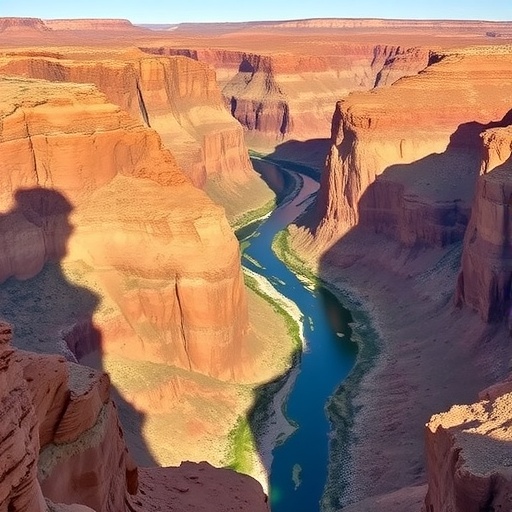
The intricate history of the Colorado River and its profound geological shaping of the Grand Canyon has long captivated geologists and earth scientists. Recent breakthrough research led by John He and his team presents compelling evidence reshaping our understanding of the river’s ancient course and its pivotal role in carving the world-renowned canyon. A detailed study of the Bidahochi Formation, supported by state-of-the-art uranium-lead geochronology of zircon crystals, reveals that the river’s integration into the Grand Canyon occurred through a spillover mechanism from a vast ancestral lake approximately 5.6 million years ago. This new insight challenges prevailing hypotheses centered around groundwater flow and gradual erosional processes, positioning lake spillover as the dominant driver behind the river’s transformative southward expansion.
The significance of the Colorado River’s trajectory through the Grand Canyon cannot be overstated, yet the geologic record has, until now, left a substantial temporal gap in our understanding. Fossil and sedimentary evidence places the Colorado River system as early as 11 million years ago in what is now western Colorado. However, it was only around 5.6 million years ago that the river assumed its modern path, exiting the canyon much as it does today. This 5.4-million-year interval has spawned divergent theories, reflecting the difficulty of piecing together the river’s complex evolutionary pathway through fragmented records. The traditional view has involved multi-stage processes, including episodic canyon incision, stream capture, and subterranean flow, but consensus remained elusive.
Central to the new findings is the pioneering application of uranium-lead (U-Pb) dating of zircon grains extracted from volcanic ash beds and sandstones within the Bidahochi Formation and neighboring sedimentary sequences. Zircon crystals are highly resistant to weathering and can retain age information faithfully, acting as natural chronometers. By analyzing these zircon age spectra, He and colleagues created a geological “fingerprint” of sediment provenance. This fingerprint revealed remarkable concordance between zircons in the upper layers of the Bidahochi Formation and those found in adjacent confirmed early Colorado River deposits. This geochronological match implies a hydrological connection existed far earlier than previously established, as early as 6.6 million years ago, signifying that river systems were already transporting sediments into the basin at this time.
The Bidahochi Formation holds particular geologic importance as a repository of clues about ancient paleolake environments. Stratigraphic evidence—the distinct layering of lake sediments and volcanic material—shows sustained sediment deposition consistent with the presence of a lake large enough to accommodate prolonged sediment influx. Elevated sediment accumulation rates, coupled with variations in strontium isotope ratios, lend further credence to an active hydraulic system feeding the basin. Moreover, fossilized fish assemblages found within this formation distinctly align with species commonly associated with riverine ecosystems, painting a picture of persistent freshwater conditions influenced by Colorado River inflows.
Perhaps most strikingly, the research integrates geomorphological data indicating that these ancient lake waters reached an elevation high enough to breach natural geological boundaries. Specifically, lake sediments resting atop the Kaibab arch reveal a scenario in which waters overtopped this structural barrier, funneling overflow southward into the Grand Canyon region. This spillover event likely served as the critical mechanism establishing the ancestral canyon-cutting flow of the Colorado River. Such elevation-controlled spillover from lake basins into adjacent drainage networks exemplifies a plausible and powerful geomorphic driver, eclipsing prior conceptions that emphasized diffuse groundwater seepage or stepwise erosional dissection as primary agents.
This reinterpretation of the river’s integration has broad implications for understanding the dynamic interactions between tectonics, climate, and surface processes shaping the southwestern United States. The timing of spillover corresponds roughly with late Miocene climatic transitions and regional uplift events, suggesting a concerted interplay between hydrological reorganization and crustal deformation. This perspective underscores the importance of considering basin hydrology and lake evolution within the broader tectono-stratigraphic framework, rather than viewing river incision as an isolated erosional phenomenon.
Beyond hydrology and tectonics, the methodological advances employed by John He’s team highlight the transformative power of high-precision geochronology in reconstructing Earth’s ancient landscapes. The uranium-lead dating of zircon detritus serves not only as a dating tool but also as an exquisite tracer enabling sediment provenance studies at temporal resolutions never before achievable. Pairing these chronological insights with geochemical signatures, sedimentological analyses, and fossil records creates a multidimensional view of landscape evolution, pushing the frontier of geological investigations.
By framing the Colorado River’s establishment through the Grand Canyon as initiated by a high-elevation lake spillover, this research invites a reevaluation of other large river systems and their responses to paleoclimate and geologic controls. It prompts a new line of inquiry into the role of transient lakes and closed basins in reorganizing continental drainage networks globally. These findings also strongly suggest that similar spillover-induced river captures may have shaped the morphology and sediment dynamics of many other iconic river systems, potentially influencing their ecological and geomorphic pathways.
While spillover stands as the leading hypothesis, the authors acknowledge the complexity inherent in the Colorado River’s history. Processes such as localized erosion, groundwater flow, and tectonic uplift likely played contributory roles in sculpting the canyon’s intricate architecture. However, the preponderance of evidence now firmly situates lake spillover as the initial pivot point for the river’s downstream migration and canyon carving. Further research combining detailed stratigraphic correlations, paleohydrological modeling, and sediment transport analyses will refine the temporal and spatial nuances of this transformative period.
This work not only advances the geological community’s understanding of Colorado River evolution but also enriches scientific narratives about Earth’s landscape formation. The Grand Canyon remains a testament to the potent forces of water and time, and by illuminating its ancient hydrological origins, we deepen our appreciation of the complex feedbacks shaping Earth’s surface environments. As multidisciplinary approaches continue to integrate geochronology, geochemistry, and paleontology, the picture of North America’s monumental river systems will become ever clearer and more nuanced.
In conclusion, the revelation that a massive late Miocene lake spillover was integral in rerouting the Colorado River through the Grand Canyon highlights how even monumental natural features may arise from relatively discrete hydrological tipping points. This research not only reshapes the geological understanding of one of the world’s most iconic landscapes but also serves as a compelling case study in the interplay of sediment provenance, paleohydrology, and tectonics. By unlocking the sedimentary record preserved in uranium-lead dated zircons and ancient lake deposits, John He and his colleagues propel the story of Earth’s dynamic surface into a new era of clarity and insight.
News Publication Date: 16-Apr-2026
Web References: https://dx.doi.org/10.1126/science.adz6826
Cite Scienmag News
Violet Maxwell. (April 16, 2026). Ancient Lake Overflow Likely Shaped the Colorado River’s Path Through the Grand Canyon. Scienmag. https://scienmag.com/ancient-lake-overflow-likely-shaped-the-colorado-rivers-path-through-the-grand-canyon/
Violet Maxwell. "Ancient Lake Overflow Likely Shaped the Colorado River’s Path Through the Grand Canyon." Scienmag, 16 April 2026, https://scienmag.com/ancient-lake-overflow-likely-shaped-the-colorado-rivers-path-through-the-grand-canyon/. Accessed 4 September 2026.
Violet Maxwell. "Ancient Lake Overflow Likely Shaped the Colorado River’s Path Through the Grand Canyon." Scienmag. April 16, 2026. https://scienmag.com/ancient-lake-overflow-likely-shaped-the-colorado-rivers-path-through-the-grand-canyon/


