


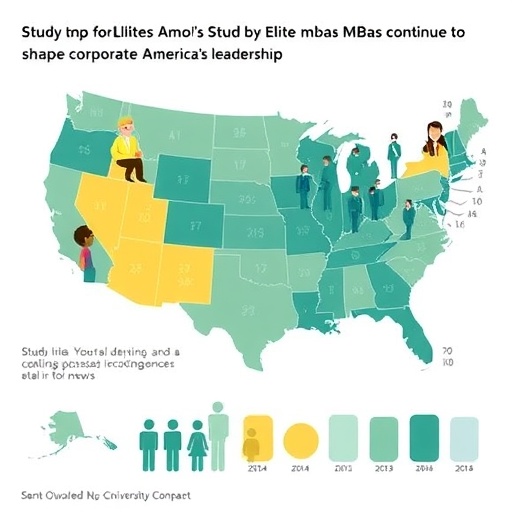
A groundbreaking study from the University of Bath has shed new light on the enduring influence of elite MBA programs on the trajectory of top executive careers within corporate America. Analyzing data from over 106,000 executives of S&P 500 companies between 2000 and 2018, the research offers a comprehensive view into how attending prestigious MBA programs — particularly the M7, a group of the most elite American business schools — decisively enhances the likelihood of ascending to senior management and CEO roles. Despite the high cost and intense competition associated with these programs, the study confirms their powerful impact on career advancement at the highest corporate levels.
Yet the benefits of obtaining an elite MBA are not distributed equally across gender, ethnicity, or economic periods, revealing a complex landscape beneath the broadly accepted assumption that education alone guarantees leadership success. Male graduates from elite programs, particularly American men, consistently reap the most substantial gains in career progression. This skew reflects deep-rooted structural patterns within corporate leadership pipelines that favor dominant demographic groups — a finding that questions the egalitarian promises often associated with advanced education credentials.
Intriguingly, the study uncovers a phenomenon aligning with the sociopsychological concept known as the “Glass Cliff,” where women, especially those with elite MBAs, gain accelerated opportunities during economic downturns or organizational crises. During turbulent periods such as the 2008 Global Financial Crisis, companies appeared more willing to diversify their leadership by appointing women to top-level positions. However, the research carefully notes that these gains for women tend to be fragile and temporary, often receding once stability returns. This transient inclusion emphasizes the conditional and instrumental nature of diversity initiatives during crises rather than signaling a permanent shift in corporate leadership paradigms.
The experience of minorities with elite MBAs during the study period reveals an even more nuanced picture. While economic turmoil occasionally creates openings for underrepresented groups as firms seek alternative strategic thinking, these breakthroughs are often insufficiently consolidated. Post-crisis phases typically witness a retrenchment to established, traditional leadership profiles that marginalize minority executives and re-center privileges on American men. This cyclical inclusion and exclusion pattern underscore persistent barriers to genuine equity in elite corporate leadership roles.
The researchers identified four distinct corporate responses towards elite MBAs, each linked to prevailing economic and organizational conditions. First, during stable times, “consolidated reproduction” dominates, where elite MBAs predominantly elevate executives who conform to established leadership archetypes. Second, in moments of crisis, “crisis-legitimated inclusion” temporarily broadens access, particularly benefiting women and minorities who possess elite credentials. Third, companies engage in “symbolic accommodation,” a form of superficial diversity wherein outsiders are visible in senior roles but rarely endorsed for the very top positions. Lastly, “defensive retrenchment” follows crisis stabilization, involving a reassertion of traditional norms that disproportionately exclude non-US nationals and other marginalized groups from leadership advancement.
These findings prompt critical questions concerning the legitimacy and social role of MBA programs, especially the elite tier. While elite MBAs undeniably function as crucial gateways to top executive positions, their capacity to foster durable inclusion remains limited. The symbolic legitimacy they confer can shift considerably in response to external pressures, implying that the power held by these programs is not absolute but subject to the vagaries of economic and cultural contexts. Such insights challenge business schools to re-examine how their admissions and credentialing systems may inadvertently perpetuate inequities rather than mitigate them.
Professor Mairi Maclean, co-author of the study, emphasized that elite MBAs provide undeniable advantages in achieving senior corporate leadership, but these are unevenly realized. This inequality bears far-reaching implications for how corporations cultivate diversity and leadership resilience. In particular, the temporary career acceleration experienced by female and minority executives during crises, followed by setbacks in stable periods, signals the urgent need for more enduring systemic change beyond episodic diversity measures.
The study, published in the prestigious Academy of Management Learning & Education journal, also critically engages with the concept of the Glass Cliff theorized by Professors Michelle Ryan and Alex Haslam. According to this framework, women are more likely to attain leadership roles during periods of heightened risk and instability — a circumstance that places them in precarious positions subject to increased scrutiny and potential failure. The Bath research empirically supports this notion within the context of elite MBA graduates, exposing the gendered nuances of career risk and reward.
Moreover, the fluctuating inclusion of minorities suggests that economic shocks sometimes catalyze temporary expansions in leadership diversity, but systemic barriers reassert themselves once the perceived crisis subsides. These dynamics highlight the fragility of progress for minority executives and caution against complacency in diversity strategies. Without structural reforms addressing the roots of exclusion, diversity gains risk being periodic and symbolic rather than substantive and sustained.
Co-author Professor Charles Harvey from Newcastle University called attention to the responsibility of business schools in this landscape. He suggested that institutions need to critically reflect on how their selection processes, network access, and prestige mechanisms influence who gets recognized as legitimate leaders. Genuine inclusion demands more than surface-level initiatives; it requires a reimagining of educational practices and credentialing to promote equitable career trajectories for all demographics, not just temporary visibility during crises.
Given the political and economic context in the contemporary United States, the researchers speculate that organizations may be gravitating towards “defensive retrenchment,” reinforcing conventional norms about who belongs at the top. This climate may curtail the fragile gains made by women and minorities with elite MBAs, underlining the ongoing challenges in achieving meaningful representation and equity in corporate power structures.
This research thus delivers vital insights for scholars, practitioners, and policymakers invested in understanding the social dynamics of corporate leadership. By disentangling the effects of elite education from broader patterns of inclusion and exclusion, the study provides a nuanced map of how privilege and crisis interact in shaping the highest echelons of business. It also advances the discourse on equity in executive careers, probing the limits of current diversity efforts and the structural transformations necessary to realize more just and sustainable leadership hierarchies.
In conclusion, while an elite MBA remains a formidable credential opening doors to the top of corporate America, the journey to enduring diversity and equitable leadership necessitates more profound changes. Both educational institutions and corporations must confront entrenched norms and biases if they aspire to move beyond symbolic gestures toward genuine inclusivity that withstands economic shifts and challenges.
News Publication Date: 16 April 2026
Web References:
Study DOI
References:
- Mairi Maclean et al., “Elite MBAs in the Making of Top Business Careers,” Academy of Management Learning & Education, March 2026.
- Michelle Ryan & Alex Haslam, Glass Cliff Theory studies.
Cite Scienmag News
Courtney Benton. (April 16, 2026). Study from University of Bath reveals Elite MBAs continue to shape corporate America’s leadership. Scienmag. https://scienmag.com/study-from-university-of-bath-reveals-elite-mbas-continue-to-shape-corporate-americas-leadership/
Courtney Benton. "Study from University of Bath reveals Elite MBAs continue to shape corporate America’s leadership." Scienmag, 16 April 2026, https://scienmag.com/study-from-university-of-bath-reveals-elite-mbas-continue-to-shape-corporate-americas-leadership/. Accessed 4 September 2026.
Courtney Benton. "Study from University of Bath reveals Elite MBAs continue to shape corporate America’s leadership." Scienmag. April 16, 2026. https://scienmag.com/study-from-university-of-bath-reveals-elite-mbas-continue-to-shape-corporate-americas-leadership/


