


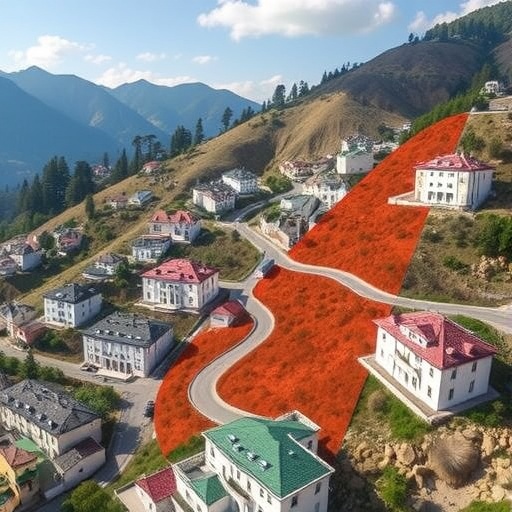
The catastrophic earthquake sequence that struck Kahramanmaraş in 2023 left indelible marks not only on the landscape but on the communities perched precariously atop vulnerable hillslopes. Recent research led by Wang, Dahal, van Westen, and colleagues, soon to be published in Communications Earth and Environment, provides a comprehensive technical analysis of how these seismic events compromised the stability of hillslope settlements—both new and established—highlighting risks that have long been underestimated. This groundbreaking study sheds light on the interplay between natural geophysical processes and anthropogenic impacts, with profound implications for future urban planning in seismically active regions.
The Kahramanmaraş earthquake sequence was extraordinary in magnitude and complexity. Unlike more transient seismic events, this series involved multiple large shocks that generated widespread shaking, triggering extensive slope failures throughout the region. The affected terrain is characterized by steep hillslopes, which are inherently susceptible to disruption due to gravitational forces and the geological composition of the substrata. When shaken by sustained, high-intensity ground motions, these landscapes become critical zones of instability, especially where anthropogenic activities have altered natural slope conditions.
Wang et al.’s study involved an integrated approach combining remote sensing, geotechnical field surveys, and sophisticated numerical modeling to assess how the earthquake sequence altered the mechanical properties of hillslope materials supporting settlements. One key finding was that seismic loading caused progressive weakening of soil and rock cohesion, dramatically lowering the shear strength parameters of these slopes. This weakening was exacerbated by pre-existing geological discontinuities such as fractures and bedding planes, promoting the initiation and propagation of landslides in both urbanized and rural zones.
The team’s analysis also revealed that many new settlements developed in the years leading up to 2023 were constructed without adequate consideration of the underlying geotechnical hazards. Rapid urban expansion, driven by demographic pressures, often prioritized convenient access and scenic vantage points over ground stability. Consequently, these locations sat atop slopes that were already marginally stable under normal conditions, rendering them highly vulnerable when subjected to the intense shaking of the Kahramanmaraş event.
In contrast, some older settlements displayed better resilience, largely because traditional construction methods frequently adapted to local terrain features and utilized more flexible building designs. However, prolonged seismic exposure and amplified ground motions still caused serious damage in these communities, underscoring the insufficiency of purely empirical or historical hazard assessments. The study stresses the urgent need for integrating detailed geotechnical hazard mapping into urban planning frameworks to mitigate future seismic risks effectively.
Central to the research is the elucidation of the mechanisms underlying seismic slope failures. The authors describe how the dynamic stresses induced by the earthquakes increased pore water pressures in saturated zones within the hillslopes, effectively triggering temporary liquefaction in certain soil layers. This process drastically reduced frictional resistance along potential slip surfaces, enabling catastrophic slope failures that were spatially extensive and sometimes rapidly mobilized, leaving little time for evacuation or warning.
Moreover, the research highlights the role of cumulative seismic strain caused by the sequence, which progressively degraded slope integrity. Unlike a single seismic shock, multiple closely spaced events caused complex loading-unloading cycles within the slopes, severely weakening internal fabrics and precipitating delayed or secondary landslides weeks after the initial shocks. This phenomenon complicates disaster response planning by prolonging the window of geological risk and necessitates continuous monitoring.
Technological advances in high-resolution satellite imaging and drone-assisted surveys were instrumental in the study. These tools allowed precise mapping of disrupted topography, including fresh scarps, lateral spreads, and mass failures across large areas previously inaccessible for ground inspection. The remote sensing data were integrated with ground truthing to calibrate numerical models simulating slope stability under seismic loads, enabling predictions of which hillslopes remain at risk under future earthquake scenarios.
Interestingly, the research also identified human-induced factors that intensified hillslope weakening beyond seismic shaking alone. These include deforestation, improper drainage, and unregulated excavation activities that collectively reduce natural slope cohesion and increase susceptibility to failure. The authors argue for a holistic approach to hazard mitigation—one that couples seismic risk evaluations with sustainable land-use management to preserve slope integrity.
The implications of this study extend well beyond the Kahramanmaraş region. As urbanization steadily expands into hilly and mountainous terrains worldwide, understanding how earthquake sequences interact with terrain stability becomes critical. The integration of geotechnical science with earthquake engineering and urban planning can bolster societal resilience against these compounded hazards, potentially saving countless lives and infrastructure.
This research also paves the way for advances in early-warning systems specific to hillslope failures triggered by earthquakes. By identifying geophysical precursor signals and monitoring key slope stability indicators, authorities could develop tailored alert mechanisms that warn communities living in hazard-prone hillslopes before catastrophic collapse events occur. Such adaptive systems would complement conventional seismic alerts focused primarily on shaking intensity.
In sum, Wang and colleagues provide a stark and scientifically rigorous reminder that the intersection of human activities and natural seismic phenomena generates complex, heightened risks in hillslope settlements. The Kahramanmaraş earthquake sequence has exposed vulnerabilities that transcend individual buildings and pose systemic challenges to regional safety and sustainable development. Addressing these challenges necessitates a paradigm shift in how seismic hazard assessments incorporate terrain deformation dynamics and long-term landscape evolution.
Their study calls for immediate policy attention directed at enforcing stricter building codes on vulnerable slopes, integrating slope stability criteria in land-use zoning, and investing in continuous geotechnical monitoring infrastructure. The lessons learned from Kahramanmaraş are applicable to seismic hazard management globally, emphasizing that scientific insight must be translated swiftly into actionable urban safety strategies to avoid similar tragedy.
Looking ahead, further interdisciplinary research combining seismology, geomorphology, geotechnical engineering, and social sciences will be essential to develop comprehensive hazard mitigation frameworks. Such integrated studies can better anticipate how earthquake sequences might modify terrain susceptibility patterns and inform community-centered resilience planning.
In conclusion, the 2023 Kahramanmaraş earthquake sequence has not only reshaped the physical hillslopes around this historic city but also reshaped the scientific understanding of earthquake-slope interactions and their ramifications for human settlements. Wang et al.’s work stands as a seminal contribution, merging cutting-edge technical analysis with urgent societal relevance, and marking a critical advance in how we conceptualize and prepare for seismic disasters in hilly regions of the world.
Cite Scienmag News
Violet Maxwell. (April 16, 2026). Settlements on Weakened Hillslopes Threatened by 2023 Quake. Scienmag. https://scienmag.com/settlements-on-weakened-hillslopes-threatened-by-2023-quake/
Violet Maxwell. "Settlements on Weakened Hillslopes Threatened by 2023 Quake." Scienmag, 16 April 2026, https://scienmag.com/settlements-on-weakened-hillslopes-threatened-by-2023-quake/. Accessed 4 September 2026.
Violet Maxwell. "Settlements on Weakened Hillslopes Threatened by 2023 Quake." Scienmag. April 16, 2026. https://scienmag.com/settlements-on-weakened-hillslopes-threatened-by-2023-quake/


