


In 2021, NASA’s James Webb Space Telescope (JWST) revolutionized our view of the cosmos by peering back into the infancy of the universe, capturing cosmic dawn moments within a few hundred million years after the Big Bang. Among the multitude of phenomenal discoveries, a particularly perplexing finding has been the presence of supermassive black holes—monumental entities boasting masses upwards of 100 million suns. These discoveries defy long-standing astrophysical models, presenting a cosmic conundrum that challenges our foundational understanding of how structure forms in the universe.
Traditionally, cosmologists have conceived black hole formation in a hierarchical framework, beginning with “light seeds.” This involves the collapse of massive stars—a process where a star exhausts its nuclear fuel and gravitationally implodes, leaving behind a black hole with a comparatively modest mass of tens to hundreds of solar masses. Over cosmic time, these smaller black holes were thought to merge and accrete matter incrementally, gradually growing into the supermassive behemoths observed today. However, the early appearance of gargantuan black holes reveals a discrepancy in this model’s timeline, indicating that the standard evolutionary pathway might be insufficient for explaining these ancient leviathans.
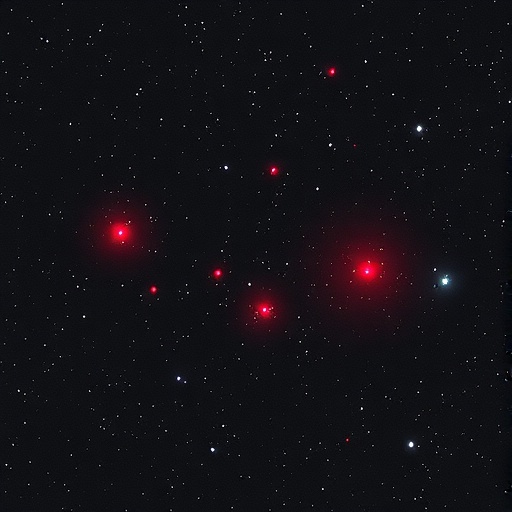
Addressing this profound puzzle, Professor Volker Bromm of the University of Texas at Austin, a leading figure in theoretical astronomy and co-director of the Cosmic Frontier Center, has co-authored a groundbreaking study investigating enigmatic astronomical phenomena dubbed “Little Red Dots” (LRDs). Published in the Astrophysical Journal in February 2026, the research utilizes advanced computational cosmology to model these compact, intensely redshifted objects. LRDs exhibit spectral signatures and physical characteristics challenging to reconcile with conventional theories, hinting instead at a radically different black hole formation mechanism than previously considered.
Central to Bromm’s study is the “heavy seed” hypothesis, which boldly posits that some black holes originated from the direct and rapid collapse of immense primordial gas clouds composed predominately of hydrogen and helium. These Direct Collapse Black Holes (DCBHs) bypass the slow stellar evolution process entirely, forming massive black hole seeds with initial masses significantly larger than those of star remnants. This model provides a plausible pathway for the emergence of supermassive black holes within the brief window post-Big Bang that JWST observations suggest.
LRDs, according to the heavy seed paradigm, represent black holes ensconced within dense gas cocoons—high-density clouds that both obscure and fuel the nascent supermassive objects. These gas envelopes result in characteristic emissions and spectral redshifts, which Bromm and his team simulated and compared against the JWST’s LRD data. The striking concordance between the heavy seed models and the observed LRD populations lends robust support to this alternative formation pathway, potentially rewriting a chapter in cosmic history.
The computational rigor underpinning this breakthrough was made possible by leveraging the formidable capabilities of supercomputers Lonestar6 and Stampede3, housed at the Texas Advanced Computing Center (TACC). Bromm secured allocations on these machines via the University of Texas Research Cyberinfrastructure program, enabling the intricate modeling of galaxy formation physics. Starting from initial cosmological conditions informed by the Cosmic Microwave Background Radiation—the relic radiation from the Big Bang—these simulations encompass the nonlinear interactions between dark matter and baryonic matter, a notoriously complex regime defying simple analytic solutions.
Bromm emphasizes that the coupling of dark matter with baryons engenders a computationally formidable challenge, necessitating the massive parallel processing power and large memory architectures offered by TACC’s systems. “The moment you couple dark matter with baryons, you enter an inherently nonlinear domain,” he explains, underscoring that only through such computational might can these multifaceted phenomena be realistically resolved.
The team’s computer simulations utilized the Ancient Stars and Local Observables by Tracing Halos (A-SLOTH) galaxy formation code. This sophisticated software populates the early universe’s virtual landscape with DCBHs and compares the resulting statistical properties against those derived from stellar remnant seeds. Their findings reveal superior alignment between the DCBH-based models and the real LRD data, particularly when analyzing host dark matter halo structures and population statistics, further signalling the viability of the heavy seed hypothesis.
A remarkable aspect of the research involved decoding the “genetics” of LRDs through a novel technique akin to constructing an evolutionary family tree. Bromm’s team employed merger tree methodologies to retrace the intricate lineage of individual LRDs, essentially unraveling their cosmic progenitors across millions of years. This approach integrated not only gravitational and hydrodynamic processes but also astrophysical mechanisms such as star formation, supernova feedback, and subsequent chemical enrichment, providing a comprehensive framework that mirrors the complex interplay shaping cosmic structures.
While the study’s simulations themselves did not directly harness artificial intelligence (AI), Bromm acknowledges that AI and machine learning techniques played supporting roles in distilling key properties from the JWST imaging data. These computational tools facilitated nuanced data analysis, helping to isolate the LRD signals amidst a cacophony of cosmic emissions, thereby enabling more precise model calibration.
Looking forward, the synergy between cutting-edge supercomputing and JWST insights heralds a new era in unraveling the primordial universe’s secrets. The formidable challenge lies in solving the coupled differential equations governing the dynamics of dark matter and baryonic matter as they evolve over cosmic time—a task that remains deeply computational and intractable without elite computational resources. Enhancing the fidelity of these models will be pivotal in bridging the luminous universe observed by JWST with the elusive nature of the underpinning dark matter scaffolding.
Philosophically, Bromm reflects on the monumental significance of these advances, highlighting humanity’s unprecedented capability to reconstruct nearly 14 billion years of cosmic history. This synthesis of observational astronomy and supercomputing marks an extraordinary leap in our quest to comprehend the universe’s genesis and evolution, placing us on the cusp of profound cosmological revelation.
The implications of this research extend beyond mere astrophysical curiosity: understanding the origins and growth of black holes informs broader fundamental physics, galaxy formation theories, and the intricate dance between visible matter and dark matter that shapes the cosmos. The study represents a quintessential example of the power of interdisciplinary science, combining observational prowess, theoretical insight, and computational excellence to address one of the most enigmatic questions in modern cosmology.
As JWST continues to collect data, and supercomputing architectures grow ever more powerful, the collaboration between telescopic observation and computational modeling stands poised to illuminate the shadowy corridors of our universe’s earliest epochs. Bromm and his collaborators have laid a robust foundation, guiding future investigations into the origins of supermassive black holes, the nature of primordial galaxies, and the grand narrative of cosmic evolution itself.
News Publication Date: 6-Feb-2026
Web References: http://dx.doi.org/10.3847/1538-4357/ae3725
References: Jeon, J., Bromm, V., Taylor, A.J., Kokorev, V., Chisholm, J., Finkelstein, S.L., Liu, B., Fujimoto, S., Larson, R.L., Kocevski, D.D. (2026). Little Red Dots and Their Progenitors from Direct Collapse Black Holes. Astrophysical Journal.
Keywords
James Webb Space Telescope, supermassive black holes, direct collapse black holes, Little Red Dots, cosmology, galaxy formation, supercomputing, Texas Advanced Computing Center, cosmic microwave background, dark matter, astrophysical simulations, early universe
Cite Scienmag News
Grant Pearson. (April 16, 2026). Tiny Red Marks: Fresh Insights from the Early Universe. Scienmag. https://scienmag.com/tiny-red-marks-fresh-insights-from-the-early-universe/
Grant Pearson. "Tiny Red Marks: Fresh Insights from the Early Universe." Scienmag, 16 April 2026, https://scienmag.com/tiny-red-marks-fresh-insights-from-the-early-universe/. Accessed 3 September 2026.
Grant Pearson. "Tiny Red Marks: Fresh Insights from the Early Universe." Scienmag. April 16, 2026. https://scienmag.com/tiny-red-marks-fresh-insights-from-the-early-universe/


