


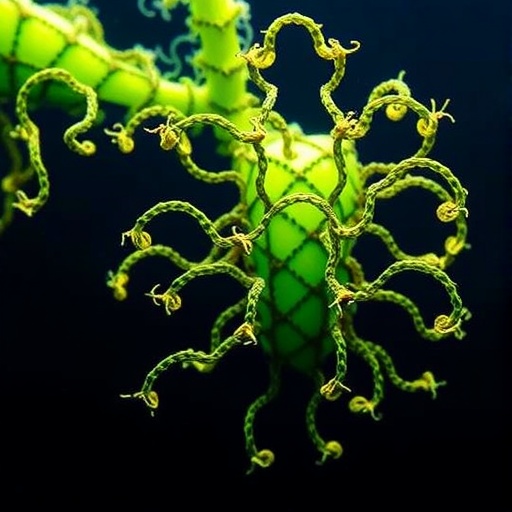
For billions of years, photosynthetic bacteria have been the unsung architects of life on Earth, shaping the planet’s atmosphere and enabling the rise of complex organisms. Among these pioneering microbes are cyanobacteria—ancient organisms responsible for oxygenating our atmosphere during the Great Oxygenation Event approximately 2.5 billion years ago. Despite their monumental role in Earth’s history, cyanobacteria continue to surprise researchers with new biological revelations. A groundbreaking study from the Institute of Science and Technology Austria (ISTA) has unveiled an unexpected evolutionary adaptation within multicellular cyanobacteria, where a protein system once dedicated to DNA segregation has been co-opted to define and maintain cell shape.
This remarkable discovery, published in Science, sheds light not only on the versatile evolution of protein machinery but also on the emergence of multicellularity—a pivotal milestone in life’s complexity. Lead researcher Benjamin Springstein and his colleagues focused their investigations on Anabaena sp. PCC 7120, a model multicellular cyanobacterium that has captivated researchers for over three decades due to its ecological significance and cellular intricacy.
At the heart of cellular life lies the accurate replication and distribution of genetic material. In bacteria, DNA is tightly packed within chromosomes and plasmids, both essential for replication fidelity and cellular function. Chromosomes carry vital genes necessary for survival, while plasmids often harbor accessory genes that may provide adaptive advantages. Classically, bacterial DNA segregation systems, such as the ParMR complex, are known to function exclusively on plasmids, ensuring their precise inheritance during cell division.
Springstein’s team made a startling observation: in Anabaena and certain other multicellular cyanobacteria, the ParMR system appeared encoded on the chromosome rather than on plasmids—a fundamental deviation from prior understanding. Initially hypothesizing a role in chromosome segregation, subsequent experimental exploration took a surprising turn. Instead of interacting with DNA as expected, the ParR component was found to associate with the inner cell membrane. ParM filaments deviated from their canonical organization by forming bipolar, membrane-associated arrays akin to a cytoskeletal cortex rather than spindle-like structures that physically segregate DNA.
This unexpected functional repurposing transforms the classical ParMR DNA segregation machinery into a novel cytoskeletal system, which the researchers have aptly renamed CorMR. Detailed in-vitro reconstitution experiments revealed the dynamic behavior of these filaments: they exhibited instability characterized by phases of elongation followed by rapid disassembly, mirroring behaviors observed in eukaryotic microtubules—a finding highlighting convergent mechanical principles across domains of life.
To elucidate the structural underpinnings of these unique filaments, the ISTA team collaborated with the Schur group, leveraging cryo-electron microscopy to capture high-resolution architectures of the CorMR filaments. Their observations confirmed a bipolar filament configuration granting growth and shrinkage at both ends — a distinct departure from the polar filament formation typical in plasmid segregation systems. This structural adaptation is likely critical for the filaments’ role in maintaining cellular morphology.
The biological significance of this system became evident when Anabaena cells lacking CorMR filaments displayed profound morphological abnormalities. Normally rectangular and elongated cells shifted toward a more rounded, swollen phenotype—a hallmark of compromised structural integrity. These defects parallel those observed in other bacteria when cell-shape determinant genes are disrupted, underscoring that the CorMR system fundamentally orchestrates cell architecture instead of DNA segregation in these cyanobacteria.
How such a transformation in function arose during evolution was itself a focus of investigation. Bioinformatic analyses conducted by collaborators illuminated a gradual, stepwise process underpinning CorMR’s evolution. Initially a plasmid-encoded system, ParMR transitioned its genomic locus onto the chromosome. This shift was accompanied by alterations in protein size and conformation, acquisition of lipid membrane-binding properties, and integration into regulatory networks governed by additional protein assemblies. Collectively, these evolutionary refinements repurposed an ancient DNA segregation machine into a sophisticated cytoskeletal scaffold critical for cell shape—a testament to the plasticity of molecular systems within living cells.
This discovery broadens our understanding of cytoskeletal diversity beyond the well-characterized eukaryotic systems, revealing how bacteria employ analogous yet distinct strategies for cellular organization and morphology control. It also suggests that bacterial cytoskeletal components may have independently evolved or been repurposed multiple times to fulfill novel structural roles. Given the ecological and evolutionary significance of cyanobacteria, insights into their cellular machinery could illuminate broader principles of bacterial multicellularity and adaptation.
Springstein remarked that the evolutionary ingenuity demonstrated by these bacteria challenges long-held dogmas about the exclusivity and functions of molecular segregation systems. The CorMR system exemplifies how proteins originally dedicated to one cellular task can be co-opted and refined for entirely new functions, thus fueling the diversification of cellular form and function that underpins biological complexity.
Beyond basic science, understanding the mechanistic basis and evolution of bacterial cytoskeletal systems holds potential for biotechnological and synthetic biology applications. Engineering such systems could pave the way for designing microbial factories with tailored morphologies, enhancing stability, and optimizing metabolic efficiencies.
As research on Anabaena and its kin progresses, questions arise about how widespread similar repurposings are across bacterial lineages and what evolutionary pressures drive such adaptations. The CorMR system opens a new frontier in the study of microbial cell biology, revealing ancient functional transitions with ripple effects that extend into ecology, evolution, and applied sciences.
News Publication Date: 16-Apr-2026
Web References: https://doi.org/10.1126/science.aea6343
Keywords
Cyanobacteria, Evolution, DNA, Bacterial DNA, Bacteria
Cite Scienmag News
Gavin Prescott. (April 16, 2026). Anabaena Masters a New Skill: Exciting Discovery Unveiled. Scienmag. https://scienmag.com/anabaena-masters-a-new-skill-exciting-discovery-unveiled/
Gavin Prescott. "Anabaena Masters a New Skill: Exciting Discovery Unveiled." Scienmag, 16 April 2026, https://scienmag.com/anabaena-masters-a-new-skill-exciting-discovery-unveiled/. Accessed 3 September 2026.
Gavin Prescott. "Anabaena Masters a New Skill: Exciting Discovery Unveiled." Scienmag. April 16, 2026. https://scienmag.com/anabaena-masters-a-new-skill-exciting-discovery-unveiled/


