


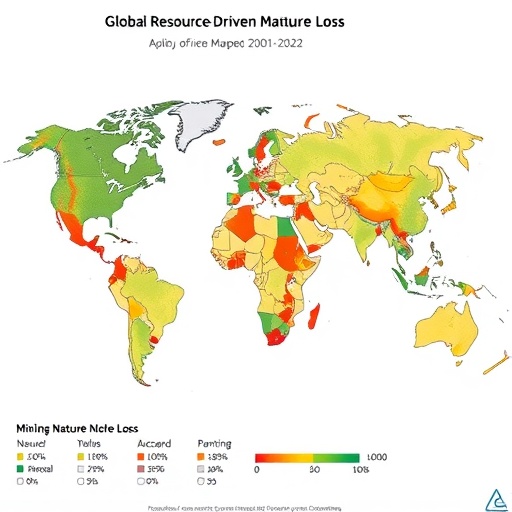
In a groundbreaking new study published in Nature Communications in 2026, researchers have unveiled a comprehensive global map illustrating the extensive nature loss driven by resource extraction in the mining sector over the past two decades. This remarkable work, led by Cheng, YT., Hoang, N.T., Shinoda, Y., and their colleagues, represents one of the most detailed, large-scale assessments of environmental degradation triggered by mining activities from 2001 to 2022. Mining, an essential industry fueling modern civilization by providing raw materials for technologies, infrastructure, and energy systems, has simultaneously imparted an irreversible footprint on natural habitats worldwide.
The research team employed advanced remote sensing technologies combined with sophisticated machine learning algorithms to analyze satellite images and environmental data collected over 21 years. This approach enabled them to discern subtle patterns of deforestation, soil degradation, and ecosystem fragmentation directly linked to mining operations. By integrating various data sources such as global mineral extraction records, land cover changes, and biodiversity loss metrics, the study offers a panoramic view of how resource-driven mining activities have reshaped the Earth’s surface.
One striking revelation is the unprecedented scale of nature loss in some of the most biodiverse hotspots. Tropical regions, especially in South America, Africa, and Southeast Asia, were identified as epicenters where mining-induced environmental harm has accelerated dramatically. The study notes that mining infrastructure expansion, including open-pit mines, tailings dams, and access roads, has not only led to immediate habitat destruction but also triggered cascading ecological consequences — from altering hydrological cycles to increasing the vulnerability of species to extinction.
Technically, the analysis relied on a multi-temporal classification framework that harnessed decades of high-resolution satellite imagery from platforms like Landsat and Sentinel missions. This enabled the researchers to isolate changes associated specifically with mining as opposed to other land-use activities. They developed precise models to quantify nature loss, distinguishing between direct mining footprint expansion and indirect degradation caused by associated activities such as logging or agricultural encroachment enabled by improved road access.
Their temporal assessment underscores how the acceleration of mining activities aligns closely with surging global demand for critical minerals, particularly those essential for renewable energy technologies and electronics. From lithium and cobalt to rare earth elements, the extraction of these resources has spiked exponentially, driven by the global transition towards electrification and digitalization. However, this demand surge has come at a tremendous ecological cost, exposing an uncomfortable paradox in sustainability efforts: while green technologies hold promise for reducing greenhouse gas emissions, the material base supporting them is entangled with severe biodiversity losses.
The spatial detail of the global maps created by the team provides policymakers and conservationists with a valuable tool for targeting intervention efforts. Hotspots highlighted for the steepest degradation correspond closely with regions lacking stringent environmental regulations or robust enforcement frameworks. This signals a critical need for international cooperation to regulate mining practices and integrate biodiversity safeguards more comprehensively into resource extraction policies.
Moreover, the study offers new insights into the magnitude of mining’s footprint relative to other drivers of nature loss, such as agriculture or urbanization. While mining accounts for a relatively smaller proportion of total land-use change globally, its localized impacts are disproportionately severe. In some cases, mining-induced deforestation rates exceeded those of agricultural expansion within ecologically sensitive regions, underscoring the urgent need for tailored mitigation strategies specifically addressing the mining sector.
The research team advocates for adopting innovative technologies such as satellite-based monitoring systems combined with artificial intelligence to enable real-time surveillance of environmental impacts. Such technologies could empower regulatory agencies and civil society organizations to identify illegal or unsustainable mining practices swiftly and impose corrective actions before irreversible damage occurs.
Additionally, the findings evoke broader discussions around the circular economy and resource efficiency paradigms. Reducing demand pressures through increased recycling, substitution of critical minerals, and improved product design could help alleviate some of the environmental stress linked to mining. However, the current global economic momentum suggests an urgent call to balance resource extraction needs with stringent environmental stewardship.
Another consequential dimension explored in the study is the social and cultural toll borne by communities residing near mining operations. The destruction of local ecosystems often correlates with the loss of traditional livelihoods, indigenous land rights, and weakened social cohesion. These human dimensions underline the importance of integrating ecological data with social impact assessments to holistically comprehend mining’s repercussions.
Importantly, the temporal scope from 2001 to 2022 captures significant technological advancements and policy shifts in the mining sector. Yet the study highlights that despite some progress in mining sustainability certifications and better environmental management practices, the aggregate nature loss continues unabated globally. This observation indicates that incremental improvements may be insufficient, advocating for transformative systemic changes across the extractive industries.
In conclusion, this landmark study by Cheng and colleagues delivers an unparalleled synthesis of data and analysis on resource-driven nature loss in the mining sector worldwide. Its granular mapping of environmental degradation offers both a wake-up call and a roadmap for future research, policymaking, and industry innovation. Confronting the dual challenges of meeting society’s resource demands while conserving the planet’s biodiversity will require leveraging such integrative science to inform equitable, effective, and forward-looking strategies. As humanity treads deeper into the Anthropocene, understanding and mitigating mining’s ecological footprint is pivotal to securing a sustainable future for all life on Earth.
Cite Scienmag News
Violet Maxwell. (May 28, 2026). Global Resource-Driven Mining Nature Loss Mapped 2001-2022. Scienmag. https://scienmag.com/global-resource-driven-mining-nature-loss-mapped-2001-2022/
Violet Maxwell. "Global Resource-Driven Mining Nature Loss Mapped 2001-2022." Scienmag, 28 May 2026, https://scienmag.com/global-resource-driven-mining-nature-loss-mapped-2001-2022/. Accessed 4 September 2026.
Violet Maxwell. "Global Resource-Driven Mining Nature Loss Mapped 2001-2022." Scienmag. May 28, 2026. https://scienmag.com/global-resource-driven-mining-nature-loss-mapped-2001-2022/


