


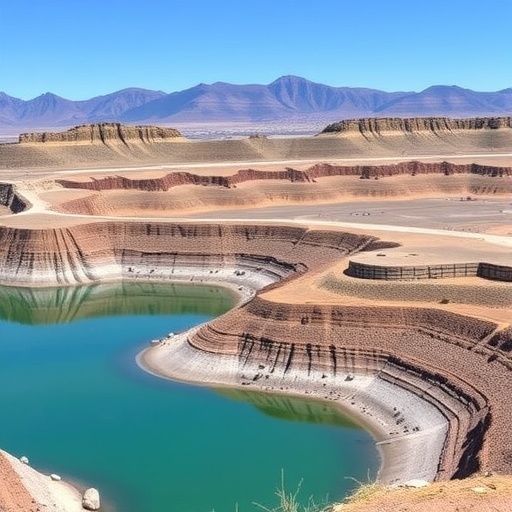
The burgeoning electric vehicle revolution and the rapid deployment of clean energy technologies have placed lithium—a key battery element—squarely in the spotlight. While the United States has ambitions to develop a self-reliant domestic lithium mining industry, a groundbreaking study from Northwestern University underscores a critical and often overlooked challenge: water scarcity. This new research reveals that the U.S., particularly its arid western regions, faces significant water constraints that threaten the viability of lithium mining operations as climate change reshapes hydrological patterns. The study, published in Communications Earth & Environment, offers a sobering assessment of the natural resource paradox embedded in the country’s quest for lithium independence.
Lithium, prized for its role in powering lithium-ion batteries, is essential to the global energy transition. Currently, most lithium mining occurs in Australia and Chile, with processing and refining predominantly in China. These entrenched international supply chains present vulnerabilities for U.S. policymakers aiming to secure sustainable and geopolitically stable sources of lithium. In response, domestic lithium exploration and extraction projects have surged, yet the environmental and logistical hurdles they face, particularly related to water availability, remain stubbornly complex.
Mining lithium is a highly water-intensive endeavor, irrespective of the extraction method employed. Brine mining, commonly practiced in places like Chile’s Atacama Desert, involves pumping lithium-rich brine to the surface, then letting vast quantities of water evaporate, leaving behind concentrated lithium salts. Hard rock mining, typical in Nevada, entails crushing ore and then washing and processing it with substantial volumes of water. The researchers emphasize that this water is not simply consumed; it frequently becomes contaminated with hazardous elements such as arsenic. The costs, both environmental and financial, of purifying and recycling this water are prohibitive, effectively rendering these water resources irretrievable from a practical standpoint.
To evaluate water constraints, the Northwestern team adopted a sophisticated interdisciplinary modeling approach. They combined outputs from five distinct global climate models, accounting for varying degrees of warming and moisture scenarios, with four separate socioeconomic pathways. This multi-faceted analysis was further enriched by a hydrological model simulating future water supply and demand dynamics from 2040 to 2060. The study centered on 23 mining projects across the U.S.—including one currently active mine in southwestern Nevada and 22 proposed sites—many embedded within hydrologically vulnerable subbasins.
The findings indicate that almost every Western U.S. subbasin examined struggles under current demands, much less when RSI (resource stress indicator) factors in potential future mining operations. Regions already wrestling with water shortages—especially southern California’s Salton Sea and numerous Nevada basins—would experience heightened water stress if proposed lithium mines proceed. This increased demand could further strain agricultural irrigation, municipal consumption, and energy production sectors, all competing for dwindling water reserves. Thus, the mining industry risks exacerbating existing resource conflicts within an increasingly arid landscape.
Jennifer Dunn, who spearheaded the study, asserts that “the lithium mining industry is trying to enter a region that is already water-strapped.” This statement reflects the study’s broader theme: the environmental trade-offs between pursuing energy resource independence and managing finite water supplies. The researchers caution that simply pushing forward with mining without enhanced water use efficiency and smarter resource governance will likely lead to untenable environmental consequences.
The study also emphasizes the inadequacy of current mining practices to address water challenges in the face of accelerating climate change. With projected warming and altered precipitation patterns, water availability will become even less predictable, requiring integrated water management strategies. Technologies that reduce water usage or allow for safer, more energy-efficient water recycling within mining operations could be pivotal in mitigating these risks. Yet, investments in such technological innovation and regulatory frameworks remain nascent and underfunded.
Lithium recycling emerges as another crucial lever for reducing freshwater demand. By recovering lithium from used batteries and industrial waste streams, the pressure to extract virgin material could be alleviated. However, widespread and efficient recycling infrastructures have yet to be developed at scale. This gap further compounds the challenge for U.S. policymakers looking to balance environmental sustainability with strategic resource needs.
Importantly, this research highlights a paradox intrinsic to the contemporary energy transition. Lithium and similar critical minerals are indispensable for decarbonization technologies—energy storage chief among them—yet their production and extraction potentially undermine environmental stability due to resource competition. Climate change, which these technologies aim to combat, simultaneously jeopardizes the availability of necessary mineral resources by altering water availability and elevating environmental risks, thereby complicating supply security.
The Northwestern team plans to extend these multidisciplinary assessments to other critical minerals required for clean energy futures, shedding light on similar water and resource constraints that may emerge. Their future work aims to provide comprehensive guidance to policymakers, industry stakeholders, and communities on balancing resource extraction with sustainable environmental stewardship under evolving climatic conditions.
In sum, this study serves as a cautionary tale about the complex interdependencies between water resources, climate change, and mineral extraction within the U.S. Lithium mining, despite its potential to fortify energy security and aid climate goals, confronts formidable hydrological hurdles. Without concerted efforts in technological innovation, water management, and circular economy principles, the U.S. might face insurmountable challenges in meeting domestic lithium demand, underscoring the inevitability of continued international reliance.
News Publication Date: 28-May-2026
Web References: DOI link
Keywords
Water resources, Lithium mining, Climate change, Hydrology, Resource management, Environmental impact, Mineral processing, Energy transition, Battery materials, Water scarcity, Sustainable mining, Recycling infrastructure
Cite Scienmag News
Faith Mcneil. (May 28, 2026). U.S. Lithium Mining at Risk Amid Growing Water Scarcity. Scienmag. https://scienmag.com/u-s-lithium-mining-at-risk-amid-growing-water-scarcity/
Faith Mcneil. "U.S. Lithium Mining at Risk Amid Growing Water Scarcity." Scienmag, 28 May 2026, https://scienmag.com/u-s-lithium-mining-at-risk-amid-growing-water-scarcity/. Accessed 4 September 2026.
Faith Mcneil. "U.S. Lithium Mining at Risk Amid Growing Water Scarcity." Scienmag. May 28, 2026. https://scienmag.com/u-s-lithium-mining-at-risk-amid-growing-water-scarcity/


