


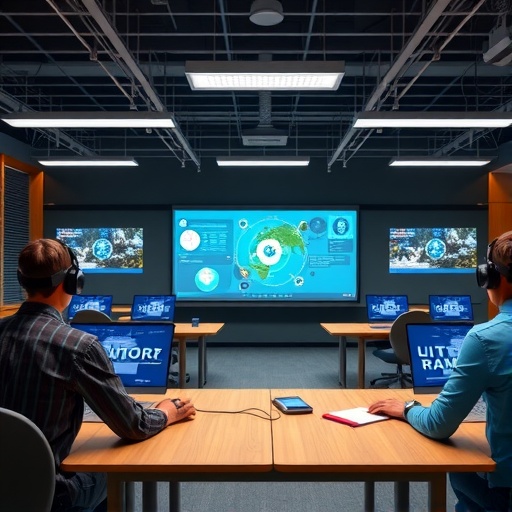
The integration of virtual reality (VR) into agricultural science education is revolutionizing the way students engage with this vital field. At the forefront of this innovation, researchers at the University of Tennessee Institute of Agriculture are pioneering new methods to empower educators with immersive technology. Through a significant USDA grant totaling half a million dollars, their initiative builds upon prior successes to extend VR’s transformative reach in secondary education. This latest project focuses not only on exposing students to cutting-edge experiences but also on enabling teachers to design tailored virtual environments relevant to agricultural science.
Virtual reality serves as a unique medium capable of creating fully immersive, interactive environments that transcend the limitations of traditional classroom settings. The University of Tennessee team, led by Assistant Professors Taylor Ruth and Tyler Granberry, alongside Professor Nathan Conner from the University of Nebraska-Lincoln, is capitalizing on this potential to enrich agricultural education. Their approach involves equipping educators with both the hardware and pedagogical skills necessary to embed VR-based learning into their curricula effectively. Notably, the original Agriscience Metaverse Academy (AMA) initiative in 2024 provided 28 teachers with Meta Quest 2 VR headsets and 360-degree cameras, facilitating hands-on interaction with immersive technology.
The foundational AMA workshop demonstrated compelling benefits; teachers gained confidence in integrating VR tools, overcame logistical and managerial challenges related to VR deployment, and introduced their students to novel experiential learning modalities. Crucially, the use of VR sparked heightened interest among students in agricultural topics, suggesting that immersive technologies offer a pathway to deepen agricultural literacy. However, early feedback underscored a critical gap: the scarcity of high-quality, agriculture-specific VR content limits the technology’s broader impact. This insight inspired the research team to shift focus from mere VR utilization towards empowering educators as creators of specialized virtual content.
To address this content gap, the new USDA-funded project will launch two interlinked professional development programs. The first, “Advanced AMA: Content Creators,” will engage a select group of ten agriscience educators in an immersive, year-long curriculum emphasizing VR content production. This program will culminate in a unique field experience in Maine, where participants will capture 360-degree video footage to construct authentic virtual field trips. These immersive experiences will enable students to explore geographically diverse agricultural settings that would otherwise be inaccessible, fostering a deeper understanding of crop systems, ecosystems, and resource management.
Preceding their Maine expedition, teachers in Advanced AMA will undergo an intensive online training module. Here, they will acquire advanced technical skills in 360-degree video capture and editing, alongside instructional design strategies rooted in problem-based learning. This pedagogical framework encourages critical thinking and situational problem solving within VR environments, enhancing both content retention and student engagement. Importantly, the focus on VR lesson development ensures that teachers don’t merely use prepackaged content but actively tailor virtual experiences to their contextual classroom needs.
Emerging content from Advanced AMA will be disseminated through AMA: Cohort II, a parallel five-day workshop offered to twenty high school agriscience teachers across Tennessee and Nebraska. This cohort will benefit from access to the newly developed virtual field trips and accompanying VR lessons, along with upgraded Meta Quest 3 headsets, facilitating state-of-the-art immersive learning. As peer mentors, the Advanced AMA graduates will guide Cohort II participants in adapting and expanding VR-enriched curricula, creating a sustainable model of knowledge transfer and technological adoption within the secondary education landscape.
The research team’s comprehensive evaluation of these professional development efforts focuses on assessing the impact VR integration has on agricultural literacy. Through longitudinal studies, they aim to determine changes in student motivation, conceptual understanding, and career interest in agriculture-related fields resulting from VR-enhanced lessons. Early indicators from the 2024 AMA project suggest that experiential VR learning supports a more engaging and interactive pedagogical context, with students expressing increased curiosity and enthusiasm.
Underpinning this initiative is a strategic vision to create an expansive digital repository—an innovative website platform housing all VR lesson plans, virtual field trips, and training materials generated through the AMA programs. This centralized resource will democratize access to bespoke agricultural VR content, enabling educators nationwide to incorporate immersive learning without prohibitive infrastructural investments. Hence, scalability and sustainability are embedded within the project’s design, aligning with land-grant university principles of outreach and community engagement.
The scientific advancement embodied in this project rests on the synthesis of immersive technology, agricultural education, and cognitive pedagogy. By marrying VR’s capability to simulate authentic environments with problem-based learning’s emphasis on critical reflection, the program fosters transferable analytical skills in students. Moreover, training teachers as content creators ensures curricula stay relevant, dynamic, and closely connected to real-world agricultural challenges, such as sustainable resource management, climate impact adaptation, and precision farming techniques.
In summation, the University of Tennessee’s Agriscience Metaverse Academy represents a groundbreaking venture into the frontier of educational technology application within agricultural sciences. With USDA’s substantial support, this multidimensional program promises not only to amplify students’ learning experiences but also to cultivate an ecosystem of educators adept in VR pedagogy and content development. As agriculture continues to evolve amid technological and environmental shifts, preparing the next generation through immersive education is both timely and imperative.
The University of Tennessee Institute of Agriculture, leveraging its land-grant mission, continues to innovate at the intersection of research, teaching, and outreach. The embedding of virtual reality into agriscience education epitomizes Real. Life. Solutions. for Tennesseans and communities beyond, equipping future farmers, scientists, and policymakers with the skills and knowledge essential for advancing sustainable agriculture in a digitally enhanced era.
News Publication Date:
2024
Web References:
Cite Scienmag News
Courtney Benton. (May 28, 2026). UTIA Faculty Drive Expansion of Virtual Reality Resources in Classrooms. Scienmag. https://scienmag.com/utia-faculty-drive-expansion-of-virtual-reality-resources-in-classrooms/
Courtney Benton. "UTIA Faculty Drive Expansion of Virtual Reality Resources in Classrooms." Scienmag, 28 May 2026, https://scienmag.com/utia-faculty-drive-expansion-of-virtual-reality-resources-in-classrooms/. Accessed 5 September 2026.
Courtney Benton. "UTIA Faculty Drive Expansion of Virtual Reality Resources in Classrooms." Scienmag. May 28, 2026. https://scienmag.com/utia-faculty-drive-expansion-of-virtual-reality-resources-in-classrooms/


