


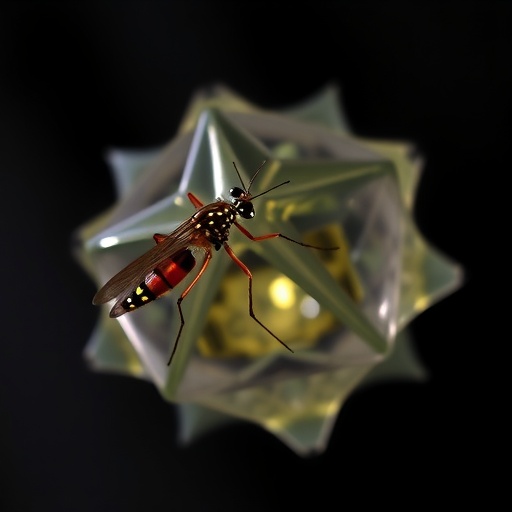
Malaria, caused by parasites of the genus Plasmodium, continues to devastate millions worldwide, disproportionately affecting some of the most vulnerable populations. This parasitic disease presents a formidable challenge to global health due to the complex life cycle of the Plasmodium species, which resides both in human hosts and mosquito vectors. Traditionally, antimalarial drugs have targeted a specific stage in the parasite’s development, failing to provide a comprehensive eradication of the infection. However, a breakthrough study by Kancharla, Dodean, Li, and colleagues outlines a potent acridone derivative demonstrating robust activity against all three primary life stages of Plasmodium, marking a paradigm shift in antimalarial therapy.
The research, recently published in Nature Communications, reveals a novel acridone-based compound exhibiting remarkable efficacy against the liver stage, blood stage, and sexual stage gametocytes of Plasmodium. This trifecta action addresses a long-standing gap in malaria treatment by not only curing the symptomatic blood-stage infection but also eradicating the liver-stage parasites—the silent reservoir responsible for recurring infections—as well as blocking transmission by targeting sexual-stage gametocytes ingested by mosquitoes.
Central to this discovery is the acridone chemical scaffold, a heterocyclic compound long studied for its potential antimicrobial properties but until now underexplored as an antimalarial agent. The compound’s unique mode of action involves interfering with multiple biochemical pathways pivotal for parasite survival and replication, as elucidated through advanced molecular assays and structural analyses. Specifically, the acridone derivative disrupts mitochondrial electron transport within hepatic and erythrocytic parasites, induces oxidative stress leading to parasite cell death, and inhibits gametocyte maturation, thereby halting transmission at its source.
The development of this compound involved sophisticated structure-activity relationship (SAR) studies whereby medicinal chemists fine-tuned the acridone core to maximize antiplasmodial activity while minimizing potential cytotoxicity to host cells. This meticulous optimization process led to a candidate with a favorable therapeutic index and pharmacokinetic profile suitable for both prophylactic and therapeutic applications.
Preclinical in vivo studies using murine malaria models demonstrated striking outcomes, with treated subjects exhibiting complete parasite clearance without recrudescence. Moreover, transmission-blocking assays, involving laboratory-reared Anopheles mosquitoes, confirmed that the treatment significantly reduced gametocyte viability, thereby drastically decreasing the likelihood of onward transmission to human populations.
Importantly, this compound’s efficacy extends across multiple Plasmodium species, including the most lethal P. falciparum as well as P. vivax, which poses additional challenges due to its dormant liver hypnozoite forms. The capability of the acridone to act on these elusive hypnozoites suggests potential utility in radical cure regimens, something currently unattainable with existing antimalarials like artemisinin-based combination therapies (ACTs) and primaquine.
Mechanistically, the acridone derivative appears to target both mitochondrial respiratory chain complexes and DNA topoisomerases, critical enzymes for parasite survival in diverse environments within the human host. This dual targeting reduces the likelihood of resistance development, a persistent issue with monotherapy regimens. Genomic analyses of treated parasites failed to reveal any immediate resistance-conferring mutations, highlighting the compound’s robust therapeutic potential.
Beyond laboratory efficacy, the pharmacodynamic properties reveal a long half-life and good oral bioavailability, characteristics essential for real-world deployment in endemic regions where adherence and healthcare access can be inconsistent. Additionally, the compound shows a promising safety profile in toxicity assays, suggesting that it could be integrated into existing malaria control programs with minimal adverse effects.
The discovery emerges at a critical juncture as malaria incidence and drug resistance threaten recent gains made in disease control. The World Health Organization reports an alarming resurgence in certain regions, fueled by the spread of artemisinin-resistant Plasmodium strains and socio-economic disruptions caused by the COVID-19 pandemic. In this context, the acridone antimalarial represents a beacon of hope, embodying a next-generation therapeutic that could curtail the malaria burden more effectively than ever before.
Scientific experts hail the study for its comprehensive approach, combining medicinal chemistry, parasitology, molecular biology, and vector transmission science to develop an innovative solution to a multifaceted global health challenge. The multifunctional nature of this compound redefines the strategy for antimalarial drug discovery, underscoring the value of targeting multiple biological pathways and parasite stages concurrently.
Looking ahead, the researchers emphasize the necessity of advancing this compound through clinical trials to evaluate its efficacy, dosing regimens, and safety in human populations. Collaborations with global health organizations and pharmaceutical partners are already underway to expedite this process, aiming at the compound’s availability in malaria-endemic countries within the next decade.
This landmark study not only reinvigorates hope in malaria eradication efforts but also sets a precedent for the treatment of other complex parasitic diseases. The successful targeting of multiple life stages within the parasite’s cycle highlights the potential for therapeutic innovations grounded in deep biochemical understanding and interdisciplinary research.
In conclusion, the potent acridone antimalarial fills a longstanding void in the fight against malaria by offering a comprehensive solution that targets the parasite across every critical phase of its lifecycle. If its promise in human populations is realized, this compound could revolutionize malaria treatment paradigms, reduce transmission rates dramatically, and bring the global health community a decisive step closer to eradicating one of humanity’s deadliest scourges.
Cite Scienmag News
Ophelia Keating. (April 14, 2026). Potent Acridone Targets All Malaria Parasite Stages. Scienmag. https://scienmag.com/potent-acridone-targets-all-malaria-parasite-stages/
Ophelia Keating. "Potent Acridone Targets All Malaria Parasite Stages." Scienmag, 14 April 2026, https://scienmag.com/potent-acridone-targets-all-malaria-parasite-stages/. Accessed 4 September 2026.
Ophelia Keating. "Potent Acridone Targets All Malaria Parasite Stages." Scienmag. April 14, 2026. https://scienmag.com/potent-acridone-targets-all-malaria-parasite-stages/


