


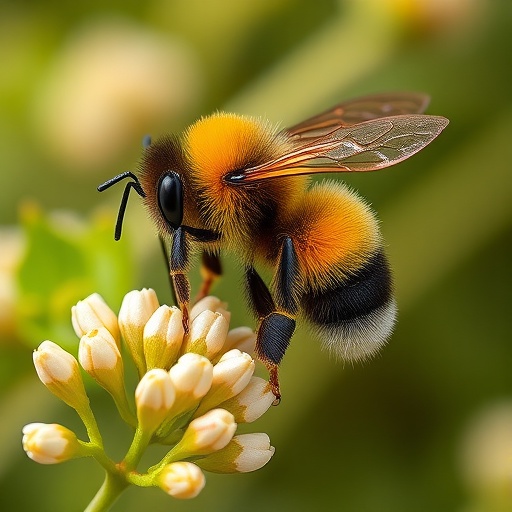
In a breakthrough that could revolutionize the production of fortified plant-based dairy alternatives, researchers at the DTU National Food Institute have pioneered a high-throughput screening method for identifying bacteria capable of producing vitamin B2, or riboflavin, directly within plant-based beverages. This innovative approach leverages droplet microfluidics technology to encapsulate individual bacterial cells from bumblebee gut microbiomes into microscopic droplets, allowing researchers to analyze thousands of bacterial cultures simultaneously with unprecedented speed and precision.
Vitamin B2 deficiency is a notable limitation in many plant-based milk alternatives, such as soy, rice, and oat drinks, which typically contain reduced levels of essential vitamins and minerals compared to traditional cow’s milk. Addressing this nutritional gap, the team explored the diverse microbial communities harbored within bumblebee guts—organisms naturally adapted to plant-associated environments—to pinpoint bacterial strains proficient in riboflavin biosynthesis during fermentation. This ecological choice was motivated by the hypothesis that these gut microbes possess inherent capabilities to thrive in and metabolize components of plant-derived substrates.
The core of this groundbreaking research is the application of droplet microfluidics, a technique that compartments single bacterial cells into picoliter-volume droplets acting as individual, isolated bioreactors. These droplets, resembling tiny sealed capsules, facilitate single-cell microbial growth and metabolic activity assays in parallel, circumventing the limitations of conventional agar plate methods that are labor-intensive and often unable to capture the full functional diversity of complex microbiota. By integrating an ultra-transparent soy-based medium, the researchers overcame the challenge posed by the natural turbidity of soy drinks that typically interferes with fluorescent detection.
This advanced screening platform allowed the researchers to introduce roseoflavin, a riboflavin analog that selectively promotes the proliferation of bacteria adept at producing vitamin B2, thereby enriching the pool for candidate strains. Fluorescence-based detection was utilized to identify droplets exhibiting high riboflavin accumulation, as elevated fluorescence signals serve as a direct proxy for enhanced vitamin biosynthesis. The entire droplet screening process proved remarkably time-efficient, with the potential to evaluate millions of microbial cells in a matter of hours, dramatically expediting the discovery pipeline for novel starter cultures.
Among the isolated strains, a particular bacterium classified as Lactococcus lactis NFICC2835 demonstrated exceptional capability in augmenting riboflavin levels during fermentation of soy drinks. Notably, this lactic acid bacterium maintained high production rates of vitamin B2 even in environments fortified with exogenous riboflavin, indicating a robust metabolic capacity that is stable across varying substrate conditions. Moreover, its versatility in metabolizing diverse carbohydrates further underscores its suitability as a starter culture for a wide array of plant-based fermentation products.
While Lactococcus lactis NFICC2835 thrived in soy beverages, its performance in other plant drinks such as those derived from rice, oats, and almonds was comparatively diminished. The research team attributed this disparity to the lower protein content in these alternatives, highlighting the critical role of fermentable proteins in supporting bacterial growth and riboflavin biosynthesis. This insight provides valuable guidance for optimizing fermentation recipes to maximize nutritional enhancements in different plant-based matrices.
Beyond identifying riboflavin producers, this droplet microfluidics methodology boasts broader implications for microbial screening in food science. By adapting the system to detect fluorescence signals linked to various bioactive compounds, researchers can potentially accelerate the discovery of microorganisms that generate a spectrum of desirable substances, from vitamins to flavor precursors. Critical to the method’s versatility is the introduction of low-fluorescence, transparent media that enable sensitive and interference-free measurements within complex plant-derived liquids.
The implications of this work extend beyond health-conscious consumers seeking nutrient-enriched plant-based alternatives. The cultivation of riboflavin-producing bacteria derived from bumblebee gut microbiota exemplifies an eco-friendly and sustainable approach to microbial strain sourcing, tapping into natural biodiversity and minimizing reliance on genetically modified organisms or synthetic additives. Furthermore, the droplet-based screening paradigm exemplifies how microfluidics can harness single-cell resolution to unlock hidden microbial traits, potentially transforming food biotechnology and fermentation science.
Technically, the successful implementation of the transparent soy medium was integral to the platform’s effectiveness. Traditional soya beverages’ opacity and particulate matter cause signal dampening and droplet instability, complicating fluorescence assays. By engineering a medium with minimal background fluorescence and enhanced optical clarity, the researchers ensured consistent droplet formation and reliable fluorescent readouts, both prerequisites for high-throughput microfluidic analysis. This methodological innovation opens avenues for screening microbial activities in other complex food matrices previously considered unsuitable for droplet analyses.
This investigation also leveraged the MALDI-TOF Biotyper technology, part of DTU National Food Institute’s FOODHAY research infrastructure, enabling precise bacterial identification and characterization post-screening. This complementary technique validates the microbial taxonomy and facilitates strain selection based on both functional and genetic criteria, streamlining the development of tailored starter cultures optimized for plant-based fermentations.
Importantly, the research was conducted with full transparency regarding conflicts of interest, ensuring scientific integrity. The funders, including Novonesis, the Innomission REPLANTED project, DTU, and FoodHay, had no influence on data interpretation or manuscript preparation. This transparent funding disclosure reinforces the credibility of the findings presented and supports the independent validation of the methods and outcomes.
Looking ahead, the application of droplet microfluidics in microbial screening promises to accelerate innovation not only in enhancing plant-based dairy alternatives but also in the broader landscape of functional foods and personalized nutrition. As the demand for plant-based products continues to surge globally, innovations like this promise to bridge nutritional gaps, enrich product quality, and reduce the environmental footprint of food production through microbial biotechnologies.
In sum, this pioneering work showcases how integrating microfluidic technologies, ecological microbiology, and food science can yield transformative solutions to long-standing challenges in plant-based nutrition. By unlocking hidden microbial diversity at the single-cell level, the researchers have paved the way for more efficient, targeted discovery of functional starter cultures, enabling the next generation of nutrient-enriched, sustainable plant-based fermented foods.
News Publication Date:
1-Feb-2026
Web References:
https://www.sciencedirect.com/science/article/pii/S0023643826000460
Cite Scienmag News
Morgan Morrow. (April 10, 2026). Bumblebee Bacterium Enables Vitamin B2 Production in Soya Drinks. Scienmag. https://scienmag.com/bumblebee-bacterium-enables-vitamin-b2-production-in-soya-drinks/
Morgan Morrow. "Bumblebee Bacterium Enables Vitamin B2 Production in Soya Drinks." Scienmag, 10 April 2026, https://scienmag.com/bumblebee-bacterium-enables-vitamin-b2-production-in-soya-drinks/. Accessed 3 September 2026.
Morgan Morrow. "Bumblebee Bacterium Enables Vitamin B2 Production in Soya Drinks." Scienmag. April 10, 2026. https://scienmag.com/bumblebee-bacterium-enables-vitamin-b2-production-in-soya-drinks/


