


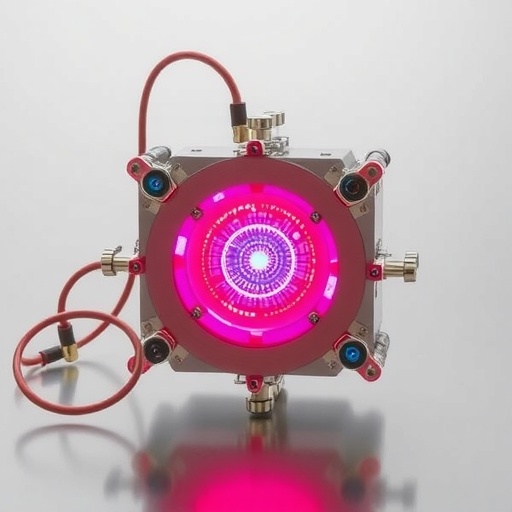
In a groundbreaking advance that could transform antimatter research, physicists at Johannes Gutenberg University Mainz (JGU) and the Helmholtz Institute Mainz have developed a novel dual-frequency Paul trap capable of confining particles with vastly different mass and charge requirements within a single apparatus. By harnessing simultaneous radiofrequency fields at both megahertz (MHz) and gigahertz (GHz) frequencies, this innovative trap can capture heavy calcium ions alongside lightweight electrons, a feat previously unattainable with standard single-frequency Paul traps.
Radiofrequency traps, commonly known as Paul traps, have served as essential tools in experimental physics for decades, using oscillating electric fields to confine charged particles in space. Traditionally, these devices operate at a single frequency optimized to trap a specific type of particle, limiting their versatility. Electrons, with their minuscule mass, demand high-frequency fields on the order of GHz for stable confinement, whereas heavier ions or antiprotons require oscillations in the MHz range. This divergence in trapping conditions has presented a formidable hurdle in experiments aiming to co-trap distinct particle species simultaneously.
The Mainz research team, led by Professor Dmitry Budker within the PRISMA++ Cluster of Excellence and in collaboration with Professor Ferdinand Schmidt-Kaler at JGU and Professor Hartmut Häffner’s group at UC Berkeley, circumvented this limitation by engineering a trap that overlays two discrete frequency fields. This design employs three intricately assembled printed circuit boards (PCBs), separated by ceramic spacers to ensure precision and stability. The central PCB houses a coplanar waveguide resonator generating GHz-frequency fields specialized for electron confinement, while the sandwiching top and bottom PCBs incorporate segmented direct current (DC) electrodes producing the lower MHz-frequency fields tailored for calcium ion trapping.
To validate their concept, the physicists utilized electrons and calcium-40 ions (40Ca+) as surrogates for the more elusive positrons and antiprotons needed for antihydrogen synthesis. Neutral calcium atoms were photo-ionized through a carefully calibrated two-photon excitation scheme using lasers at 423 nm and 390 nm wavelengths to produce trapped ions and electrons within the apparatus. Through precise timing of voltage pulses applied to the DC electrodes, particles could be stored for durations ranging from mere milliseconds to several seconds before extraction and detection.
While the trap successfully confined either electrons or ions independently, simultaneous capture revealed unexpected challenges. Electrons demonstrated significant sensitivity to variations in the amplitude of the low-frequency MHz fields used for ion trapping; increasing this amplitude correlated strongly with elevated electron loss. In contrast, calcium ions exhibited remarkable resilience against fluctuations in the GHz fields designed for electron confinement. This asymmetric sensitivity underscores the complex interplay between multiple trapping frequencies and particle dynamics within the confined space.
Moreover, mechanical factors intrinsic to the construction of the trap impose additional limitations. Surface roughness on the electrodes, minor misalignments of the composite PCBs, and dielectric charging effects collectively degrade the trap’s performance and stability. To address these issues, the research group plans to transition to next-generation hardware employing laser-etched electrodes with reduced surface imperfections and enhanced thermal stability, alongside refined assembly techniques to minimize mechanical mismatches.
The implications of this pioneering work are profound. Achieving the ability to confine particles as disparate as antiprotons and positrons in the same ultra-high vacuum environment paves the way for more efficient synthesis and study of antihydrogen, the antimatter counterpart of hydrogen. As antihydrogen consists simply of an antiproton bound to a positron, stable trapping of both constituents is crucial for high-precision tests of fundamental symmetries and gravity’s influence on antimatter—key unanswered questions in modern physics.
Currently, antihydrogen production depends heavily on facilities like CERN’s Antimatter Factory, which supplies antiprotons. Breakthroughs in transporting these particles, recently confirmed through successful vehicular movement of antiprotons over large distances, hint at a future where complex antimatter experiments could be decentralized. Professor Budker highlighted ongoing technological hurdles such as maintaining long-term cryogenic conditions necessary for antiproton storage, but expressed optimism about the feasibility of wider access to antimatter research tools.
Beyond facilitating antihydrogen synthesis, the dual-frequency trap opens avenues for experimental verification of exotic theoretical predictions involving positrons. Positrons are hypothesized to transiently bind with ordinary atoms, forming short-lived complexes that can elucidate fundamental particle interactions. This trap’s capacity to confine electrons at GHz frequencies alongside ions at MHz frequencies allows physicists to explore such phenomena in controlled laboratory conditions for the first time.
This innovative hardware thus stands at the intersection of atomic physics, quantum optics, and antimatter science, promising to accelerate discoveries with implications ranging from tests of the Standard Model to quantum information processing. As the team at Mainz refines their trap design and explores its multifaceted capabilities, they anticipate a suite of groundbreaking experiments that will deepen our understanding of matter, antimatter, and the universe’s fundamental forces.
This research exemplifies the power of interdisciplinary collaboration, integrating specialized hardware design, laser physics, and quantum theory to overcome entrenched experimental limitations. The creative application of dual-frequency trapping marks a pivotal step in particle manipulation technology, catalyzing progress in one of physics’ most enigmatic frontiers.
As further improvements enhance trap stability and longevity, the scientific community eagerly awaits results from upcoming studies probing antihydrogen production efficiency, precision spectroscopy, and positron-atom interactions. The dual-frequency Paul trap embodies a new era of experimental finesse, transforming how researchers approach the challenge of mastering antimatter and its myriad mysteries.
News Publication Date: 1-Apr-2026
Web References: https://mediasvc.eurekalert.org/Api/v1/Multimedia/b1842c9c-44fd-4a2d-a580-a77c3ca5a8ba/Rendition/low-res/Content/Public, DOI: 10.1103/q5kr-5dp7
References: Physical Review A (Published article)
Keywords
Dual-frequency Paul trap, electron confinement, calcium ion trapping, antihydrogen synthesis, radiofrequency trapping, coplanar waveguide resonator, photo-ionization, antimatter research, particle physics, Gustav Paul trap, GHz and MHz fields, quantum optics
Cite Scienmag News
Bethany Barker. (April 10, 2026). Breakthrough in Mainz: New Dual-Frequency Paul Trap Achieves Milestone Toward Antihydrogen Creation. Scienmag. https://scienmag.com/breakthrough-in-mainz-new-dual-frequency-paul-trap-achieves-milestone-toward-antihydrogen-creation/
Bethany Barker. "Breakthrough in Mainz: New Dual-Frequency Paul Trap Achieves Milestone Toward Antihydrogen Creation." Scienmag, 10 April 2026, https://scienmag.com/breakthrough-in-mainz-new-dual-frequency-paul-trap-achieves-milestone-toward-antihydrogen-creation/. Accessed 3 September 2026.
Bethany Barker. "Breakthrough in Mainz: New Dual-Frequency Paul Trap Achieves Milestone Toward Antihydrogen Creation." Scienmag. April 10, 2026. https://scienmag.com/breakthrough-in-mainz-new-dual-frequency-paul-trap-achieves-milestone-toward-antihydrogen-creation/


