


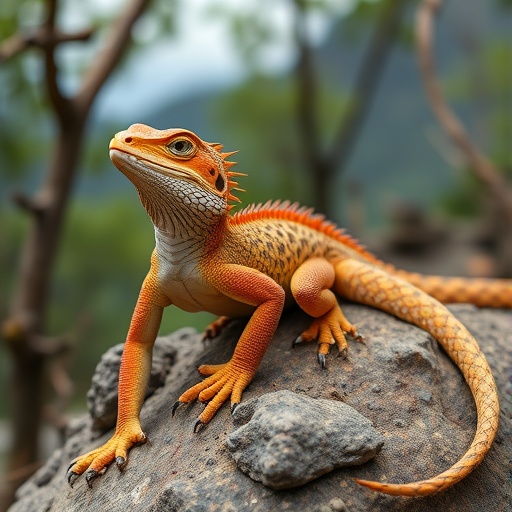
Scientists have identified a new species of mountain horned dragon in the high-elevation forests of western Thailand, and its name has already captured the imagination of fantasy fans. The lizard, formally described as Acanthosaura syrax, is named after Syrax, the golden dragon ridden by Queen Rhaenyra Targaryen in the television series House of the Dragon. Beneath the pop-culture reference, however, lies a scientifically significant discovery: a highly localized reptile with distinctive anatomy, a unique genetic profile and a potentially vulnerable future.
The new species was found in evergreen forest within Mae Wong National Park, in Thailand’s Tak–Kamphaeng Phet Province. Its known habitat lies above approximately 1,300 metres, where steep mountain terrain, cooler conditions and dense vegetation create an isolated ecological zone. The researchers report that A. syrax appears to be restricted to this high-altitude environment and has not been recorded elsewhere. Its discovery brings the number of recognized species in the genus Acanthosaura to 23.
Mountain horned dragons are agamid lizards known for the dramatic spines and scales that extend along the neck and back. These structures vary considerably among species and are important features for identifying closely related animals. In A. syrax, the crest scales are exceptionally small—the smallest recorded in the genus—while the lizard itself is also among the smallest known Acanthosaura. Its body is covered in yellowish-green tones, a coloration that helped inspire the connection with the fictional dragon Syrax.
The choice of name was not based on appearance alone. In the fantasy world of House of the Dragon, Syrax is noted for her yellow colouring, relatively modest size compared with other dragons and unusually high egg production. The research team found striking parallels in the real reptile. Acanthosaura syrax displays yellow-green coloration, has a small body size and produces relatively large clutches of eggs for its dimensions. The researchers have proposed “Syrax mountain horned dragon” as the English common name, with a corresponding Thai name carrying the same meaning.
The species can also be distinguished from related mountain horned dragons by several visible traits. Unlike a number of other members of the genus, A. syrax lacks the conspicuous black patch surrounding the eye. It instead possesses a characteristic dark collar marking, together with its unusually reduced neck and dorsal crest scales. These features provide a practical way to separate it from similar-looking species in the field, although the researchers relied on a combination of morphology and molecular evidence to establish its status.
To test whether the lizard was genuinely a previously unknown species, the team analysed two mitochondrial genes and compared the results with genetic data from other Acanthosaura. The DNA evidence placed A. syrax as genetically distinct from its closest relative, Acanthosaura lepidogaster, as well as from the other known species in the genus. This genetic separation, combined with the lizard’s body proportions, coloration, scale pattern and reproductive traits, supported the designation of A. syrax as a new species rather than a regional form of an existing one.
The discovery also highlights how much biodiversity can remain hidden in mountain forests. High-elevation habitats are often fragmented naturally by ridges, valleys and abrupt changes in temperature and vegetation. For a small forest reptile with limited ability to disperse across unsuitable terrain, those barriers can divide populations and encourage genetic divergence over time. The researchers say the populations of A. syrax are naturally scattered across the rugged mountain landscape, making the species especially dependent on the continued integrity of its restricted habitat.
That dependence could become a conservation concern. Although the new lizard occurs inside Mae Wong National Park, legal protection does not necessarily eliminate threats to high-altitude ecosystems. Changes in forest conditions, human disturbance, climate shifts and the degradation of localized breeding areas could affect a species that appears to occupy only a narrow environmental band. Because its full distribution and population size remain uncertain, further surveys will be needed to determine how widespread it is, how many individuals survive and whether its habitat is declining.
The researchers suggest that A. syrax could become a flagship species for protecting Mae Wong’s high-elevation forests. The park supports other rare and threatened wildlife, including the Asian forest tortoise, Oldham’s leaf turtle and the Indochinese tiger. By drawing public attention through an accessible and memorable name, the new mountain horned dragon may help connect scientific discovery with conservation action. The study describing the species was published in the open-access journal ZooKeys, turning a creature inspired by fantasy into a real-world symbol of the remarkable, and still incompletely documented, biodiversity of Thailand’s mountains.
News Publication Date: 31-Jul-2026
Web References: https://zookeys.pensoft.net/; https://doi.org/10.3897/zookeys.1287.186636
References: Trivalairat P, Trivalairat K, Moungkhaek N, Caponov S, Lorsunyaluck B (2026). Acanthosaura syrax sp. nov., a new species of mountain horned dragon from high-elevation habitats of western Thailand (Squamata, Agamidae). ZooKeys 1287: 47–76. DOI: 10.3897/zookeys.1287.186636
Cite Scienmag News
Margaret Porter. (August 10, 2026). New Thai mountain dragon lizard named after House of the Dragon’s Syrax. Scienmag. https://scienmag.com/new-thai-mountain-dragon-lizard-named-after-house-of-the-dragons-syrax/
Margaret Porter. "New Thai mountain dragon lizard named after House of the Dragon’s Syrax." Scienmag, 10 August 2026, https://scienmag.com/new-thai-mountain-dragon-lizard-named-after-house-of-the-dragons-syrax/. Accessed 4 September 2026.
Margaret Porter. "New Thai mountain dragon lizard named after House of the Dragon’s Syrax." Scienmag. August 10, 2026. https://scienmag.com/new-thai-mountain-dragon-lizard-named-after-house-of-the-dragons-syrax/


