


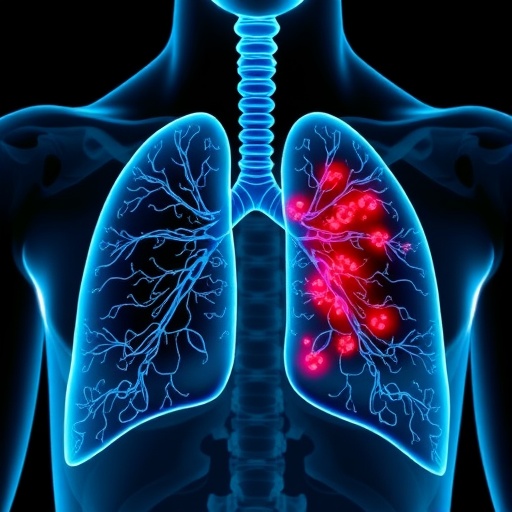
Lung cancer can leave behind a molecular fingerprint long after a surgeon has removed every visible tumor. In a study published in Nature Communications, Zhou, Su, Liang and colleagues examine whether that hidden signal can be used to guide care for people with early-stage, resected non-small cell lung cancer carrying mutations in the EGFR gene. The research focuses on molecular residual disease, or MRD—the presence of tumor-derived genetic material that remains detectable after surgery and may reveal that cancer cells have survived elsewhere in the body.
For patients with early-stage disease, surgery can be curative, but it does not always eliminate the risk of relapse. Conventional scans provide an important view of anatomy, yet they may not detect a small population of cancer cells before it grows into a visible lesion. MRD testing approaches the problem from a different direction. Instead of searching for a mass, it looks for fragments of tumor DNA circulating in the blood. If those fragments persist after resection, they may indicate that microscopic disease remains, even when imaging appears clear.
The study’s focus on EGFR-mutated lung cancer is particularly significant. EGFR mutations can drive the uncontrolled growth of tumor cells and are found in a substantial proportion of lung adenocarcinomas, especially among people who have never smoked or have smoked lightly. These alterations also create an opportunity for precision medicine because they can be targeted by drugs known as EGFR tyrosine kinase inhibitors. The challenge is determining which patients need additional treatment after surgery and which may be spared months or years of therapy and its potential side effects.
Molecular residual disease detection is designed to make that decision more precise. After a tumor is removed, researchers can analyze its genetic profile and identify mutations or other molecular features unique to that cancer. Highly sensitive sequencing methods can then search for matching fragments in subsequent blood samples. The technical difficulty is considerable: tumor DNA may represent only a tiny fraction of all cell-free DNA in the bloodstream, while normal tissues continuously release their own genetic material. A reliable test must therefore distinguish a genuine cancer signal from background noise and laboratory artifacts.
The clinical value of MRD does not rest solely on whether a test can detect DNA. The crucial question is whether the result changes what doctors do and improves outcomes for patients. A positive result might identify people at particularly high risk of recurrence, supporting closer surveillance or consideration of adjuvant targeted treatment. A negative result could help define a group with a lower immediate risk, although it cannot guarantee that a relapse will never occur. The timing of blood collection, the depth of sequencing, the mutation selected for tracking and the duration of follow-up all influence the meaning of a result.
In EGFR-mutated disease, the stakes are amplified by the availability of effective targeted therapies. Drugs such as osimertinib have demonstrated benefits in the postoperative setting, but treatment decisions still require a balance between reducing recurrence risk and avoiding unnecessary exposure. MRD could eventually provide a dynamic measure of disease status, allowing care to become more responsive than a one-time decision based only on tumor stage and pathology. A rising molecular signal might prompt further investigation, while sustained clearance could help doctors assess whether treatment is suppressing residual disease.
The research also highlights why a blood-based test should be interpreted as part of a broader clinical framework rather than as an isolated verdict. A negative result may reflect the biological limits of detection, particularly when a tumor sheds little DNA into the bloodstream. A positive result may require confirmation, because technical contamination or clonal changes in non-cancerous cells can complicate genetic analysis. For this reason, the practical adoption of MRD testing depends on standardized laboratory methods, carefully defined thresholds and prospective evidence connecting test results with treatment decisions and long-term survival.
As precision oncology moves beyond matching drugs to mutations, it is increasingly turning toward the continuous monitoring of disease. The work by Zhou and colleagues places EGFR-mutated early-stage lung cancer within that wider transformation, where molecular information collected after surgery may help reveal what conventional scans cannot yet see. The promise is substantial: earlier recognition of recurrence, more individualized use of targeted therapy and a clearer understanding of who remains at risk. The field’s next challenge is ensuring that molecular signals translate into decisions that are not only technically accurate, but demonstrably better for patients.
Cite Scienmag News
Nathaniel Bowman. (August 10, 2026). Molecular Residual Disease Testing Guides Care After EGFR-Mutated Lung Cancer Surgery. Scienmag. https://scienmag.com/molecular-residual-disease-testing-guides-care-after-egfr-mutated-lung-cancer-surgery/
Nathaniel Bowman. "Molecular Residual Disease Testing Guides Care After EGFR-Mutated Lung Cancer Surgery." Scienmag, 10 August 2026, https://scienmag.com/molecular-residual-disease-testing-guides-care-after-egfr-mutated-lung-cancer-surgery/. Accessed 3 September 2026.
Nathaniel Bowman. "Molecular Residual Disease Testing Guides Care After EGFR-Mutated Lung Cancer Surgery." Scienmag. August 10, 2026. https://scienmag.com/molecular-residual-disease-testing-guides-care-after-egfr-mutated-lung-cancer-surgery/


