


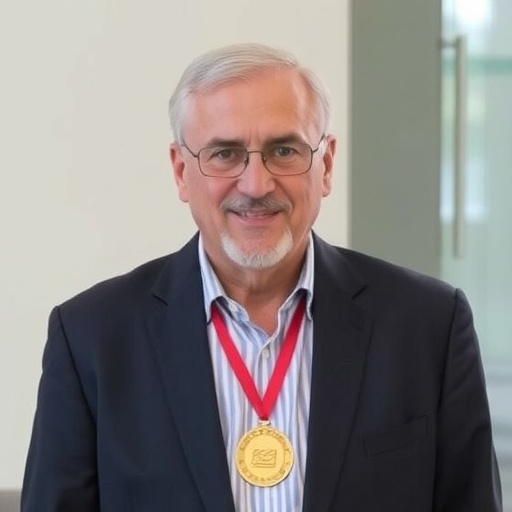
Theoretical physicist and neuroscientist Haim Sompolinsky has been awarded the 2026 Dirac Medal and Prize, one of the most prestigious international honors in theoretical physics. The award, presented by the Abdus Salam International Centre for Theoretical Physics (ICTP), recognizes Sompolinsky alongside Deepak Dhar of the Indian Institute of Science Education and Research Pune, Bernard Derrida of the Collège de France, and Marc Mézard of Bocconi University. Together, the four scientists are being honored for transforming ideas from equilibrium statistical mechanics into powerful tools for understanding complex, dynamic systems, from disordered materials and biological networks to optimization and artificial intelligence.
Established in 1985 in memory of Nobel Prize-winning physicist Paul A.M. Dirac, the Dirac Medal celebrates researchers whose work has produced lasting advances in theoretical physics. The 2026 citation highlights the laureates’ “pioneering contributions to equilibrium statistical mechanics and for extending its concepts and methods into non-equilibrium statistical mechanics, optimization problems, theoretical neuroscience, and, finally, artificial intelligence.” The wording reflects a major scientific trend: methods originally developed to describe atoms, molecules, and magnetic materials are now being used to investigate how brains process information and how machine-learning systems acquire complex abilities.
Sompolinsky is Professor Emeritus at the Hebrew University of Jerusalem’s Edmond and Lily Safra Center for Brain Sciences and Racah Institute of Physics. He is also Professor of Molecular and Cellular Biology and of Physics in Residence at Harvard University. Across a career spanning physics, neuroscience, and computer science, he has helped establish statistical physics as a central framework for studying the collective behavior of neurons. His research has addressed how large populations of interacting cells can generate memory, computation, learning, and the flexible dynamics associated with cognition.
Statistical physics is especially valuable in neuroscience because the brain contains enormous numbers of interacting components whose individual behavior is difficult to predict. Rather than tracking every neuron separately, researchers can describe populations using collective variables, probability distributions, energy-like functions, and order parameters. These tools make it possible to identify transitions between different network states, estimate the stability of memories, and determine how patterns of activity emerge from noisy and seemingly disordered interactions. Sompolinsky’s work has shown how principles used to understand spin glasses and other complex physical systems can illuminate the organization of neural circuits.
One of his influential contributions concerns associative memory, the ability of a network to retrieve a complete pattern from incomplete or corrupted information. In neural-network models, memories can be represented as stable activity configurations. When a partial cue is presented, the system evolves toward the corresponding stored state, much as a physical system settles into a low-energy configuration. Statistical analysis can reveal how many memories a network can store, when those memories interfere with one another, and how connectivity and noise affect recall. These ideas became foundational for theoretical studies of biological memory and influenced later developments in computational learning.
Sompolinsky also made fundamental contributions to the study of chaotic dynamics in recurrent neural networks. In such networks, neurons continuously influence one another through feedback, creating behavior that can be highly sensitive to initial conditions. His research helped clarify when recurrent systems remain stable, when they become chaotic, and how the boundary between order and chaos can support useful computation. A network that is too stable may respond rigidly and possess limited flexibility, while one that is too chaotic may fail to preserve meaningful information. The intermediate regime can allow signals to spread, transform, and remain computationally accessible.
These questions have become increasingly relevant to artificial intelligence. Modern systems, including large neural networks, contain vast numbers of adjustable parameters and display collective properties that cannot be understood by examining one unit at a time. Statistical mechanics provides a language for describing high-dimensional optimization landscapes, phase transitions during training, generalization, and the effects of randomness. Concepts such as attractors, criticality, disorder, and collective modes can help researchers understand why some networks learn robust representations while others become unstable or memorize training data without performing well on new inputs.
The 2026 Dirac Medal therefore recognizes more than a set of isolated discoveries. It celebrates a scientific bridge connecting the mathematics of complex physical systems with some of the most important questions in biology and technology. Dhar, Derrida, Mézard, and Sompolinsky have each contributed to a broader framework in which systems containing many interacting elements can be analyzed through shared principles. Their work shows how equilibrium models, traditionally used to describe systems at rest, can be extended to non-equilibrium settings in which energy, information, and activity continuously flow through the system.
“By forging deep connections between physics, neuroscience, and artificial intelligence, Haim has fundamentally changed the way we understand intelligence, both natural and artificial,” said Tamir Sheafer, President of the Hebrew University of Jerusalem. The university described the award as recognition of Sompolinsky’s scientific vision and interdisciplinary influence. The laureates will receive the medal and prize and deliver lectures during a ceremony at ICTP in Trieste, Italy, in 2027. For neuroscience and AI researchers, the honor underscores the growing importance of theoretical frameworks capable of explaining how intelligence emerges from vast networks of interacting elements.
Web References: Abdus Salam International Centre for Theoretical Physics; The Hebrew University of Jerusalem; Harvard University.
References: 2026 Dirac Medal and Prize citation honoring Haim Sompolinsky, Deepak Dhar, Bernard Derrida, and Marc Mézard.
Keywords
Haim Sompolinsky, Dirac Medal, statistical physics, theoretical neuroscience, neural networks, associative memory, chaotic dynamics, artificial intelligence, Hebrew University of Jerusalem, ICTP.
Cite Scienmag News
Cassandra Pierce. (August 8, 2026). Hebrew University Congratulates Haim Sompolinsky on Receiving 2026 Dirac Medal. Scienmag. https://scienmag.com/hebrew-university-congratulates-haim-sompolinsky-on-receiving-2026-dirac-medal/
Cassandra Pierce. "Hebrew University Congratulates Haim Sompolinsky on Receiving 2026 Dirac Medal." Scienmag, 8 August 2026, https://scienmag.com/hebrew-university-congratulates-haim-sompolinsky-on-receiving-2026-dirac-medal/. Accessed 3 September 2026.
Cassandra Pierce. "Hebrew University Congratulates Haim Sompolinsky on Receiving 2026 Dirac Medal." Scienmag. August 8, 2026. https://scienmag.com/hebrew-university-congratulates-haim-sompolinsky-on-receiving-2026-dirac-medal/


