


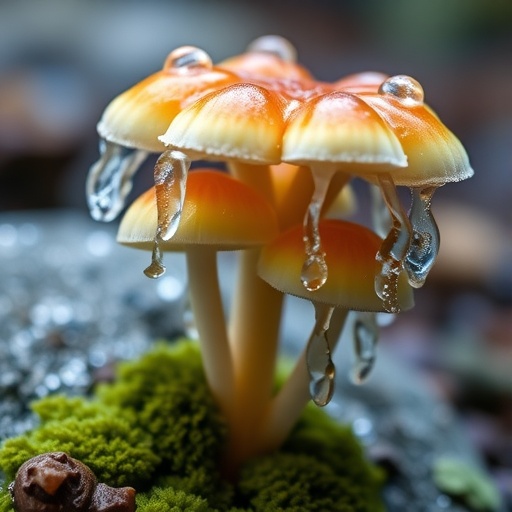
Can fungi influence the weather? Emerging evidence from an international research collaboration suggests they might play an unexpected role in atmospheric processes. This groundbreaking study, which includes key contributions from Virginia Tech scientists Xiaofeng Wang and Boris A. Vinatzer, reveals the discovery of a novel class of fungal ice-nucleating proteins capable of catalyzing ice formation at relatively high subzero temperatures. Their findings, published in the prestigious journal Science Advances, challenge existing paradigms and open new avenues for environmentally sustainable weather modification techniques.
The process of ice nucleation is fundamental to precipitation formation. Within cold clouds, particles known as ice nucleators initiate the crystallization of supercooled water droplets into ice. These nascent ice crystals attract additional water molecules, progressively growing larger and heavier, ultimately falling as snow or melting en route to becoming rain. Traditionally, silver iodide has been deployed as the benchmark ice nucleating agent for cloud seeding projects designed to induce rainfall. However, the high toxicity of silver iodide poses significant environmental risks, necessitating the search for safer alternatives. The fungal ice-nucleating proteins identified in this new research represent a promising candidate.
Professor Boris Vinatzer highlights the potential of these fungal proteins to revolutionize cloud seeding practices. Unlike silver iodide particles, the fungal proteins are water-soluble and cell-free, removing concerns related to toxicity or unintended microbial contamination. Mass production of these proteins could enable the development of a biologically inspired ice nucleator that is inexpensive and ecologically benign. This breakthrough may herald a shift towards sustainable, bioengineered solutions for augmenting precipitation in water-scarce regions, offering profound implications for meteorology and climate interventions.
A particularly captivating aspect of the study lies in the evolutionary origin of these fungal ice-nucleating proteins. Genetic analyses suggest that their encoding genes were horizontally transferred from bacteria to fungi, an event likely occurring hundreds of thousands to millions of years ago. Horizontal gene transfer across kingdoms is an uncommon phenomenon, especially between bacteria and eukaryotic organisms such as fungi. This discovery not only enhances our understanding of microbial evolution but also underscores the complexity of gene flow influencing phenotypic traits critical to environmental interactions.
Advances in DNA sequencing and computational biology were instrumental in pinpointing the specific gene responsible for ice nucleation in fungi belonging to the Mortierellaceae family. This level of precision was unattainable in earlier decades due to technological constraints. Once identified, researchers employed yeast biotechnology techniques, aided by Xiaofeng Wang’s expertise, to validate the gene’s function, confirming its role in ice nucleation. This multidisciplinary approach exemplifies the power of modern genomics to unravel intricate biological mechanisms with environmental significance.
The biochemical distinction of fungal ice-nucleating proteins lies in their solubility and lack of cellular structures, contrasting with bacterial ice nucleators that require intact cells. This difference is consequential for industrial and environmental applications. In food technology, for instance, the water-soluble fungal protein could serve as a pure additive to improve freezing processes without introducing whole bacterial cells or associated impurities. Such specificity enhances safety profiles and regulatory acceptability for frozen food production, suggesting new opportunities in agri-food biotechnology.
Cryopreservation technologies stand to benefit considerably from these fungal ice nucleators as well. Freezing living cells, such as tissues, sperm, eggs, and embryos, demands careful control to avoid ice crystal formation that damages delicate cellular structures. Fungal proteins facilitate the initiation of ice formation at higher subzero temperatures, thereby stabilizing the extracellular environment and protecting cells from mechanical stress during freezing. This method is superior to bacterial nucleators because it obviates the need to expose cells to entire bacterial organisms, reducing contamination risks and improving preservation efficacy.
From a climatological perspective, accurately characterizing ice nucleators in the atmosphere is critical for climate modeling. Ice particles in clouds influence the radiative balance of the Earth by affecting how much solar radiation is reflected back into space versus absorbed at the surface. The presence of fungal ice nucleating molecules complicates previous assumptions that mainly bacterial or mineral ice nucleators dominate cloud processes. Incorporating fungal proteins into climate models could substantially refine predictions of radiation flux, cloud dynamics, and resultant weather patterns, enhancing the precision of forecasting extreme events.
The research trajectory that culminated in these results began with the collaborative efforts of Vinatzer and David Schmale, who initiated ice nucleation studies at Virginia Tech. Their summer research program in Austria provides undergraduate students hands-on experience in atmospheric microbiology and ice nucleation phenomena. This educational initiative underscores the symbiotic relationship between fundamental research, student training, and international scientific advancement. Xiaofeng Wang’s role in confirming the gene identity bridged plant sciences with biotechnology, illustrating the interdisciplinary nature of this endeavor.
Sustained funding from prominent institutions such as the National Science Foundation, Department of Defense, and Air Force Office of Scientific Research enabled this high-impact study. The collective efforts of researchers from a diversity of disciplines and institutions — spanning universities in the United States and research centers in Germany — highlight the global significance and broad interest in uncovering biologically based methods to engineer weather and understand atmospheric processes better.
In conclusion, the discovery of a previously unrecognized class of fungal ice-nucleating proteins with bacterial ancestry introduces a paradigm-shifting perspective on fungal roles in atmospheric science and weather modification. This novel insight not only advances scientific knowledge of ice nucleation at the molecular level but also paves the way for safer, bioinspired applications in cloud seeding, frozen food processing, cryopreservation, and climate modeling. Continued exploration of fungal and microbial interactions with the atmosphere promises to unlock further transformative technologies essential for addressing environmental challenges in a warming world.
News Publication Date: 11-Mar-2026
Web References: https://doi.org/10.1126/sciadv.aed9652
Cite Scienmag News
Roger Howard. (March 17, 2026). Incredible Fungi Discovered That Can Freeze Water. Scienmag. https://scienmag.com/incredible-fungi-discovered-that-can-freeze-water/
Roger Howard. "Incredible Fungi Discovered That Can Freeze Water." Scienmag, 17 March 2026, https://scienmag.com/incredible-fungi-discovered-that-can-freeze-water/. Accessed 6 September 2026.
Roger Howard. "Incredible Fungi Discovered That Can Freeze Water." Scienmag. March 17, 2026. https://scienmag.com/incredible-fungi-discovered-that-can-freeze-water/


