


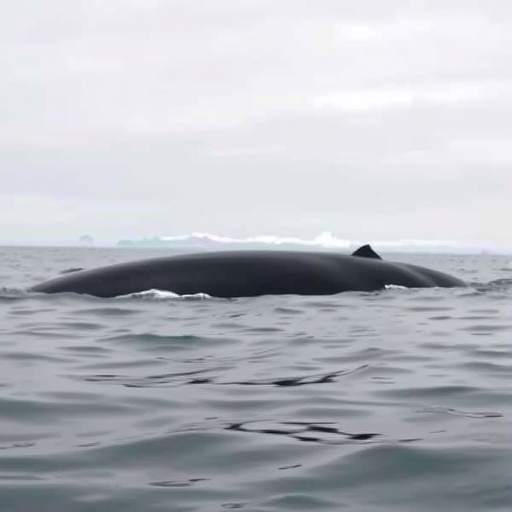
In a landmark study, researchers have unveiled an unprecedented view into the long-term ecological and genetic history of bowhead whales, revealing how centuries of human exploitation have inflicted irreversible damage on this iconic Arctic species. By leveraging an extraordinary collection of whale fossils dating back 11,000 years, an international team led by the University of Copenhagen has deciphered the complex interplay between natural environmental shifts and anthropogenic impacts, offering sobering insights into the species’ fragile future in a rapidly changing world.
Bowhead whales, known scientifically as Balaena mysticetus, are uniquely adapted to Arctic ecosystems, residing year-round in some of the planet’s coldest waters. Their thick blubber, constituting nearly half their body mass, and extraordinary longevity make them biological marvels. Despite millennia of evolutionary resilience to climate fluctuations since the last Ice Age, this recent research demonstrates that four centuries of intense commercial whaling have profoundly eroded their genetic diversity—damage that persists even as populations begin to stabilize.
The study, recently published in the prestigious journal Cell, represents a milestone in marine conservation genetics and paleogenomics. Scientists examined more than 850 radiocarbon-dated fossil bones excavated from key Arctic regions, including the Canadian Arctic Archipelago and Norway’s Svalbard Archipelago. State-of-the-art genomic sequencing and stable isotope analysis were combined with detailed palaeoclimate reconstructions spanning the Holocene epoch. This comprehensive methodology enabled the team to reconstruct bowhead whale population dynamics, genetic structure, and habitat usage over an evolutionary timescale rarely captured in marine megafauna studies.
Findings unveiled an enduring period of demographic stability and genetic diversity in bowhead populations throughout most of the last 11,000 years. However, starting approximately 500 years ago—coinciding precisely with the advent of commercial Arctic whaling—the genetic makeup of these whales underwent a severe contraction. This loss was not merely a function of diminished numbers, but a signal of profound population fragmentation and genetic bottlenecking catalyzed by sustained human hunting pressures.
Lead author Michael V. Westbury, now at the Technical University of Denmark, emphasizes the gravity of these results: “Bowhead whales have weathered dramatic climate oscillations over millennia, yet recent human actions have sharply curtailed the species’ genetic toolkit. This loss diminishes their capacity to cope with forthcoming challenges,” he explains. The study predicts continued genetic erosion in coming generations, even if demographic recovery occurs, posing significant risks to the species’ adaptability in the face of accelerating environmental change.
This disconnect between demographic stability and genetic fragility underscores a critical aspect of conservation biology: population counts alone are insufficient indicators of species health. Genetic diversity functions as an evolutionary reservoir, enabling populations to respond to pathogens, shifting climates, and ecological disruptions. As senior author Eline Lorenzen from the University of Copenhagen notes, “Genetic diversity is essentially the biological Swiss Army knife for survival. Losing it equates to losing the tools necessary to adapt and thrive.”
The origins of this genetic decay trace back to the mid-16th century, when burgeoning demand for whale oil propelled multinational hunting expeditions into the Arctic. English, American, Dutch, German, and Danish whalers established extensive commercial operations, targeting bowhead whales for their blubber which fueled lamps and industry alike. Cultural footprints of this era remain visible today, such as the bone fences on Denmark’s Rømø Island, constructed from bowhead remains retrieved during 17th and 18th-century voyages.
Despite the species-wide extinction threat posed by centuries of hunting, international protective measures were only enacted in the early 20th century. The 1931 moratorium on right whale family hunting marked a turning point, effectively ending commercial exploitation. Unfortunately, the genetic consequences of prior overharvesting continue to echo through the bowhead lineage, illustrating the delayed but enduring impact of intense human predation on genetic health.
This research pioneers the integration of paleogenomics with climate modelling to untangle the complex effects of both natural and anthropogenic influences on marine megafauna. By situating genetic data within a rich environmental context, scientists achieved a finely resolved narrative of bowhead whales’ demographic trajectories, detailing how stable populations suddenly fragmented amidst human exploitation against a backdrop of Holocene ecological shifts.
The implications of these findings extend beyond bowhead whales, serving as a cautionary tale for broader marine conservation efforts. As climate change accelerates variability in Arctic ice cover and habitats, species with diminished genetic diversity face heightened vulnerability. To safeguard their futures, conservation strategies must account for both population numbers and genetic resilience, fostering recovery efforts that preserve or enrich genetic variability.
Moreover, this study exemplifies the power of ancient DNA research to reveal hidden chapters in species’ evolutionary histories. With advances in sequencing technology and interdisciplinary collaborations, paleogenomic insights are revolutionizing our understanding of how historical events continue to shape contemporary biodiversity and ecosystem function.
In sum, the bowhead whale narrative is one of resilience tempered by human-induced fragility. While the species has endured natural climatic upheavals for millennia, the added burden of commercial whaling has inflicted genetic wounds that will challenge its persistence in an uncertain future. The study implores the scientific and conservation communities to incorporate genetic data into management plans, recognizing that “gone is gone” when genetic diversity is lost.
As Arctic ecosystems face unprecedented transformation, understanding the legacy of past human impacts on species like the bowhead whale is essential for crafting effective conservation paradigms. This research not only charts the invisible scars of hunting on a majestic marine mammal but also illuminates a path toward more holistic stewardship of the world’s vulnerable wildlife.
News Publication Date:
17-Mar-2026
Web References:
http://dx.doi.org/10.1016/j.cell.2026.02.022
References:
Published in Cell, 2026
- Fredrik Christiansen (Bowhead whale photograph)
- Art Dyke (Fossil photographs)
- National Maritime Museum, Amsterdam (Painting by Abraham Storck)
- Michael V Westbury (Fossil chronologies)
Cite Scienmag News
Gavin Prescott. (March 17, 2026). Historical Intensive Whaling Jeopardizes the Future of Bowhead Whales. Scienmag. https://scienmag.com/historical-intensive-whaling-jeopardizes-the-future-of-bowhead-whales/
Gavin Prescott. "Historical Intensive Whaling Jeopardizes the Future of Bowhead Whales." Scienmag, 17 March 2026, https://scienmag.com/historical-intensive-whaling-jeopardizes-the-future-of-bowhead-whales/. Accessed 3 September 2026.
Gavin Prescott. "Historical Intensive Whaling Jeopardizes the Future of Bowhead Whales." Scienmag. March 17, 2026. https://scienmag.com/historical-intensive-whaling-jeopardizes-the-future-of-bowhead-whales/


