


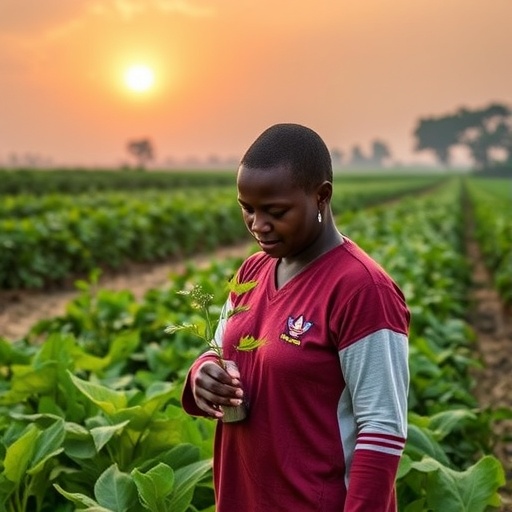
Climate change represents one of the most formidable challenges to global food security, threatening to exacerbate hunger risks across vulnerable regions. While efforts to limit global warming through stringent climate mitigation policies are imperative, these initiatives can paradoxically increase the risk of hunger. This paradox primarily arises because mitigation strategies often involve the expansion of bioenergy production and afforestation, which consume vast areas of arable land, intensifying competition between agriculture and land-use change. However, a novel integrated analysis leveraging advanced global agroeconomic models reveals that reductions in ground-level ozone pollution, a co-benefit of climate mitigation, may partially offset these adverse hunger outcomes.
In their recent study published in Nature Food, an international consortium of researchers from prominent Japanese institutions including The University of Tokyo, Ritsumeikan University, Kyoto University, and the National Institute for Environmental Studies, alongside collaborators worldwide, employed simulations from six state-of-the-art global agroeconomic models. These models encapsulate the intricate dynamics of land use, food availability, pricing, and air pollution under various climate trajectories. By dissecting the multifaceted interplay between climate change, mitigation policies, and tropospheric ozone levels, the study offers a nuanced perspective on future global hunger risks.
The baseline scenario, reflecting a continuation of current climate and air pollution conditions coupled with the SSP2 socio-economic pathway—characterized by moderate population growth and technological advancement—projects an improvement in global food availability by 2050. According to model medians, this trajectory would reduce the global population at risk of hunger by roughly 390 million people compared to 2020 figures, settling around 330 million hungry individuals globally. This projected improvement underscores ongoing gains in agriculture productivity and socio-economic development under a “middle-of-the-road” future scenario.
However, the introduction of ambitious climate mitigation policies consistent with limiting warming to 1.5°C above pre-industrial levels (SSP2-2.6) alters this optimistic outlook. These policies, encompassing carbon pricing and rigorous emissions controls, induce significant cost pressures on agricultural production. Elevated input costs and competition from land-intensive bioenergy and forestry projects drive up commodity prices substantially more than in less stringent warming scenarios (SSP2-7.0). This economic strain reduces overall food availability and is anticipated to increase the global hunger risk by approximately 56 million people by mid-century. The study’s simulations demonstrate how land competition and commodity price inflation constitute substantial barriers to equitable food access under stringent climate pathways.
Intriguingly, the scenario’s concurrent reduction in ozone precursor emissions from fossil fuel combustion and industrial activity leads to decreased ambient ozone concentrations. Tropospheric ozone is a potent phytotoxic pollutant, damaging photosynthetic processes and lowering crop yields across staple cereals and other food crops. The mitigation-induced improvement in air quality directly enhances agricultural productivity by mitigating ozone stress. This positive effect manifests as increased crop yields, dampened food price inflation, and heightened food availability at the global scale.
Quantitatively, the models estimate that by 2050 approximately 8.4 million people—representing about 15% of the additional hunger risk attributable to climate mitigation policies—will be spared from food insecurity due to ozone reduction. This finding highlights the critical but often overlooked role that air quality improvements play in shaping the food security outcomes of climate policy. It suggests that prior assessments which overlooked ozone pollution benefits may have overstated the negative trade-offs of ambitious climate mitigation on hunger.
The spatial distribution of the ozone-related hunger benefits is notably uneven, with the majority concentrated in regions currently bearing the greatest burdens of food insecurity. Sub-Saharan Africa and India together account for approximately 56% of the hunger risk alleviation linked to reduced ozone exposure. These findings emphasize the importance of incorporating regional heterogeneity in both climate impacts and air pollution dynamics within integrated assessment frameworks, as well as tailoring mitigation strategies to local socio-environmental contexts.
This research underscores the complexity inherent in navigating the co-benefits and trade-offs embedded in climate mitigation strategies. Climate policies designed without accounting for interactions between greenhouse gas emissions, air pollutants like ozone, and food system dynamics may yield incomplete or misleading conclusions regarding hunger risk trajectories. The partial offset provided by ozone reduction presents a compelling rationale for integrating air quality management explicitly within climate-food nexus frameworks.
Nonetheless, even with ozone benefits accounted for, stringent mitigation scenarios involve a non-trivial increase in hunger risk unless concomitant measures address land-use competition and food price volatility. Effective policies will require balancing greenhouse gas reductions with sustainable land management, agricultural innovation, and social protection mechanisms. These findings advocate for a holistic design of climate mitigation approaches that embed food security objectives from the outset rather than treating them as ancillary outcomes.
The implications of this study resonate with global efforts to achieve the United Nations Sustainable Development Goals, particularly zero hunger and climate action. It advances the scientific understanding required to develop synergistic policies that minimize unintended negative consequences on vulnerable populations while maximizing environmental co-benefits. By illuminating the pivotal role of ozone pollution control in mediating food security outcomes, this research charts a nuanced pathway forward for climate-food policy integration.
Future research directions should prioritize refining the spatial and temporal resolution of models to capture localized ozone and food system dynamics better. Additionally, incorporating emerging agricultural technologies and adaptive capacity scenarios may further elucidate resilience pathways under varying climate futures. Interdisciplinary collaboration across atmospheric science, agronomy, economics, and social sciences remains critical for addressing the intertwined challenges of climate change and global food security.
In conclusion, while climate mitigation efforts aimed at maintaining global temperature increases below 1.5°C are indispensable, they come with inherent complexities that affect global food systems. The reduction in surface ozone pollution emerges as a critical moderating factor, partially ameliorating the heightened hunger risk posed by land competition and increased food prices. Policymakers must consider these interlinked effects holistically, ensuring that climate action does not inadvertently compromise the fundamental human right to food.
Cite Scienmag News
Russell Cooper. (March 16, 2026). Cutting Air Pollution Through Climate Action May Enhance Crop Yields and Reduce Hunger Risk. Scienmag. https://scienmag.com/cutting-air-pollution-through-climate-action-may-enhance-crop-yields-and-reduce-hunger-risk/
Russell Cooper. "Cutting Air Pollution Through Climate Action May Enhance Crop Yields and Reduce Hunger Risk." Scienmag, 16 March 2026, https://scienmag.com/cutting-air-pollution-through-climate-action-may-enhance-crop-yields-and-reduce-hunger-risk/. Accessed 4 September 2026.
Russell Cooper. "Cutting Air Pollution Through Climate Action May Enhance Crop Yields and Reduce Hunger Risk." Scienmag. March 16, 2026. https://scienmag.com/cutting-air-pollution-through-climate-action-may-enhance-crop-yields-and-reduce-hunger-risk/


