


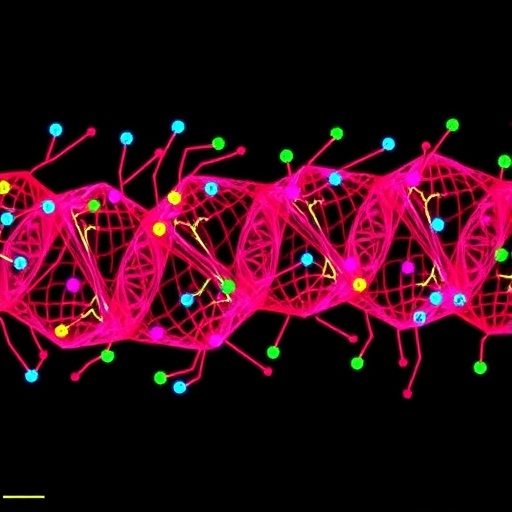
In a groundbreaking development that promises to reshape our understanding of cellular signaling, a team of researchers led by Hardy, Haider, and Patel has identified a novel heteromeric TRP channel that astonishingly functions as a WNT-activated G protein-coupled receptor (GPCR). This discovery, detailed in their 2026 publication in Nature Communications, opens unprecedented avenues in cell biology, pharmacology, and the therapeutic targeting of diseases linked to aberrant WNT signaling pathways.
Transient Receptor Potential (TRP) channels are traditionally recognized as ion channels involved in sensing environmental stimuli such as temperature, pressure, and noxious chemicals. For decades, these channels have been studied predominantly for their ion-conducting properties, contributing to sensory perception and cellular homeostasis. However, the revelation that a heteromeric assembly of TRP subunits can act beyond its classical ion channel role to functionally behave as a G protein-coupled receptor introduces a paradigm shift in receptor biology.
The WNT signaling pathway is one of the most critical and evolutionarily conserved mechanisms that regulate embryonic development, cell proliferation, and tissue homeostasis. Dysregulation of WNT signaling is implicated in numerous pathologies, including cancer, neurodegenerative disorders, and bone density diseases. Historically, WNT proteins exert their effects primarily through Frizzled receptors, which are bona fide GPCRs. The new study’s demonstration that a heteromeric TRP channel can directly act as a WNT-responsive GPCR suggests a hitherto unknown receptor architecture and mode of signal transduction.
Through a series of meticulous electrophysiological experiments, complemented by advanced molecular imaging and genetic manipulation techniques, Hardy and colleagues elucidated how this TRP channel complex integrates WNT ligand engagement with G protein activation. Their data show that upon WNT binding, conformational changes within the heteromeric TRP channel facilitate the recruitment and activation of intracellular heterotrimeric G proteins, thereby triggering downstream signaling cascades traditionally associated with GPCR signaling.
This dual-functional receptor challenges the classical receptor categorization, blurring the lines between ion channel and GPCR functionalities. The heteromeric TRP channel exhibits ligand specificity and signaling versatility that surpasses the scope of its individual subunits. Each subunit contributes unique domains essential for ligand recognition, channel gating, and G protein coupling, enabling the receptor to act as an integrated signaling hub.
Such a receptor composition holds profound implications for pharmacology. Targeting this TRP-GPCR hybrid could yield unprecedented therapeutic opportunities, especially in modulating WNT-dependent pathways involved in oncogenesis and tissue regeneration. The channel’s inherent ion permeability alongside its GPCR competency provides a dual leverage point to fine-tune cellular responses more precisely than with conventional receptor targeting strategies.
Structurally, the study offers tantalizing hints into the mechanistic synergy between the TRP ion conduction pore and the GPCR-like intracellular domains. High-resolution cryo-electron microscopy conducted by the team revealed that the heteromeric complex assembles into a unique conformation not previously observed in either classical TRP channels or GPCRs alone. This structural arrangement facilitates allosteric modulation, where ligand binding induces long-range conformational cascades, enabling G protein engagement without necessarily altering ion conduction directly.
The researchers also investigated the downstream signaling consequences of receptor activation. Their results indicate that G protein activation triggers canonical second messenger systems—including cyclic AMP production and intracellular calcium fluxes—that coordinate diverse cellular processes like gene transcription regulation, cytoskeletal remodeling, and cell motility. This multiplexed signaling underscores the receptor’s functional complexity, bridging membrane excitability with biochemical signaling networks.
Importantly, the discovery of this WNT-activated heteromeric TRP-GPCR offers fresh insights into the modulation of WNT signaling by membrane microenvironments. The receptor’s localization in lipid raft domains suggests spatial regulation of signaling, potentially explaining context-dependent WNT responses in different cell types or disease states. This spatial dimension adds another layer of control, orchestrating signal specificity and intensity.
From a methodological perspective, the team’s integration of genetic knock-in models expressing fluorescently tagged receptor subunits enabled real-time visualization of receptor dynamics in living cells. They demonstrated that receptor assembly, trafficking, and turnover are tightly regulated by cellular cues, ensuring precise control over signal initiation and termination. Such fine-tuning is pivotal in maintaining physiological homeostasis and preventing pathological hyperactivation.
The implications for drug discovery are vast and exciting. The receptor’s dual nature allows for innovative screening strategies combining electrophysiological assays with classical ligand-binding studies. Small molecules or biologics that selectively modulate either the ion channel function or the G protein-coupling ability—or ideally both—could be developed to treat a spectrum of diseases where WNT signaling is aberrant or insufficient.
Moreover, this discovery raises important evolutionary questions about receptor diversification. The heteromeric TRP channel’s ability to act as a GPCR suggests that nature may have evolved multifunctional proteins capable of integrating multiple signaling modalities, thus enhancing cellular adaptability. This evolutionary perspective may inspire synthetic biology approaches aiming to engineer receptors with bespoke functionalities.
The broader scientific community will undoubtedly be energized by this work’s demonstration of unconventional receptor functionality. It invites a reexamination of other ion channels and membrane proteins that might harbor cryptic signaling capabilities, potentially revealing an undiscovered layer of cellular communication complexity.
Future studies will be crucial to delineate the physiological roles of the heteromeric TRP-GPCR in vivo, including its tissue distribution, developmental functions, and involvement in disease mechanisms. Elucidating the interplay between this receptor and canonical WNT-Frizzled pathways will also be essential, especially in understanding how cells integrate multiple extracellular signals to orchestrate coordinated responses.
In conclusion, the identification of a heteromeric TRP channel acting as a WNT-activated GPCR stands as a major milestone illustrating the dynamic and multifaceted nature of membrane receptors. This discovery not only advances fundamental cell biology but also lays the foundation for novel therapeutic strategies targeting a broad array of pathologies with unmet medical needs. As research continues to unravel the complexities of this hybrid receptor, it promises to redefine how scientists conceive of receptor signaling networks and their immense potential in medicine.
Cite Scienmag News
Drew Townsend. (February 26, 2026). New TRP Channel Identified as WNT-Activated GPCR. Scienmag. https://scienmag.com/new-trp-channel-identified-as-wnt-activated-gpcr/
Drew Townsend. "New TRP Channel Identified as WNT-Activated GPCR." Scienmag, 26 February 2026, https://scienmag.com/new-trp-channel-identified-as-wnt-activated-gpcr/. Accessed 3 September 2026.
Drew Townsend. "New TRP Channel Identified as WNT-Activated GPCR." Scienmag. February 26, 2026. https://scienmag.com/new-trp-channel-identified-as-wnt-activated-gpcr/


