


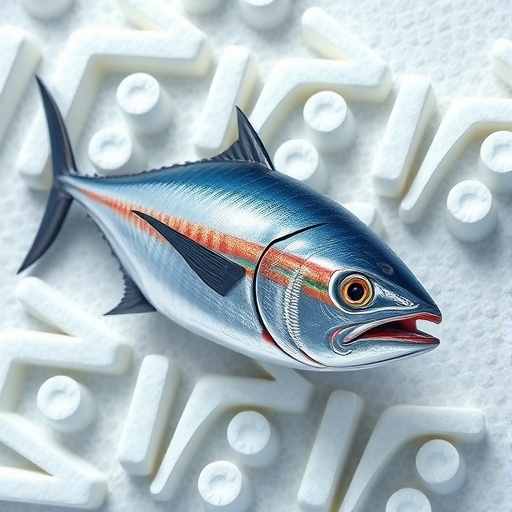
Tsukuba, Japan—A new imaging system could transform the way frozen skipjack tuna are measured, sorted, and processed, bringing three-dimensional machine vision to one of the most demanding environments in the seafood industry. Researchers from the University of Tsukuba, Ishida Tec Co., Ltd., and the Tokyo University of Marine Science and Technology have developed a noncontact method that estimates the body size and weight of frozen fish moving along a conveyor belt. The approach combines time-of-flight sensing, dense 3D point clouds, and machine-learning analysis to overcome a problem that has long limited automated fish inspection: frost-covered surfaces that distort conventional camera images.
Determining the size and weight of fish is essential at several stages of the seafood supply chain. Fisheries managers use body-size information to evaluate stocks and understand the structure of marine populations, while processors rely on accurate weight estimates to sort fish, plan production, and assign products to commercial categories. In many facilities, however, fish are still measured manually or visually graded by experienced workers. These procedures can be slow when thousands of fish arrive in a short period, and their results may vary depending on the operator, working conditions, and the appearance of individual fish.
The challenge becomes especially pronounced for skipjack tuna caught in distant-water fisheries. These fish are commonly frozen soon after capture and remain frozen during transport and processing. Ice crystals and frost can form unevenly across the skin, creating bright, irregular surfaces that strongly reflect visible light. Conventional two-dimensional imaging systems may interpret those reflections as part of the fish’s outline or lose the boundary between the fish and its surroundings. Even when the head-to-tail length can be estimated, important information about the fish’s overall shape may be obscured. This makes it difficult to derive reliable measurements from a single camera view.
The research team addressed this problem with a three-dimensional time-of-flight camera. Instead of relying only on the brightness or color of an image, the system emits infrared light and measures the time required for reflected light to return to the sensor. Because light travels at a known speed, the return time can be converted into the distance between the camera and each point on the fish’s surface. The result is a point cloud: a large collection of spatial coordinates that describes the geometry of the object. By recording thousands of these points as a fish passes beneath the camera, the system can reconstruct the contours of a frost-covered tuna in three dimensions.
This geometric approach offers a crucial advantage over ordinary image analysis. Frost may create intense highlights in a two-dimensional photograph, but the physical location of the surface remains measurable through the depth information captured by the time-of-flight sensor. The resulting point cloud contains the shape of the exposed fish rather than simply its pattern of reflected light. In the study, the researchers used these data to extract three morphometric parameters: body width, fork length, and body height. Fork length is measured from the tip of the fish’s snout to the fork of its tail, while body height describes its vertical thickness. Body width provides an additional dimension across the fish and is particularly valuable because it has been difficult to measure consistently using conventional camera systems.
The inclusion of body width proved to be one of the most important features of the new method. Fish with similar lengths can have substantially different weights depending on their thickness and overall body condition. A length-only model may therefore treat two differently built fish as nearly identical, even though their commercial weights differ. By combining length, height, and width, the researchers captured more of the three-dimensional structure associated with body mass. These measurements were then supplied to machine-learning models designed to estimate the weight of each fish and assign it to the appropriate weight class.
The researchers compared the machine-learning estimates with the classifications produced by experienced market graders. The 3D-based predictions showed closer agreement with the measured weight classes than the judgments made by the graders in the study. The result is significant because visual grading is already performed by skilled professionals who can rapidly assess fish based on appearance, size, and experience. A system that can match or improve upon that consistency could provide processors with a more standardized method while reducing the physical and cognitive demands placed on workers.
The current system remains a proof of concept rather than a fully autonomous production line. Although the acquisition of 3D point-cloud data was automated as the fish traveled on a conveyor belt, the researchers manually selected and extracted the morphometric parameters from the scans. Full deployment would require software capable of recognizing each fish automatically, isolating it from the conveyor and neighboring objects, identifying anatomical landmarks, and calculating width, length, and height without human intervention. The system would also need to operate reliably under changing conditions, including differences in fish orientation, overlapping specimens, conveyor speed, frost thickness, lighting, and surface damage.
Further development could extend the technology beyond weight estimation. A complete automated inspection platform might detect physical defects, classify fish according to condition, monitor size distributions in commercial catches, or provide standardized data for fisheries research. Because the system measures fish without physical contact, it could reduce handling and allow specimens to remain in continuous motion through a processing facility. The same principle may also be adaptable to other frozen seafood products whose surfaces are difficult to analyze with ordinary cameras. Integrating depth sensing with artificial intelligence could ultimately create a faster and more reproducible link between marine-resource management, industrial processing, and digital measurement.
The researchers say their findings demonstrate the potential of 3D imaging to make fish measurement more accurate, consistent, and labor efficient. For fisheries and seafood companies, the technology offers a route toward automated sorting in situations where frost and irregular surfaces defeat traditional computer vision. For resource managers, the ability to collect standardized morphometric information at high speed could support more detailed monitoring of commercially important species. The study, published in Fisheries Research, represents an early step, but it points toward a future in which frozen fish can be scanned, measured, and classified as they move through the supply chain—without scales, calipers, or subjective visual assessment.
News Publication Date: 18 July 2026
Web References: University of Tsukuba Institute of Systems and Information Engineering: https://www.sie.tsukuba.ac.jp/eng/
References: Fisheries Research. DOI: https://doi.org/10.1016/j.fishres.2026.107820
Cite Scienmag News
Teresa Odom. (August 25, 2026). 3D imaging and machine learning improve weight estimates for frozen skipjack tuna. Scienmag. https://scienmag.com/3d-imaging-and-machine-learning-improve-weight-estimates-for-frozen-skipjack-tuna/
Teresa Odom. "3D imaging and machine learning improve weight estimates for frozen skipjack tuna." Scienmag, 25 August 2026, https://scienmag.com/3d-imaging-and-machine-learning-improve-weight-estimates-for-frozen-skipjack-tuna/. Accessed 3 September 2026.
Teresa Odom. "3D imaging and machine learning improve weight estimates for frozen skipjack tuna." Scienmag. August 25, 2026. https://scienmag.com/3d-imaging-and-machine-learning-improve-weight-estimates-for-frozen-skipjack-tuna/


