


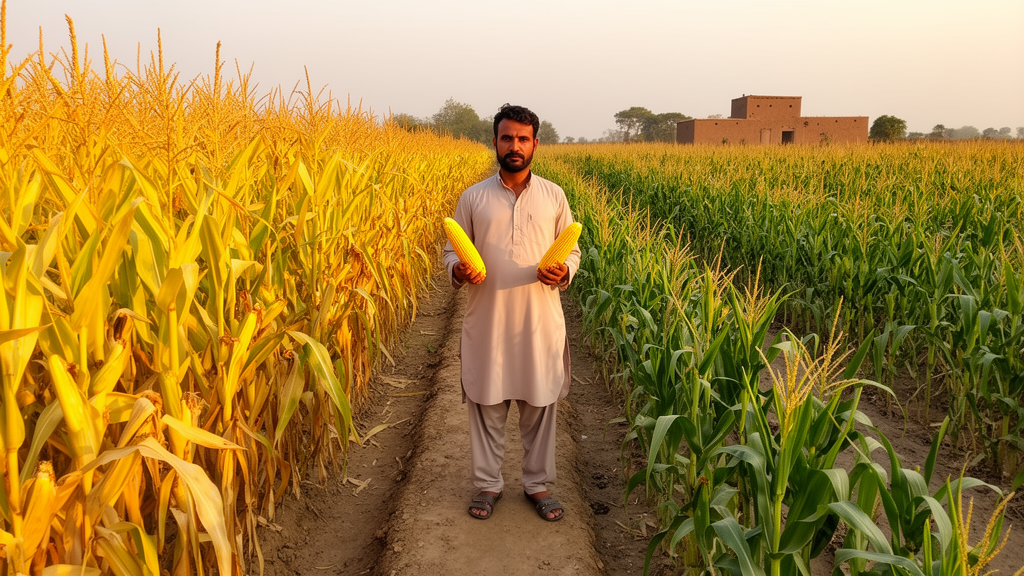
A breeding study at the Cereal Crop Research Institute in Pirsabaq, Nowshehra, Pakistan, has identified yellow maize hybrid combinations with strong yield performance, with one cross, YL-2 × YD-4, recording 15.1 percent economic heterosis and 3.30 percent commercial heterosis for grain yield. The work was carried out during the Kharif 2022 season and is published in Scientific Reports.
The research team, including Abbas Ali, Sher Aslam Khan and colleagues, crossed ten inbred maize lines with three testers in a line-by-tester mating design, producing thirty F1 hybrids. These crosses, together with two check entries, were evaluated in a randomized complete block design with three replications. The aim was to estimate general combining ability (GCA) and specific combining ability (SCA) effects, along with heterotic effects, for morphological and yield-related traits of yellow maize.
Statistical analysis showed significant differences among both parents and crosses for all traits studied, a result the authors interpret as indicating that further selection is possible. GCA and SCA estimates were significant for all studied traits except ear diameter.
Three inbred lines showed desirable negative GCA values for earliness: YL-1, YL-2 and YL-8 RC. Separately, the parental lines YL-1, YL-2 and YL-6 displayed desirable and significant positive GCA values for ear length, 100-grain weight and grain yield, which the study attributes to favorable additive genetic effects for these traits.
Among the thirty F1 crosses, three combinations delivered the highest grain yields. YL-2 × YD-4 reached 8629.5 kilograms per hectare, YL-6 × YD-4 produced 7617.5 kilograms per hectare, and YL-1 × YL-07 RC yielded 7602.8 kilograms per hectare. All three showed positive and significant SCA effects for grain yield.
The top performer, YL-2 × YD-4, recorded positive and significant economic heterosis of 15.1 percent and commercial heterosis of 3.30 percent for grain yield, and the study highlights its potential for further evaluation.
Assessment of combining ability variances revealed a predominance of SCA variance over GCA variance for most traits. Baker’s ratio values below unity likewise indicated a greater contribution of non-additive genetic effects to the expression of the traits studied in this population.
The study is a single-location trial conducted over one season at one institute, so the reported yields and heterosis values describe performance under those specific Kharif 2022 conditions. The abstract does not report multi-environment testing of the crosses.
Within the scope of the trial, the findings supply breeders with measured GCA values for individual inbred lines, significant SCA effects for specific cross combinations, and quantified heterosis for the leading hybrid, all based on the observed performance of the thirty crosses and two checks in the 2022 season.
Subject of Research: Combining ability and heterosis in yellow maize hybrids evaluated in Pakistan
Article Title: Genetic components and heterotic performance of yellow maize hybrids for morphological and yield traits
Article References: Ali, A., Khan, S. A., Khalili, A., Ali, N., Ali, S., Hussain, I., & Qayyum, A. (2026). Genetic components and heterotic performance of yellow maize hybrids for morphological and yield traits. Scientific Reports. https://doi.org/10.1038/s41598-026-75670-2
Image Credits: AI Generated
DOI: 10.1038/s41598-026-75670-2
Keywords: maize, hybrid breeding, heterosis, combining ability, GCA, SCA, grain yield, inbred lines, line-by-tester, genetics, Pakistan, plant breeding
Cite Scienmag News
Alan Morgan. (October 26, 2026). Yellow Maize Cross Shows 15 Percent Heterosis in Pakistani Hybrid Trial. Scienmag. https://scienmag.com/yellow-maize-cross-shows-15-percent-heterosis-in-pakistani-hybrid-trial/
Alan Morgan. "Yellow Maize Cross Shows 15 Percent Heterosis in Pakistani Hybrid Trial." Scienmag, 26 October 2026, https://scienmag.com/yellow-maize-cross-shows-15-percent-heterosis-in-pakistani-hybrid-trial/. Accessed 26 October 2026.
Alan Morgan. "Yellow Maize Cross Shows 15 Percent Heterosis in Pakistani Hybrid Trial." Scienmag. October 26, 2026. https://scienmag.com/yellow-maize-cross-shows-15-percent-heterosis-in-pakistani-hybrid-trial/


