

Monday, October 26, 2026
Science
No Result
View All Result
  • Login
  • HOME
  • SCIENCE NEWS
  • CONTACT US
  • HOME
  • SCIENCE NEWS
  • CONTACT US
No Result
View All Result
Scienmag
No Result
View All Result
Home Science News Technology and Engineering

Phosphate-Loaded PVA Nanofibers Show Enhanced Bone-Like Mineralization

October 26, 2026
in Technology and Engineering
Denise Maddox
By Denise Maddox Scienmag Editorial Profile - Mechanical Engineering
Reading Time: 2 mins read
0
Phosphate-Loaded PVA Nanofibers Show Enhanced Bone-Like Mineralization

Phosphate-Loaded PVA Nanofibers Show Enhanced Bone-Like Mineralization

65
SHARES
587
VIEWS
Share on FacebookShare on Twitter
ADVERTISEMENT

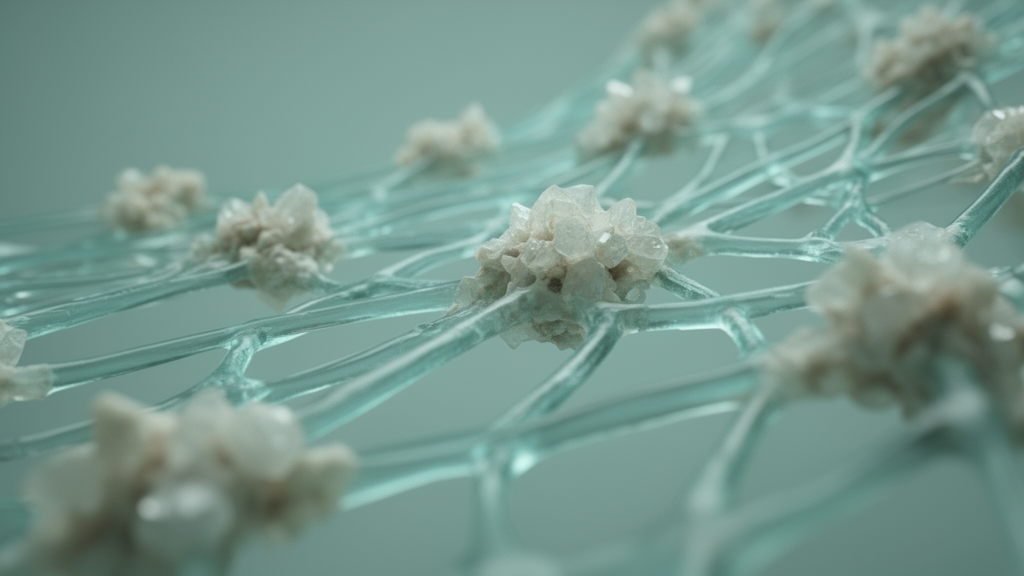
Electrospun poly(vinyl alcohol) nanofibers enriched with calcium and magnesium phosphates have shown markedly improved biomineralization behavior, according to a peer-reviewed study published in Scientific Reports. The research, led by Fatemeh Habibi and colleagues, describes nanocomposite scaffolds designed to mimic key features of bone tissue for use in bone tissue engineering. The team fabricated scaffolds by electrospinning PVA solutions containing monocalcium phosphate (MCP) and magnesium phosphate (MgP) nanoparticles.

Fourier-transform infrared spectroscopy revealed that the nanoparticles interact with PVA chains through non-covalent forces, including hydrogen bonds and electrostatic attractions, confirming their successful incorporation into the fibrous matrices rather than simple physical mixing. Nanoparticle loading had a pronounced effect on fiber morphology. Adding 0.5 w/v% of either phosphate reduced the average fiber diameter from 541 nm in a PVA/surfactant formulation to 284 nm for PVA/MCP and 257 nm for PVA/MgP, while also producing narrower fiber diameter distributions.

When concentrations were raised from 0.5 to 1.5 w/v%, the average diameter varied non-linearly, first increasing and then decreasing with further loading. Thermal analysis showed that the strong intermolecular interactions between the polymer and the phosphate phase improved the stability of the composite scaffolds. The temperature of maximum degradation rate rose from 280 °C for neat PVA to 290 °C for PVA/MCP and 300 °C for PVA/MgP, indicating that the dispersed nanoparticles reinforce the polymer matrix at the molecular level.

The most striking findings emerged from immersion testing in simulated body fluid at 37 °C for 21 days. Scanning electron microscopy, energy-dispersive X-ray analysis, and X-ray diffraction confirmed substantial surface mineralization and phase transformation in both composite systems. The two phosphate additives produced distinctly different mineral products: PVA/MCP scaffolds predominantly developed hydroxyapatite-like calcium phosphate, whereas PVA/MgP scaffolds exhibited newberyite and bobierrite phases, both magnesium-containing phosphate minerals.

According to the authors, the results demonstrate that incorporating MCP and MgP modulates both the physicochemical properties and the biomineralization behavior of electrospun PVA nanofibers. This tunability could allow researchers to select additive type and concentration to steer the surface chemistry of scaffolds toward specific mineral phases. The work remains a laboratory-scale materials study, and the findings offer a foundation for designing bone-mimetic nanofibrous scaffolds whose intrinsic bioactivity can be adjusted through phosphate nanoparticle incorporation, a direction the authors identify as pivotal for bone tissue engineering applications.

Subject of Research: Electrospun PVA nanofiber scaffolds incorporating calcium and magnesium phosphates for bone tissue engineering

Article Title: Bioactive phosphate-containing electrospun PVA nanofibers incorporating calcium phosphate and magnesium phosphate

Article References: Habibi, F., Salimi-Kenari, H., Nabavi, S. R., & Nikpour, P. (2026). Bioactive phosphate-containing electrospun PVA nanofibers incorporating calcium phosphate and magnesium phosphate. Scientific Reports. https://doi.org/10.1038/s41598-026-77740-x

Image Credits: AI Generated

DOI: 10.1038/s41598-026-77740-x

Keywords: electrospinning, PVA nanofibers, monocalcium phosphate, magnesium phosphate, biomineralization, hydroxyapatite, bone tissue engineering, simulated body fluid, nanocomposite scaffolds, thermal stability, Bioactive, phosphate-containing

Cite Scienmag News

Denise Maddox. (October 26, 2026). Phosphate-Loaded PVA Nanofibers Show Enhanced Bone-Like Mineralization. Scienmag. https://scienmag.com/phosphate-loaded-pva-nanofibers-show-enhanced-bone-like-mineralization/

Denise Maddox. "Phosphate-Loaded PVA Nanofibers Show Enhanced Bone-Like Mineralization." Scienmag, 26 October 2026, https://scienmag.com/phosphate-loaded-pva-nanofibers-show-enhanced-bone-like-mineralization/. Accessed 26 October 2026.

Denise Maddox. "Phosphate-Loaded PVA Nanofibers Show Enhanced Bone-Like Mineralization." Scienmag. October 26, 2026. https://scienmag.com/phosphate-loaded-pva-nanofibers-show-enhanced-bone-like-mineralization/


Tags: bioactivebiomineralizationbiomineralization enhancement in nanocomposite scaffoldsBone tissue engineeringbone tissue engineering scaffoldselectrospinningelectrospun PVA nanofibers with calcium magnesium phosphatefiber diameter modulation by nanoparticle loadingFourier-transform infrared spectroscopy of biomaterialshydroxyapatiteinfluence of nanoparticle concentration on fiber morphologymagnesium phosphatemonocalcium phosphatenanocomposite scaffoldsnanostructure design for biomimetic mineralizationnon-covalent interactions in nanocompositesphosphate-containingphosphate-loaded nanofibers for bone regenerationPVA nanofiberssimulated body fluidthermal stabilitythermal stability of phosphate-infused PVA fibers
Share26Tweet16
Previous Post

Alpine summit blooms: Italian peak’s flora triples as warming lifts plants to record heights

Next Post

Why Hospice Care Reaches Fewer American Indian Families at Life’s End

Related Posts

Australian smart bedding sensors that flag falls risk win US patent
Technology and Engineering

Australian smart bedding sensors that flag falls risk win US patent

October 26, 2026
Engineered Human Cell-Derived Matrix Outperforms Recombinant Collagen, but Senescence Looms
Science News

Engineered Human Cell-Derived Matrix Outperforms Recombinant Collagen, but Senescence Looms

October 26, 2026
AI chatbots outperformed dentists and doctors on radiation safety quiz
Technology and Engineering

AI chatbots outperformed dentists and doctors on radiation safety quiz

October 26, 2026
AI pinpoints and explains smart contract flaws at function level
Technology and Engineering

AI pinpoints and explains smart contract flaws at function level

October 26, 2026
Quantum Codebreakers May Gain Thousandsfold Speedups on Renaissance Ciphers, Study Finds
Technology and Engineering

Quantum Codebreakers May Gain Thousandsfold Speedups on Renaissance Ciphers, Study Finds

October 26, 2026
Snout moth Hypena nakajimai recorded in Korea for the first time with DNA evidence
Biology

Snout moth Hypena nakajimai recorded in Korea for the first time with DNA evidence

October 26, 2026
Next Post
Why Hospice Care Reaches Fewer American Indian Families at Life’s End

Why Hospice Care Reaches Fewer American Indian Families at Life's End

  • Mothers who receive childcare support from maternal grandparents show more optimized

    Mothers who receive childcare support from maternal grandparents show more parental warmth, finds NTU Singapore study

    27656 shares
    Share 11059 Tweet 6912
  • University of Seville Breaks 120-Year-Old Mystery, Revises a Key Einstein Concept

    1061 shares
    Share 424 Tweet 265
  • Bee body mass, pathogens and local climate influence heat tolerance

    682 shares
    Share 273 Tweet 171
  • Researchers record first-ever images and data of a shark experiencing a boat strike

    546 shares
    Share 218 Tweet 137
  • Groundbreaking Clinical Trial Reveals Lubiprostone Enhances Kidney Function

    531 shares
    Share 212 Tweet 133
Science

Embark on a thrilling journey of discovery with Scienmag.com—your ultimate source for cutting-edge breakthroughs. Immerse yourself in a world where curiosity knows no limits and tomorrow’s possibilities become today’s reality!

RECENT NEWS

  • Why Hospice Care Reaches Fewer American Indian Families at Life’s End
  • Phosphate-Loaded PVA Nanofibers Show Enhanced Bone-Like Mineralization
  • Alpine summit blooms: Italian peak’s flora triples as warming lifts plants to record heights
  • Three New Trapdoor Spider Species Mark the First Record of an Ancient Family in China

Categories

  • Agriculture
  • Anthropology
  • Archaeology
  • Athmospheric
  • Biology
  • Biotechnology
  • Blog
  • Bussines
  • Cancer
  • Chemistry
  • Climate
  • Earth Science
  • Editorial Policy
  • Marine
  • Mathematics
  • Medicine
  • Pediatry
  • Policy
  • Psychology & Psychiatry
  • Science Education
  • Science News
  • Social Science
  • Space
  • Technology and Engineering

Subscribe to Blog via Email

Enter your email address to subscribe to this blog and receive notifications of new posts by email.

Join 5,151 other subscribers

© 2025 Scienmag - Science Magazine

Welcome Back!

Login to your account below

Forgotten Password?

Retrieve your password

Please enter your username or email address to reset your password.

Log In
No Result
View All Result
  • HOME
  • SCIENCE NEWS
  • CONTACT US

© 2025 Scienmag - Science Magazine

Discover more from Science

Subscribe now to keep reading and get access to the full archive.

Continue reading