


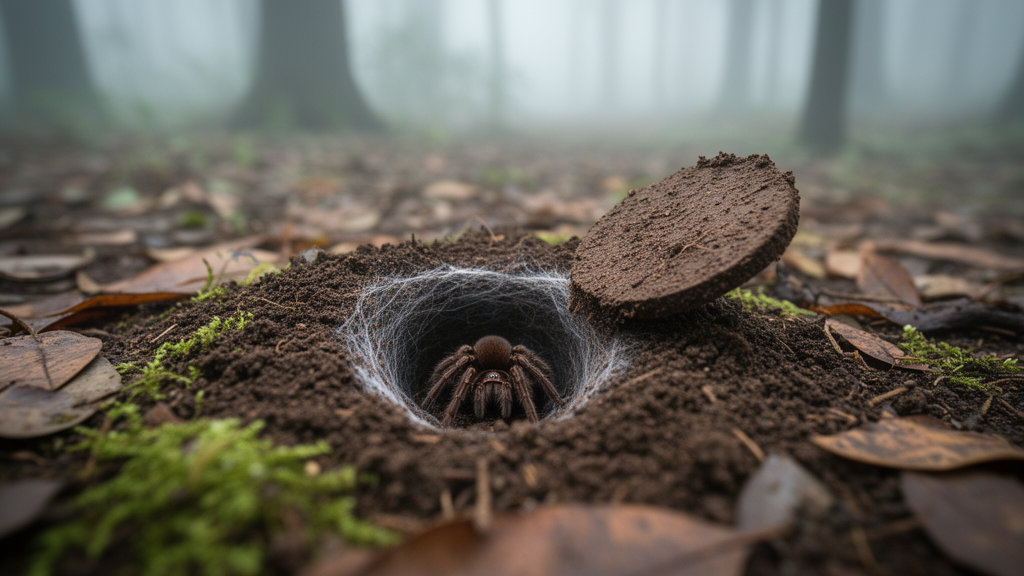
Deep in the forests of Yunnan Province, China, spiders that dig hidden burrows with escape tunnels have been quietly living under stones, unnoticed by science. A new taxonomic study now reports the first record of the spider family Bemmeridae from China, describing three new species of the genus Damarchus from the country's subtropical southwest. The discovery, published in the journal ZooKeys, extends the known range of a poorly understood lineage of mygalomorph spiders and adds fresh fuel to an ongoing debate about how species should be defined in this notoriously conservative group.
Bemmeridae has had a turbulent taxonomic history. Today the family contains four genera: Homostola and Spiroctenus in southern Africa, and Atmetochilus and Damarchus in Southeast Asia. But even this arrangement is shaky.
A 2023 phylogenetic analysis by Kulkarni and colleagues found the family is not monophyletic, meaning it does not consist of a single ancestor and all of its descendants. In that analysis, the Asian genus Damarchus emerged as the sister group to a clade containing the brush-legged trapdoor spiders (Barychelidae) and tarantulas (Theraphosidae), while the African Homostola pardalina sat beside part of Cyrtaucheniidae. Some researchers still place the Asian genera within Bemmeridae, while others label them incertae sedis, a taxonomic term of convenience meaning their placement is uncertain.
The newly described spiders belong to Damarchus, a genus of small to medium mygalomorphs with body lengths of roughly 10 to 23 millimeters. Like many of their relatives, they are burrow dwellers with a distinctive architectural signature: their burrow consists of an open main shaft plus a blind side shaft into which the spider retreats when disturbed. In most species the main entrance remains open while the side shaft is sealed by a pair of lateral flaps.
A few species add flaps or turrets at the entrance, or plug the side shaft with a pellet of soil. These cryptic habits, combined with low dispersal ability, have likely kept the group under-sampled across much of Asia. Taxonomic attention to Damarchus has indeed been sparse.
Of the 11 species described before this study, six were named before the mid-twentieth century, including Damarchus montanus from 1890 and D. workmani, the type species, from 1891. Renewed interest in recent years produced five new species, all from Thailand: D. dao, D. lanna and D. pylorus described in 2023 by Schwendinger and Hongpadharakiree, and D. inazuma and D. sirindhornae described in 2025 by Kunsete and colleagues. The three Chinese species now extend the genus into Yunnan Province, where they were found in the Xishuangbanna region in the south and in Dehong Prefecture in the west.
The first new species, Damarchus dai, is named for the Dai people, the main ethnic group of Xishuangbanna Dai Autonomous Prefecture, where the type specimens were collected near Jinghong. The second, D. erebus, takes its name from the Greek primordial deity of darkness, a nod to the spiders' somber coloration; it was found in Lianghe and Yingjiang counties in Dehong. The third, D. rutilus, named for the orange-red coloration of the living female, also comes from Dehong.
All three species closely match the current diagnostic characters of Damarchus, which is why the authors assigned them to that genus despite the broader uncertainty surrounding the family's boundaries. Distinguishing the new species relied on detailed anatomy of the sexual structures, the standard currency of spider taxonomy. D. dai males have a long embolus, the intromittent part of the palpal organ, measuring roughly one and a half times the width of the tegulum, the bulb that supports it, and lack a retrolateral bump on the palpal tibia.
D. erebus males, by contrast, have an embolus about equal in length to the tegulum width and do carry that bump. Females differ correspondingly: in D. dai the spermathecal stalk, the duct of the sperm-storage organ, is about two to three times the length of the receptacle, whereas in D. erebus the stalk is short and distinctly everted. D. rutilus stands apart with a slender, elongated embolus about 2.5 times the tegulum width, a tulip-bulb-shaped tegulum, and a coupling spur on the first leg bearing a single stout spine seven to eight times longer than wide, a feature that separates it from the Thai species D. inazuma, which has three straight adjacent spines instead.
Specimens were collected by turning over stones and excavating burrows, then preserved in 75 to 100 percent ethanol and examined under stereomicroscopes. Female genitalia were cleared with pancreatin to reveal fine details, and measurements were taken in millimeters, excluding the chelicerae from total body length. All vouchers are deposited in the Museum of Hebei University in Baoding, China.
The authors explicitly followed a morphological species concept, delimiting species by identifiable anatomical features, and acknowledged that this approach carries a degree of subjectivity even though it remains standard in classical spider taxonomy. Nomenclatural acts were registered in ZooBank. In addition to morphology, the team sequenced the mitochondrial cytochrome c oxidase subunit I gene, COI, the workhorse of animal DNA barcoding, using the standard Folmer primers and standard amplification conditions.
The results were striking, and complicated. Within the Jinghong population of D. dai, COI distances ranged from 0.3 to 5.2 percent, averaging 3.45 percent, while the Menglun population showed 1.9 percent. Between the two populations, distances reached 10.6 to 12.2 percent, averaging about 11.2 percent, a figure that exceeds the interspecific thresholds of 2 to 6 percent, or 9.5 percent, used in some previous mygalomorph studies.
Similar patterns appeared in the other species: D. erebus populations in Lianghe and Yingjiang differed by 13.3 to 14.3 percent, and D. rutilus populations by 10.1 to 11.3 percent. Here is the puzzle: despite these large mitochondrial distances, the researchers could find no reliable morphological differences between the geographically separated populations, particularly in the key sexual features used to diagnose species. In D. dai, the single Menglun female showed stronger sclerotization of the spermathecal receptacle, but the authors note this could reflect individual age and developmental stage, since that specimen was also the largest female examined.
Mygalomorph spiders, with their sedentary lives and limited dispersal, are known to accumulate deep genetic structure within single species; previous work on tarantulas, funnel-webs and other trapdoor spiders has documented intraspecific COI divergences of 5 to 16 percent. The authors therefore treated each pair of populations as conspecific rather than splitting them on molecular data alone, and they argue that their findings show COI thresholds are inconsistent and potentially misleading for species delimitation in Damarchus. The sequences are offered as supplementary descriptive data, not as the basis for taxonomic decisions.
The study also touches on a lingering question about the genus itself. The main morphological distinction between Damarchus and its putative sister genus Atmetochilus has been the arrangement of sternal sigilla, small sclerotized spots on the underside of the thorax: discrete in Damarchus, fused in Atmetochilus. Recent work suggests this character varies continuously, which could blur the boundary between the two genera.
With China now on the bemmerid map and molecular data deposited in GenBank for 20 specimens, the authors say further genetic studies of Damarchus are needed, and they acknowledge that with the acquisition of more specimens in future studies, D. erebus may prove to contain more than a single species.
Subject of Research: First record of the spider family Bemmeridae in China, with descriptions of three new Damarchus species from Yunnan Province
Article Title: First record of the family Bemmeridae Simon, 1903 from China, with descriptions of three new species of Damarchus Thorell, 1891 ( Arachnida , Araneae )
Article References: Zhang, Y., Yu, K., & Zhang, F. (2026). First record of the family Bemmeridae Simon, 1903 from China, with descriptions of three new species of Damarchus Thorell, 1891 (Arachnida, Araneae). ZooKeys, 1287, 153-199. https://doi.org/10.3897/zookeys.1287.187795
Image Credits: AI Generated
DOI: 10.3897/zookeys.1287.187795
Keywords: Bemmeridae, Damarchus, mygalomorph spiders, new species, Yunnan, taxonomy, DNA barcoding, COI, species delimitation, trapdoor spiders, ZooKeys, China
Cite Scienmag News
Margaret Porter. (October 26, 2026). Three New Trapdoor Spider Species Mark the First Record of an Ancient Family in China. Scienmag. https://scienmag.com/three-new-trapdoor-spider-species-mark-the-first-record-of-an-ancient-family-in-china/
Margaret Porter. "Three New Trapdoor Spider Species Mark the First Record of an Ancient Family in China." Scienmag, 26 October 2026, https://scienmag.com/three-new-trapdoor-spider-species-mark-the-first-record-of-an-ancient-family-in-china/. Accessed 26 October 2026.
Margaret Porter. "Three New Trapdoor Spider Species Mark the First Record of an Ancient Family in China." Scienmag. October 26, 2026. https://scienmag.com/three-new-trapdoor-spider-species-mark-the-first-record-of-an-ancient-family-in-china/


