


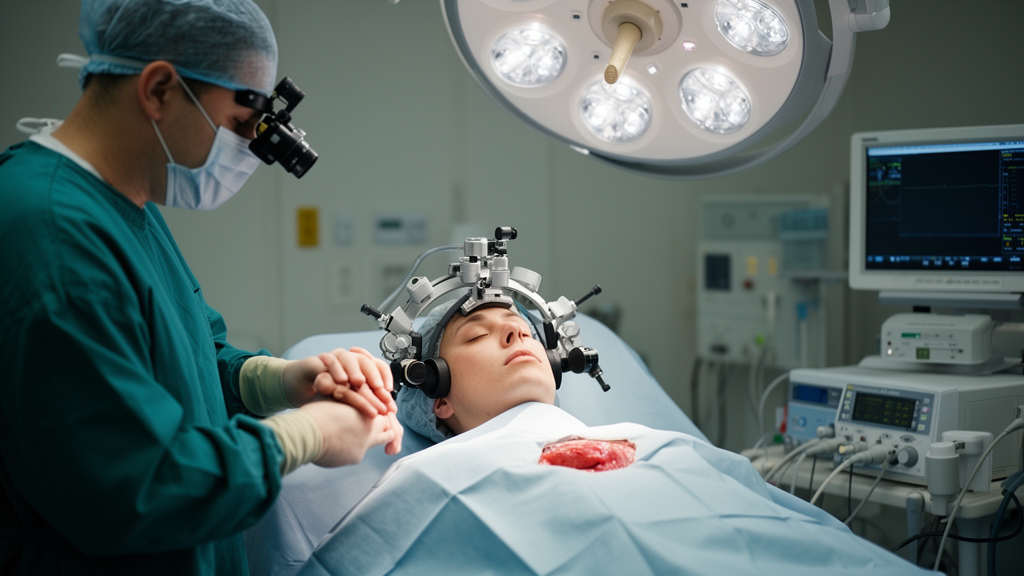
Nearly one in three patients who undergo awake craniotomy for lesions near movement or language areas of the brain show new or worsened neurological dysfunction within the first two to three days after surgery, according to a retrospective single-center study published in Volume 12 of the Chinese Neurosurgical Journal. The study, led by Professor Fang Liu of Nanjing Medical University and made available online on September 1, 2026, examined 30 patients operated on between January 2019 and November 2024 and found that 30 percent experienced acute deterioration when assessed 48 to 72 hours after surgery. Crucially, the researchers caution that these early changes may not reflect permanent injury, and that no statistically significant predictors of acute deterioration could be identified in their analyses.
Awake craniotomy is a surgical technique that allows patients to remain awake during critical stages of tumor or lesion removal, particularly when the lesion lies in or near eloquent cortex, the regions of the brain responsible for essential functions such as movement and language. During the awake phase, the surgical team applies direct electrical stimulation to the exposed cortical surface and to the pathways beneath it, mapping the locations of functional tissue in real time. When stimulation of a given site interrupts speech, produces weakness, or otherwise disturbs function, the surgeon marks that area as territory to be preserved, adjusting the boundaries of resection accordingly.
Yet the days immediately following such surgery present a diagnostic dilemma that the new study places at the center of its analysis. Neurological function assessed within the first 48 to 72 hours can be clouded by temporary effects of the operation itself, including cerebral edema, postoperative fatigue, and residual sedation from anesthesia. A patient who cannot name objects or lift an arm on the second postoperative day may be experiencing reversible swelling or medication effects rather than lasting damage to functional brain tissue.
Distinguishing between these possibilities matters enormously for postoperative counseling, rehabilitation planning, and the interpretation of surgical outcome data, and it is precisely this distinction that early time-point assessments cannot yet make with confidence. To characterize the pattern of early change, the research team assessed neurological function at 48 to 72 hours after surgery using a battery of standardized measures: the Karnofsky Performance Status scale, which rates overall functional performance on a 0 to 100 scale; the Glasgow Coma Scale, which quantifies level of consciousness; the Mini-Mental State Examination, a bedside test of cognition; and manual muscle strength testing. The cohort consisted of 30 patients with intracranial lesions involving motor or language areas, treated at a single center.
The authors also conducted exploratory survival analyses, which they explicitly state were not designed to establish definitive prognostic factors. The headline figures from the study are striking in their granularity. Nine of the 30 patients, or 30 percent, experienced new or worsened acute neurological dysfunction within the assessment window.
A decline of at least 10 points on the Karnofsky Performance Status scale occurred in 30 percent of patients, while 26.7 percent showed a drop of at least two points on the Mini-Mental State Examination, indicating measurable cognitive change. New or worsened motor weakness was documented in 16.7 percent of the cohort, and new-onset aphasia, a loss or impairment of language function, appeared in 10 percent. On the technical side of the operation, full intraoperative awake mapping was completed in 27 of the 30 patients, or 90 percent; in the remaining three cases, the procedure had to be converted to general anesthesia without functional mapping being completed, a recognized contingency when patients cannot tolerate the awake phase.
The researchers emphasize that these early functional changes should not automatically be read as permanent surgical injury. Performance status and cognitive scores obtained within days of craniotomy can be depressed by cerebral edema, fatigue, and the lingering effects of sedation, all of which tend to resolve over time. This interpretive caution extends to the comparison the team drew between patients who completed mapping and those who did not: patients with successful intraoperative mapping had a numerically lower rate of acute neurological decline than those in whom mapping failed, at 25.9 percent versus 66.7 percent, but the difference did not reach statistical significance.
Univariate analyses of potential clinical predictors similarly came up empty. No clinical variable examined was statistically significantly associated with acute neurological deterioration in the first days after surgery. In a descriptive study of this size, that absence of significant associations is less a finding in itself than a reflection of the study's limitations, but it underscores a practical point for clinicians: at present, no simple clinical rule identifies which patients are likely to deteriorate briefly after awake surgery, and every early decline must be evaluated on its own terms rather than assumed to be either trivial or permanent.
The study also followed patients for survival, though the authors frame these analyses as exploratory. During follow-up, 17 of the 30 patients died, and median overall survival for the cohort was 43 months. No statistically significant survival differences or independent prognostic factors were identified.
The heterogeneity of the cohort, which included varied intracranial pathologies rather than a single tumor type or disease stage, together with the small sample size, makes survival inference particularly fragile in this dataset. Professor Liu addressed this directly, stating that the survival findings should be interpreted cautiously because of the small sample size, the diverse intracranial pathologies, and the lack of long-term neurological assessments. Indeed, the limitations the authors acknowledge are substantial and worth spelling out for readers weighing the significance of the results.
There were no long-term functional assessments, so the central question of how often early deficits resolve could not be answered. The study also had no comparison group of patients undergoing craniotomy under general anesthesia, which means it cannot address whether awake procedures produce different early neurological trajectories than asleep ones. The retrospective, single-center design further limits generalizability to other institutions and patient populations.
What the study does provide is a preliminary, quantified description of the neurological landscape in the first days after awake craniotomy, and a clear statement of what remains unknown. The authors call for larger, prospective studies involving patients in more clearly defined pathological groups, with serial assessments extending over at least three months. Such follow-up would allow researchers to determine how frequently early deficits resolve spontaneously, which patient or lesion characteristics predict persistent impairment, and how early scores relate to long-term function.
That evidence, in turn, could support more informative postoperative counseling for patients and families, better rehabilitation planning, and more meaningful evaluation of surgical outcomes across centers. Until such data exist, the study's central message is one of interpretive restraint: an early decline in performance or cognition after awake craniotomy is common, measurable with standard bedside tools, and not yet a reliable signal of lasting neurological damage.
Subject of Research: Early neurological outcomes after awake craniotomy for intracranial lesions near motor or language areas
Article Title: Chinese Neurosurgical Journal reports early neurological outcomes after awake craniotomy
Article References: Chinese Neurosurgical Journal reports early neurological outcomes after awake craniotomy. Original publication (Bibliographic details unavailable.)
Image Credits: AI Generated
DOI: Not provided
Keywords: awake craniotomy, direct electrical stimulation, neurological outcomes, aphasia, Karnofsky Performance Status, Mini-Mental State Examination, cerebral edema, motor weakness, retrospective study, neurosurgery, survival analysis, language mapping
Cite Scienmag News
Ophelia Keating. (October 26, 2026). Awake craniotomy study finds early neurological decline in 30% of patients. Scienmag. https://scienmag.com/awake-craniotomy-study-finds-early-neurological-decline-in-30-of-patients/
Ophelia Keating. "Awake craniotomy study finds early neurological decline in 30% of patients." Scienmag, 26 October 2026, https://scienmag.com/awake-craniotomy-study-finds-early-neurological-decline-in-30-of-patients/. Accessed 26 October 2026.
Ophelia Keating. "Awake craniotomy study finds early neurological decline in 30% of patients." Scienmag. October 26, 2026. https://scienmag.com/awake-craniotomy-study-finds-early-neurological-decline-in-30-of-patients/


