


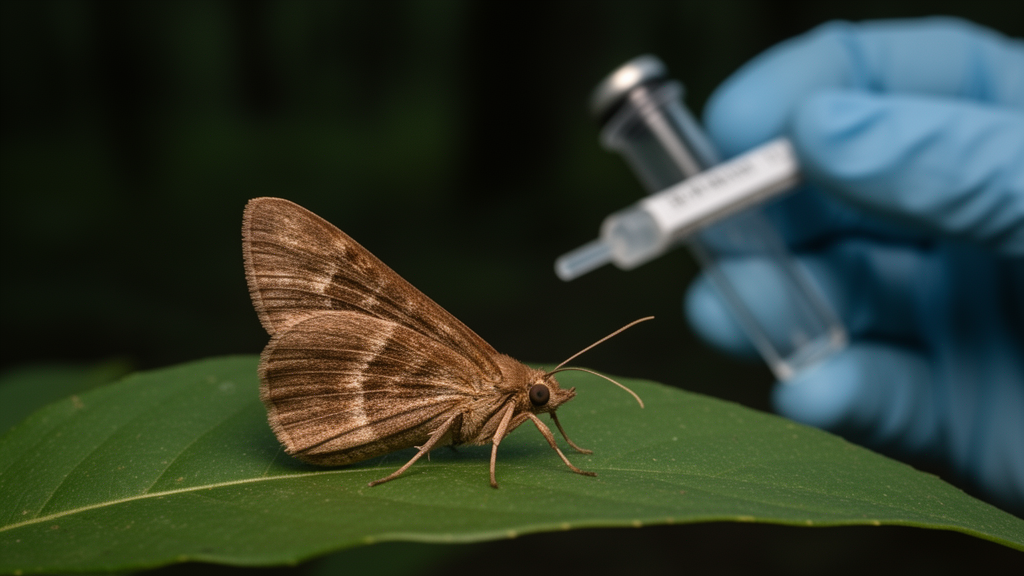
A moth that spent roughly three decades without a scientific name has now turned up somewhere no one had formally documented it before. Researchers report the first record of the southern erebid moth Hypena nakajimai Kishida, 2010 from Korea, based on a single male adult collected on Wando Island off the country’s southern coast. The finding, published with a full re-description and molecular analyses, raises the number of Hypena species known from the Korean Peninsula and adds a distinctly subtropical element to its fauna.
The genus Hypena is one of the most species-rich lineages in the Lepidoptera, with around 500 described species worldwide. Its members belong to the subfamily Hypeninae, the so-called snout moths, a name earned from a combination of external features: adults carry a distinctive tuft of scales protruding at the front of the head, and their labial palpi are elongated, with conspicuously long second segments. The larvae are typical semi-loopers, lacking prolegs on the third abdominal segment. Beyond their curiosity value for taxonomists, some Hypena species matter economically in both directions. Hypena humuli defoliates hops, while Hypena opulenta has been deployed as a biological control agent against swallow-worts.
The taxonomic history of H. nakajimai is a case study in how long a species can remain visible yet unnamed. The moth was first illustrated in 1965 by Inoue, who gave it only a Japanese vernacular name. In 1982, Sugi recorded it as Hypena sp. 2 on the basis of female specimens and even supplied morphological diagnoses separating it from similar species, but a formal scientific name still did not follow. Only in 2007 were male specimens successfully reared by S. Tominaga on Okinawa Island, and these became the holotype and paratypes when Kishida finally described the species as new to science in 2010. In other words, an insect that any careful observer could distinguish spent about 30 years in taxonomic limbo.
Until now, 29 Hypena species had been recorded in Korea. The tally has grown piecemeal over decades: Kononenko and colleagues reviewed 21 Korean species plus one unidentified species in 1998; Kononenko and Han raised the count to 22 in 2007; Choi and co-authors added Hypena sinuosa in 2015; Lee and colleagues recorded Hypena narratalis, a species that hibernates in limestone caves, in 2022; and a 2025 checklist by Jin and colleagues reported five Hypena from the country. The new paper adds H. nakajimai to that list, documented from a male specimen collected on 8 October 2021 in Jungdo-ri, Wando-eup, Wando-gun, in Jeollanam-do province, and deposited in the Jeonbuk National University collection.
The specimen was prepared with standard but meticulous techniques. After the living moth was killed with ammonia or ethyl acetate and kept refrigerated, its wings were spread and the sample dried for two to three weeks at 40 degrees Celsius in a drying oven. High-resolution habitus photographs were taken with a Canon EOS 6D and a 100 mm macro lens, with multiple images stacked using Helicon Focus software to sharpen specific regions. For identification, the abdomen was removed and heated overnight in a 10 percent potassium hydroxide solution, cleaned, stained with chlorazol black and mercurochrome, dehydrated in 99 percent ethyl alcohol, transferred to xylene and mounted on a slide in Canada balsam. Genitalia were photographed through a Leica S8AP0 stereomicroscope with a Tucsen Dhyana 400 DC digital camera.
The resulting description paints a small, warm-toned moth. The Korean male has a wingspan of 19.1 millimetres and a yellowish-brown to orange-brown ground colour. Its labial palpi are extremely long, roughly six times the diameter of the compound eye, with the second segment three to four times longer than the third. The fore-wing is divided into a dark costal area and a bright posterior area, separated by a dark line that runs from the basal discal cell to the end of vein R5 and forms a V-shape opening towards the costal margin. The hind-wing is uniformly pale yellowish-brown or greyish-brown, paler towards the inner margin. The male genitalia show a strongly sclerotised, apically hooked uncus, a subscaphium divided into two lobes, tongue-shaped valvae bearing a rounded saccular process, an inverted Y-shaped juxta, and a vesica armed with a set of strong large cornuti and small spines.
Those genital characters matter because H. nakajimai is extremely similar to Hypena pulverulenta, its closest look-alike. The new work carefully separates the two: H. nakajimai is smaller, with a wingspan of about 20 millimetres against roughly 24 in H. pulverulenta, and its fore-wing is less elongated. In the male genitalia, the connection between tegumen and vinculum is more slender, the valvae thinner and slightly more elongated, the basal division of the valva more deeply split, and the saccular process far more prominent. The juxta is diamond-shaped, smaller than in H. pulverulenta and, unlike that species, not fused with the valvae and vinculum. The aedeagus is thinner and more elongated, and the vesica carries strong cornuti that H. pulverulenta lacks. Notably, the authors provide the first genital diagnostic keys for the pair, because a character Sugi once relied on, the absence of dark scales on the fore-wing, proved unreliable: the Korean specimen does bear some dark fore-wing scales.
To test the identification independently of morphology, the team extracted genomic DNA from the specimen’s abdomen and amplified a partial sequence of the mitochondrial COI gene, the standard animal DNA barcode. Using the primer pair LEP-F1 and a newly designed reverse primer called JHCO, they targeted a fragment of roughly 720 base pairs. Although both directions were sequenced commercially, the reverse reaction failed to yield a reliable read, so only the high-quality forward read was used, giving a final 691-base-pair fragment after trimming. A search of NCBI’s database with BLAST returned a H. nakajimai sequence, accession number PV203691, that was 100 percent identical to the novel sequence, corroborating the morphological identification.
Phylogenetic analyses placed the species within the genus with confidence. The dataset comprised 34 sequences representing 19 species, including an outgroup, Paracolax tristalis from the subfamily Herminiinae, and Korean Hypena species used in the 2025 checklist. Sequences were aligned with MAFFT v.7.511, and relationships were inferred by two complementary approaches: maximum likelihood using IQ-TREE 2.4.0 with the best-fit substitution model selected by ModelFinder, and neighbour joining in MEGA 11 under the K2P model with 1,000 bootstrap replicates. Nodal support for the likelihood tree was assessed with 1,000 replicates of the Shimodaira-Hasegawa approximate likelihood-ratio test and the ultrafast bootstrap algorithm with nearest neighbour interchange optimisation. Both analyses showed H. nakajimai as sister to the remaining sampled Hypena, including H. pulverulenta, which sat within a well-supported clade with SH-aLRT support of 97.4, ultrafast bootstrap support of 94 and neighbour-joining bootstrap support of 89. The rest of the topology largely matched the earlier Korean checklist.
Beyond the new national record, the authors frame the finding as a symptom of a larger problem. Hypena has never received the comprehensive taxonomic and phylogenetic treatment its size demands; the most intensive studies of the genus, by Lödl in the 1990s, concentrated on African taxa, leaving substantial gaps in both the New and Old World tropics. H. nakajimai, a typical East Asian subtropical species known in Japan from Shikoku, Kyushu, Amami Oshima, Okinoerabujima, Okinawa Island, Kohamajima and Ishigakijima, and whose caterpillar feeds on the Commelinaceae plant Commelina diffusa, exemplifies how poorly such lineages remain charted. The researchers argue that progress will require lepidopteran taxonomists to describe unknown species, compare similar taxa directly, and ultimately undertake a full phylogenetic revision of the genus, work that a single well-documented specimen from a Korean island can help to catalyse.
Subject of Research: First Korean record of the erebid moth Hypena nakajimai with morphological and molecular analyses
Article Title: A new record of the southern erebid moth species, Hypena nakajimai Kishida, 2010 ( Lepidoptera , Erebidae ), from Korea with molecular analyses
Article References: Han, H., Park, D. H., & Kim, S. (2026). A new record of the southern erebid moth species, Hypena nakajimai Kishida, 2010 (Lepidoptera, Erebidae), from Korea with molecular analyses. Biodiversity Data Journal, 14, Article e198224. https://doi.org/10.3897/bdj.14.e198224
Image Credits: AI Generated
Keywords: Hypena nakajimai, Erebidae, Lepidoptera, Korea, new record, COI barcode, phylogenetics, taxonomy, snout moths, Wando Island, male genitalia, Hypena pulverulenta
Cite Scienmag News
Drew Townsend. (October 26, 2026). Snout moth Hypena nakajimai recorded in Korea for the first time with DNA evidence. Scienmag. https://scienmag.com/snout-moth-hypena-nakajimai-recorded-in-korea-for-the-first-time-with-dna-evidence/
Drew Townsend. "Snout moth Hypena nakajimai recorded in Korea for the first time with DNA evidence." Scienmag, 26 October 2026, https://scienmag.com/snout-moth-hypena-nakajimai-recorded-in-korea-for-the-first-time-with-dna-evidence/. Accessed 26 October 2026.
Drew Townsend. "Snout moth Hypena nakajimai recorded in Korea for the first time with DNA evidence." Scienmag. October 26, 2026. https://scienmag.com/snout-moth-hypena-nakajimai-recorded-in-korea-for-the-first-time-with-dna-evidence/


