


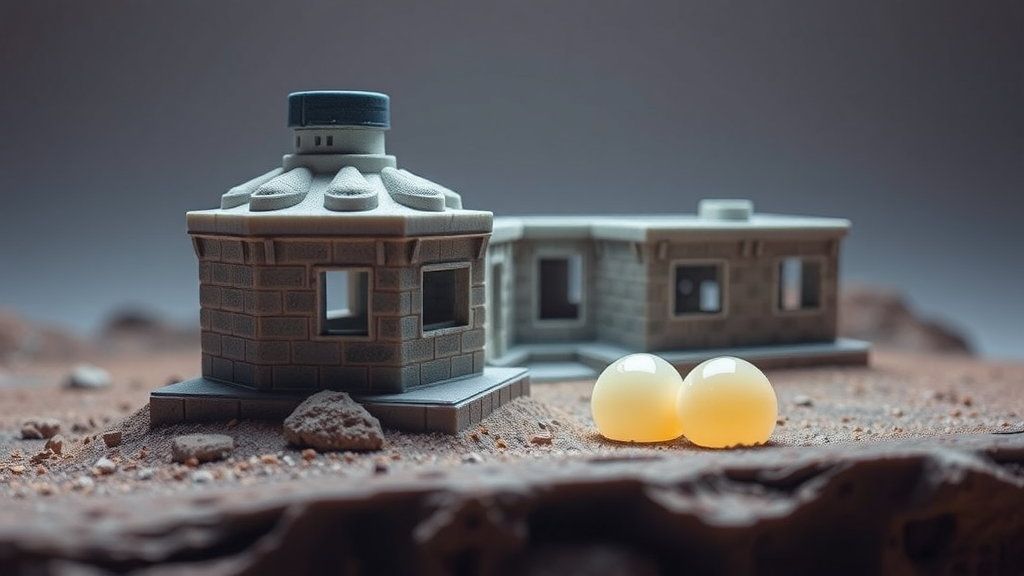
Mars is, by almost every measure, a terrible place to build a house. The planet’s surface is bitterly cold, bathed in radiation, and wrapped in an atmosphere so thin that it behaves more like a near vacuum than the air we breathe. Any shelter that future explorers might hope to construct would need to withstand all of these hostile conditions at once. Worse still, the conventional approach of hauling building materials from Earth would mean sending even the components of a modest structure on a months-long journey through space before a single wall could be raised. The cost, energy, and sheer logistics of such an undertaking have long been among the most stubborn obstacles standing between humanity and a permanent foothold on the Red Planet.
But a new study suggests that the materials do not have to come from Earth at all. In research publishing on September 10 in the journal Chem Circularity, a team of scientists has developed a recipe that could one day be used to 3D print houses on Mars. The formula combines one ingredient that Mars has in abundance—Martian rock—with a pair of surprisingly humble Earthly imports: gelatin and yeast. Once the printed material dries and hardens under Martian conditions, it becomes a living building material with a compressive strength comparable to low-grade concrete. And because the material is alive, it can be broken down, recycled, and brewed again for new construction, offering something that no conventional building product on Earth or Mars can match: a genuinely circular building economy on another world.
The inspiration for the project came, perhaps unexpectedly, from the kitchen. My inspiration came from freeze-dried fruits that become harder, says civil engineer and senior author Jishen Qiu of The Hong Kong University of Science and Technology. Mars’s extremely low temperature and pressure create conditions that are strikingly similar to the freeze-drying process used to preserve food, in which moisture is drawn out of a material while it is frozen. So I asked myself if we can take advantage of that and make some materials, Qiu explains. Rather than fighting the planet’s punishing environment, the team decided to exploit it, turning the very conditions that make Mars hostile into a natural manufacturing step that hardens and stabilizes their printed structures.
To conjure the printable material, Qiu and her colleagues needed the right mixture of sand and glue. In this case, the sand is crushed Martian rock, which provides mass and structural bulk, while the glue is a carefully engineered blend of gelatin and a specialized strain of yeast. The team engineered yeast cells coated with highly adhesive proteins, including the same kinds of molecules that mussels use to cling tenaciously to rocks in the surf zone. The gelatin knits the ingredients together into a coherent paste and provides a hospitable scaffold in which the yeast cells can live and grow, while the adhesive proteins bind the mineral particles to one another and to the organic matrix. The result is a slurry that behaves like an ink, thick enough to hold its shape as it emerges from a printing nozzle yet fluid enough to be extruded layer by layer into a designed form.
The critical test came when the researchers exposed their printed material to simulated Martian conditions. Once the mixture pushes through the nozzle, the extreme cold and low pressure of the chamber freeze-dry it almost immediately. Under these conditions, water does not simply melt and evaporate; instead, it freezes and then sublimates, turning directly from ice into vapor without ever passing through a liquid phase. As the ice crystals vanish, they leave behind a network of microscopic pores throughout the material. The final product resembles a foam—light, porous, and rigid—whose internal architecture is sculpted by the sublimation process itself. In effect, the Martian atmosphere performs the final curing step for free, requiring no kilns, no furnaces, and no external energy input beyond the cold and vacuum that the planet already provides.
For now, the printed structures are modest in scale: small domes roughly the size of a wine cork, standing 45 millimeters tall and 30 millimeters wide. But the material itself is far more impressive than its dimensions suggest. The team measured a compressive strength of 10 to 12 megapascals, a figure comparable to low-grade concrete used in everyday construction on Earth. So this is actually strong enough to build a one- or two-story building on Earth whose gravity is three times that of Mars, Qiu says. So, you can probably easily build a multistory building on Mars with the material. Because Martian gravity is only about a third as strong as Earth’s, structures printed from this material would experience far less compressive load than their terrestrial counterparts, meaning the strength demonstrated in the laboratory translates into even greater structural headroom on the Red Planet itself.
The approach stands in sharp contrast to many other proposals for building extraterrestrial cities, most of which involve heating and melting Martian rocks or lunar dust into bricks and beams. Sintering or smelting regolith requires substantial energy, typically delivered by kilns, lasers, or concentrated sunlight, all of which demand heavy equipment and a robust power supply that settlers would need to establish before construction could even begin. The biology-based material takes an entirely different manufacturing approach, saving the enormous energy cost of heating by letting freeze-drying do the hardening instead. Just as importantly, it could support a circular economy on Mars. Settlers could recover the yeast from dismantled or damaged structures and regrow it in bioreactors, turning old buildings into feedstock for new ones. As long as there’s one yeast that’s still alive, you can grow them again, Qiu says—a resilience that ordinary concrete, mortar, and steel can never offer.
Significant challenges remain before anyone could print a habitat on the Martian surface. So far, the living building material has only been tested on Earth, under chambers that simulate Martian temperature and pressure but cannot capture every nuance of the planet’s environment, including its radiation environment and the chemistry of its dust. The team does not yet know whether the engineered yeasts can survive actual Martian conditions over the long term, where cosmic radiation and desiccation would test any living system. The material still relies, albeit to a lesser degree than conventional approaches, on Earthly ingredients: the gelatin, the engineered yeast, and the adhesive proteins would all need to be shipped from home, at least initially. Its ultimate success will therefore depend in part on advances in rocket technology and launch economics. Qiu estimates that meaningful on-site engineering could require hundreds of tons of cargo from Earth, a figure that underscores how much progress is still needed before biology can truly carry the weight of extraterrestrial construction.
Even so, the researchers are optimistic that the fundamental physics and biology are on their side. I always ask myself: Is there any physical law or fundamental mechanism that prevents us from doing this? Qiu says. I can’t see any at this point in time. We are confident in scaling it up. The team’s confidence rests on the fact that every step of the process—mixing, extrusion, freeze-drying, and biological recovery—has already been demonstrated, at least at laboratory scale, under conditions that mimic Mars. What remains is engineering: scaling up the printers, hardening the yeasts against radiation, and closing the loop on ingredient recycling so that each mission carries less and reuses more. It would surprise me if materials for future Martian engineering will not be as diverse as those used in Earth engineering—and biology will certainly contribute, Qiu says. If she is right, the first houses on Mars may not be built at all in the traditional sense. They may be grown, printed, and brewed into existence by an army of microscopic builders, one freeze-dried layer at a time, turning the planet’s own hostile climate into the most reliable construction worker on site.
Subject of Research: Engineered living building material made from Martian rock, gelatin, and yeast for 3D-printed low-energy construction on Mars
Article Title: Scientists want to 3D print houses on Mars with the help of yeast
Article References: Scientists want to 3D print houses on Mars with the help of yeast. (n.d.). Original publication
Image Credits: AI Generated
DOI: Not provided
Keywords: Mars, 3D printing, living building material, engineered yeast, gelatin, freeze-drying, compressive strength, circular economy, space construction, regolith, bioreactors, Cell Press
Cite Scienmag News
Denise Maddox. (September 12, 2026). Yeast-Powered 3D Printing Could Build Homes on Mars From Martian Rock and Gelatin. Scienmag. https://scienmag.com/yeast-powered-3d-printing-could-build-homes-on-mars-from-martian-rock-and-gelatin/
Denise Maddox. "Yeast-Powered 3D Printing Could Build Homes on Mars From Martian Rock and Gelatin." Scienmag, 12 September 2026, https://scienmag.com/yeast-powered-3d-printing-could-build-homes-on-mars-from-martian-rock-and-gelatin/. Accessed 5 October 2026.
Denise Maddox. "Yeast-Powered 3D Printing Could Build Homes on Mars From Martian Rock and Gelatin." Scienmag. September 12, 2026. https://scienmag.com/yeast-powered-3d-printing-could-build-homes-on-mars-from-martian-rock-and-gelatin/


