


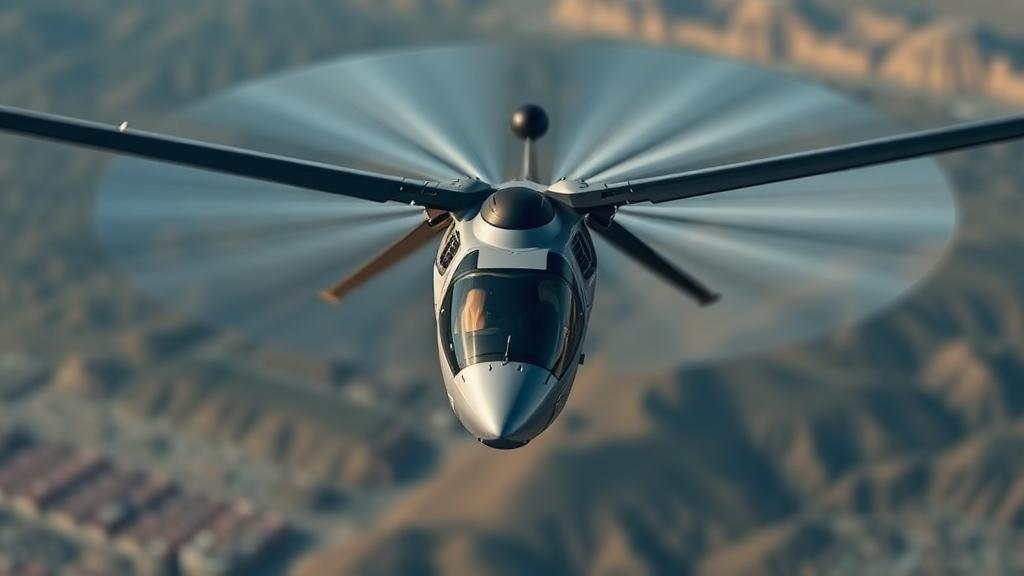
Helicopters and future electric air taxis may soon be able to reshape their own rotors in flight, but a new computational study shows that when a rotor’s diameter changes, the surrounding air behaves in ways that conventional rotor models never anticipated. Researchers at the State Key Laboratory of Helicopter Aeromechanics at Nanjing University of Aeronautics and Astronautics have carried out one of the most detailed numerical investigations yet of what happens, moment by moment, to the flow field around a rotor whose blades extend and retract during operation. Their work, published in the International Journal of Aeronautical and Space Sciences, reveals a suite of unsteady aerodynamic phenomena, including hysteresis effects, overshoot responses, and previously unseen blade–vortex and vortex–vortex interactions in the midspan region of the blade, that will directly shape how engineers design the next generation of adaptive rotors.
The concept of a variable-diameter rotor is not new. Engineers have flirted with the idea since at least the late 1960s, when early studies explored the Trac variable diameter rotor concept, followed by Air Force Flight Dynamics Laboratory studies in the 1970s and wind tunnel tests of a variable-diameter tiltrotor model in the 1990s. The appeal is straightforward: a rotor that can extend its diameter in hover gains lift efficiency, while retracting the blades in forward flight or high-speed cruise reduces drag, noise, and structural loads. More recent work has shown that combining variable rotor radius with variable rotational speed can significantly improve helicopter performance, and that span morphing can expand a rotorcraft’s usable flight envelope. Yet almost all previous analyses treated the morphing process itself as quasi-steady, assuming the aerodynamics simply track the geometric change. The new study challenges that assumption head-on.
Xiayang Zhang, Chencheng Gao, Wei Li, Bo Wang, Jiachen Yang, and Qijun Zhao developed a computational fluid dynamics framework specifically built to capture the physics of diameter morphing as it happens. The method solves the unsteady Reynolds-averaged Navier–Stokes equations, the workhorse equations of practical aerodynamics that describe how momentum, mass, and energy evolve in a turbulent flow with time-averaged turbulence modeling. Crucially, the team coupled these equations with a moving-embedded grid method, an overset grid approach in which separate mesh systems around each blade move, overlap, and exchange information with a background mesh. This allows the blades to slide spanwise, extending or retracting their tips, while the simulation continues to resolve the wake, the tip vortices, and the flow between blades without remeshing the entire domain at every instant.
Before trusting the method on morphing rotors, the researchers validated it against a well-studied benchmark: a rotor undergoing a rapid ramp change in collective pitch, the same kind of transient that has been measured experimentally on full-scale helicopter rotors since the 1950s. Rapid blade-pitch increases are known to produce thrust responses that lag behind the control input, and the team’s comparative analysis confirmed that their unsteady aerodynamic method reproduces these dynamic behaviors. This validation step matters because the same lag, or hysteresis, between geometry change and aerodynamic response is precisely what the researchers set out to quantify for diameter morphing, and a method that could not capture pitch transients could not be trusted with span transients.
With the method verified, the team simulated the full three-dimensional flow field of a rotor during diameter morphing in both hover and forward flight. The simulations exposed a rich set of interactions. As the blades extend or retract, the tip vortices, the concentrated spirals of air shed from each blade tip that dominate rotor noise and vibration, move spanwise along with the blade geometry. This spanwise motion of the wake system couples with the flow along the blade itself, and in the midspan region, far from the tip where blade–vortex interaction is normally expected, the simulations revealed novel blade–vortex interaction and vortex–vortex interaction phenomena. In other words, the very act of changing the rotor’s diameter creates new collision patterns between blades and vortices that a fixed-diameter rotor never produces, with implications for loading, vibration, and acoustic signatures that designers must now account for.
The study also quantified how the parameters of the morphing maneuver itself, rather than just the final geometry, control the aerodynamic outcome. The amplitude of the diameter change, how far the rotor extends or retracts, exhibits a broadly linear relationship with rotor thrust, a reassuringly simple rule of thumb for control engineers. The speed of the change is a different story: the faster the diameter morphs, the more unsteady the flow field becomes, with overshoots in the unsteady loads that temporarily exceed the values associated with either the starting or ending diameter. This overshoot response is an aerodynamic inertia effect, analogous to the way a rapid pitch increase on a conventional rotor produces a thrust spike before the induced velocity field catches up. For an intelligent variable-diameter rotor, it means the actuation system and the blade structure must be designed to tolerate transient loads well above the steady-state design loads.
Perhaps the most practically significant finding concerns the pattern of the diameter change. The researchers found that the morphing trajectory, the specific time history by which the diameter varies, affects both the peak magnitude and the phase of the aerodynamic loads. Moreover, the aerodynamic response is not symmetric: extending the diameter and retracting it produce different degrees of load change, a clear signature of hysteresis in which the flow field remembers its history. Similar hysteretic aerodynamic characteristics have been documented on variable-sweep morphing wings, and the new results extend that picture to rotating systems, where centrifugal and rotational effects add further complexity. The asymmetry means that a morphing schedule optimized for extension cannot simply be reversed for retraction.
The implications reach well beyond conventional helicopters. Variable-diameter concepts are being studied for tiltrotors, ducted fans in urban air mobility vehicles, quadcopters with variable speed and geometry, and even large wind turbines under adaptive rotor programs. As electric vertical-takeoff-and-landing aircraft crowd the design space, the ability to trade hover efficiency against cruise drag by reshaping the rotor in flight is one of the most promising levers for extending range and reducing noise. The Nanjing team’s results provide engineering guidance for exactly this design problem: how fast to morph, how far to morph, and which morphing patterns minimize the unsteady load penalties while achieving the desired performance change. Their conclusions suggest that morphing strategies should be treated as dynamic aerodynamic maneuvers in their own right, not merely as transitions between static configurations.
The work, supported by the National Natural Science Foundation of China and the State Key Laboratory of Helicopter Aeromechanics, arrives as computational power finally makes it feasible to resolve the full unsteady flow field of a morphing rotor rather than relying on simplified wake models. What the simulations reveal is that a rotor in the act of changing shape is a genuinely distinct aerodynamic object, governed by coupling between spanwise flow and tip vortices, by transient overshoots, and by history-dependent loads. For the engineers hoping to build rotors that breathe, extending to lift and contracting to cruise, the message of this study is clear: the transition is where the physics lives, and mastering it will determine whether morphing rotors deliver their promised revolution in flight efficiency.
Subject of Research: Unsteady aerodynamic characteristics of variable-diameter morphing rotors analyzed with CFD
Article Title: Aerodynamic Analysis of Rotor During Diameter Morphing Process
Article References: Zhang, X., Gao, C., Li, W., Wang, B., Yang, J., & Zhao, Q. (2026). Aerodynamic Analysis of Rotor During Diameter Morphing Process. International Journal of Aeronautical and Space Sciences. https://doi.org/10.1007/s42405-026-01237-0
Image Credits: AI Generated
DOI: 10.1007/s42405-026-01237-0
Keywords: variable-diameter rotor, rotorcraft, CFD, unsteady aerodynamics, blade–vortex interaction, tip vortices, morphing aircraft, hysteresis, URANS, helicopter performance, urban air mobility, overset grids
Cite Scienmag News
Grant Pearson. (October 5, 2026). Morphing Rotor Blades That Change Diameter Mid-Flight Reveal Strange Aerodynamics. Scienmag. https://scienmag.com/morphing-rotor-blades-that-change-diameter-mid-flight-reveal-strange-aerodynamics/
Grant Pearson. "Morphing Rotor Blades That Change Diameter Mid-Flight Reveal Strange Aerodynamics." Scienmag, 5 October 2026, https://scienmag.com/morphing-rotor-blades-that-change-diameter-mid-flight-reveal-strange-aerodynamics/. Accessed 5 October 2026.
Grant Pearson. "Morphing Rotor Blades That Change Diameter Mid-Flight Reveal Strange Aerodynamics." Scienmag. October 5, 2026. https://scienmag.com/morphing-rotor-blades-that-change-diameter-mid-flight-reveal-strange-aerodynamics/


