


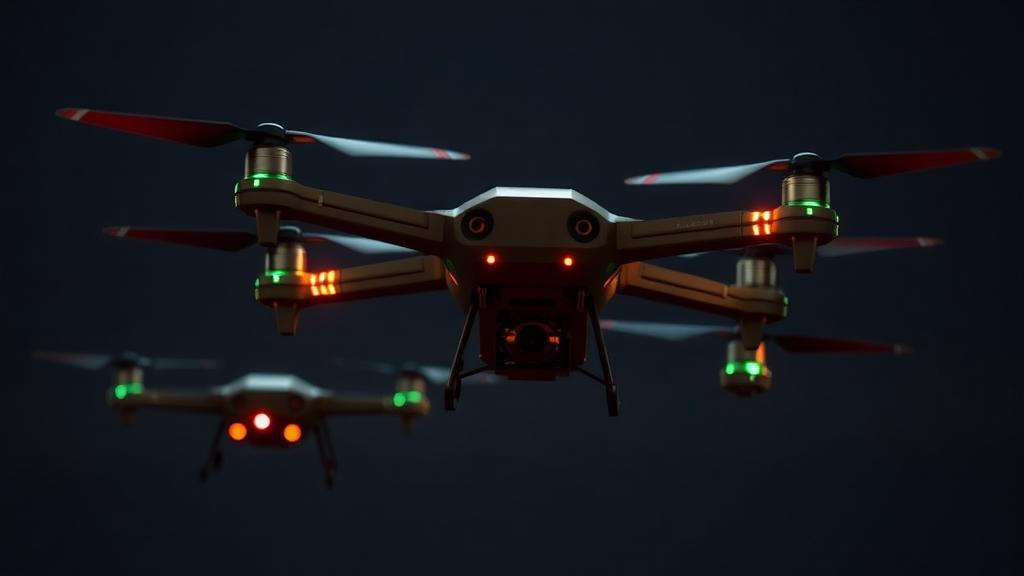
Imagine a swarm of autonomous drones locked in a simulated dogfight, each one deciding in real time how to maneuver, when to strike, and how to support its teammates — without a human pilot in the loop. That vision is moving closer to reality thanks to a new study published in the International Journal of Aeronautical and Space Sciences, in which researchers from Beihang University and Southwest University of Science and Technology in China report a significantly upgraded artificial intelligence framework for unmanned aerial vehicle (UAV) swarm air combat. The work, led by Qinglin Yang and corresponding author Daochun Li, tackles two stubborn weaknesses that have plagued standard multi-agent reinforcement learning algorithms in adversarial settings, and the results suggest that swarms trained with the new method not only win more often but also generalize to situations they have never seen before.
The foundation of the study is Multi-Agent Proximal Policy Optimization, or MAPPO, one of the most widely used algorithms for training teams of learning agents. In MAPPO, each agent learns a policy — a mapping from what it observes to what actions it should take — while a shared critic estimates how good a given situation is for the whole team. The approach has proven effective in cooperative games and robotic coordination tasks, but air combat is a far harsher teacher. The battlespace is highly dynamic, opponents adapt, and the set of entities a drone can perceive changes from moment to moment as aircraft enter and leave sensor range, get shot down, or split into new formations. Standard neural network architectures, which typically expect inputs of fixed size and fixed meaning, struggle to cope with this variability.
The first problem the researchers identified concerns what might be called tactical blindness. In a conventional setup, the observations fed into a drone’s neural network are often concatenated into a single vector, which means the network has no explicit way of knowing which data points describe the drone itself, which describe friendly allies, and which describe hostile adversaries. Yet that distinction is the essence of air combat: an ally’s position calls for cooperation, while an adversary’s position calls for evasion or attack. Moreover, when the number of visible entities changes, fixed-size input representations either waste capacity or break down entirely. The team’s answer is a Role-Aware Representation, or RAR, module that gives every observable entity a learnable embedding encoding its tactical role — ego, ally, or enemy — and then applies self-attention, the same mechanism that powers modern language models, to reason about the relationships among all entities at once.
Self-attention is what makes the architecture flexible. Because attention operates over sets rather than fixed vectors, the network can process a variable number of observable entities without retraining or architectural surgery. Each entity’s contribution to the drone’s internal representation is computed as a weighted combination of all entities, with the weights determined by compatibility scores between role embeddings and feature content. In practical terms, a drone can learn to focus intensely on the nearest threat while keeping a lighter watch on distant teammates, and it can do so in a way that scales smoothly as the swarm grows or shrinks. The researchers describe this as enabling role perception and relational reasoning, drawing on a broader line of research in relational deep reinforcement learning and graph-based neural networks that treats interactions between entities, rather than raw sensory data alone, as the key to intelligent behavior.
The second innovation addresses a subtler but equally consequential issue: how an AI agent explores. Reinforcement learning agents improve by trial and error, and the classic way to encourage experimentation is entropy regularization — a term added to the training objective that rewards the policy for remaining somewhat random. Standard implementations use a fixed entropy coefficient, meaning the appetite for exploration stays constant throughout training. In a chaotic adversarial environment this is wasteful. Early in training, when the agent knows little, broad exploration is valuable; later, when the policy is competent, persistent randomness degrades performance and burns through training samples inefficiently. The new framework’s Uncertainty-Driven Policy Regularization, or UDPR, module makes the exploration budget adaptive, tuning it moment by moment according to how uncertain the agent is about the consequences of its own actions.
The clever part of UDPR is how it measures uncertainty without requiring any extra supervision. The researchers train an auxiliary dynamics model — a small neural network whose only job is to predict the next latent state of the environment given the current state and action. When the agent encounters situations it has not mastered, this forward-prediction model makes large errors; when conditions are familiar, its predictions are accurate. The prediction error thus serves as an empirical proxy for model uncertainty, an idea related to curiosity-driven exploration methods that have gained traction in the machine learning community. RAUD-MAPPO feeds this uncertainty signal into the entropy coefficient: when the agent is uncertain, exploration is amplified; when it is confident, the policy is allowed to sharpen and exploit what it has learned. Exploration becomes directed rather than blind, which the authors identify as a key driver of improved sample efficiency.
Empirical evaluations reported in the paper show that the combined framework outperforms established baselines on the metrics that matter most in simulated air combat: asymptotic episodic rewards, meaning the long-run payoff the trained agents accumulate per engagement, and win rates against opposing forces. The gains are attributed to the synergy of the two modules — the RAR module supplies a richer, role-sensitive picture of the battlespace, while the UDPR module ensures that training effort is concentrated where the agents are most ignorant. Notably, the learned policy also exhibits interpretable cooperative behaviors, meaning that human observers can discern recognizable tactics, such as coordinated positioning and mutual support, in the way the trained drones behave, rather than inscrutable machine-generated maneuvers.
Perhaps the most striking claim is zero-shot generalization: policies trained in one set of combat scenarios performed competently in configurations they had never encountered during training. For autonomous systems intended for the real world, this property is arguably more important than raw benchmark scores, because no simulator can anticipate every future engagement. The combination of set-based, role-aware perception and uncertainty-calibrated exploration appears to produce policies that capture transferable principles of air combat rather than memorizing particular matchups. The work builds on a fast-growing literature, including prior studies by overlapping research groups on transformer-based maneuver decision-making for close-range combat, and on benchmarking efforts comparing centralized, decentralized, and federated reinforcement learning strategies for UAV swarms.
The broader context makes clear why this line of research is attracting attention. UAV swarms have been proposed for missions ranging from cooperative reconnaissance to electronic warfare, and military analysts worldwide view swarm autonomy as a potentially transformative capability. Earlier generations of combat decision systems relied on expert rules, receding-horizon optimal control, dynamic game theory, or Bayesian inference — approaches that require extensive human engineering and struggle against unscripted opponents. Multi-agent reinforcement learning promises policies that emerge from experience, but only if the underlying algorithms can handle the scale, heterogeneity, and uncertainty of real engagements. By attacking the representation problem and the exploration problem simultaneously, RAUD-MAPPO offers a template that could extend beyond air combat to any multi-robot domain where heterogeneous teams must coordinate against adaptive adversaries.
Caveats remain, as they always do in simulation-based research. The reported results come from simulated engagements, and transferring such policies to physical drones involves challenges the paper does not solve, including communication constraints, sensor noise, and safety certification of learned controllers. The authors declare no conflict of interest, and the study was communicated through the journal’s standard peer-review process, having been received in May 2026, revised in July, and accepted in August before publication in October 2026. Still, the trajectory is clear: as role-aware architectures and uncertainty-driven training mature, the gap between simulated swarms and deployable autonomous teams continues to narrow. What was recently a research question — can drones learn to fight as a coordinated team? — is steadily becoming an engineering problem, and the answer, increasingly, is yes.
Subject of Research: Multi-agent reinforcement learning for autonomous UAV swarm air combat decision-making
Article Title: Role-Aware Representation and Uncertainty-Driven Policy Regularization for UAV Swarm Air Combat
Article References: Yang, Q., Li, D., Yan, H., Li, F., & Jia, J. (2026). Role-Aware Representation and Uncertainty-Driven Policy Regularization for UAV Swarm Air Combat. International Journal of Aeronautical and Space Sciences. https://doi.org/10.1007/s42405-026-01284-7
Image Credits: AI Generated
DOI: 10.1007/s42405-026-01284-7
Keywords: UAV swarm, multi-agent reinforcement learning, MAPPO, air combat, self-attention, transformer, uncertainty-driven exploration, policy entropy, autonomous drones, zero-shot generalization, sample efficiency, Beihang University
Cite Scienmag News
Grant Pearson. (October 5, 2026). AI Learns to Fight as a Team: Role-Aware Algorithm Boosts UAV Swarm Air Combat. Scienmag. https://scienmag.com/ai-learns-to-fight-as-a-team-role-aware-algorithm-boosts-uav-swarm-air-combat/
Grant Pearson. "AI Learns to Fight as a Team: Role-Aware Algorithm Boosts UAV Swarm Air Combat." Scienmag, 5 October 2026, https://scienmag.com/ai-learns-to-fight-as-a-team-role-aware-algorithm-boosts-uav-swarm-air-combat/. Accessed 5 October 2026.
Grant Pearson. "AI Learns to Fight as a Team: Role-Aware Algorithm Boosts UAV Swarm Air Combat." Scienmag. October 5, 2026. https://scienmag.com/ai-learns-to-fight-as-a-team-role-aware-algorithm-boosts-uav-swarm-air-combat/


