


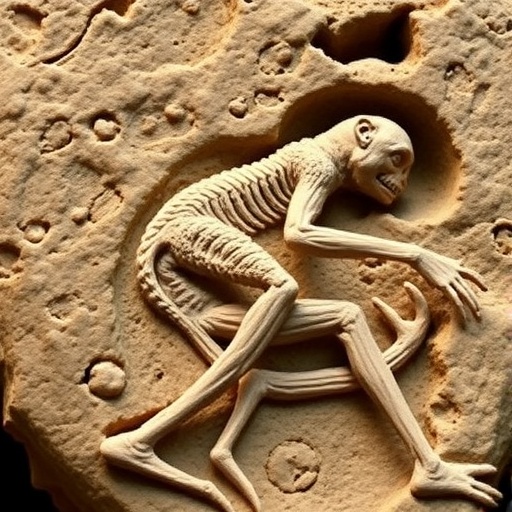
LAWRENCE, Kansas — A newly described fossil primate from Wyoming is forcing scientists to rethink how some of North America’s earliest primates evolved. The species, named Tetonius varleyorum, lived approximately 55 million years ago during the Eocene, a geologic interval marked by global warmth, rapid mammalian diversification and the early expansion of primate lineages across the Northern Hemisphere.
The discovery comes from Smiley Draw, a fossil site in Wyoming located outside the better-known Bighorn Basin. Researchers from the University of Kansas and the University of North Carolina at Greensboro say fossils from this less-studied locality complicate a classic evolutionary scenario involving Tetonius, a genus of omomyid primates. Omomyids were extinct early primates positioned near the evolutionary split that ultimately produced modern lemurs on one branch and monkeys, apes and humans on the other.
The new species was identified primarily from fossilized jaws and teeth, the parts of small mammals most likely to survive millions of years of erosion, burial and geological transformation. T. varleyorum was approximately the size of a modern mouse lemur, making its remains extremely difficult to locate in the field. Fossil crews must often screen or closely inspect large quantities of sediment to recover tiny teeth and jaw fragments that can reveal differences in species, diet and evolutionary relationships.
Parker Rhinehart, a doctoral student at the University of Kansas Biodiversity Institute and Natural History Museum and the study’s lead author, said the fossils add an important geographic dimension to the evolutionary history of Tetonius. For decades, much of the genus’s evolutionary narrative has been built from specimens collected in the Bighorn Basin. Those fossils were used to propose a gradual transformation from one form of Tetonius into another, with each successive population appearing to replace the previous one.
That model is known as anagenesis, a pattern in which a single lineage changes through time without splitting into multiple descendant branches. A landmark 1987 study by paleontologists Thomas Bown and Kenneth Rose presented the Bighorn Basin fossils as a prominent example of this type of evolutionary transition. The sequence became influential because it appeared to document anatomical change in a relatively orderly progression, particularly in the shape and structure of fossil Tetonius jaws.
The Smiley Draw fossils challenge the idea that this history was a simple, unbranching sequence. According to the new analysis, T. varleyorum does not fit neatly into the presumed transition represented by the Bighorn Basin specimens. Instead, its presence suggests that different Tetonius populations may have occupied separate regions at the same time, or that the genus diversified through branching speciation events rather than evolving along one continuous line.
This distinction matters because fossil records are often geographically incomplete. A sequence that appears linear in one sedimentary basin may look very different when fossils from neighboring regions are included. The apparent absence of branching can reflect a limited sampling area rather than the true evolutionary pattern. By adding Smiley Draw to the record, the researchers are expanding the geographic and ecological context needed to interpret the anatomical changes seen in early primates.
The new species also offers insight into Eocene biogeography, the study of how organisms were distributed across ancient landscapes. During this period, warm climates supported diverse mammalian communities, but local environments could still differ substantially. Populations separated by distance, habitat or geological barriers may have followed distinct evolutionary paths. The Smiley Draw fossils indicate that early omomyids may have been more regionally diverse than studies centered on a single basin had suggested.
The species name honors the Varley family, who operate a truck stop near the campground used by fossil researchers during fieldwork. Robert Anemone of the University of North Carolina at Greensboro discovered the Smiley Draw site and has led field investigations there for several years. K. Christopher Beard, a senior curator at the University of Kansas Biodiversity Institute and a professor in the Department of Ecology and Evolutionary Biology, is advising Rhinehart’s doctoral research.
The researchers plan to continue collecting at Smiley Draw, where additional jaws, teeth and other fragmentary remains could clarify the relationships among Tetonius species. Each new specimen may help determine whether the genus experienced multiple regional radiations, overlapping species distributions or more complex patterns of migration and replacement. For now, Tetonius varleyorum serves as a warning against treating apparently smooth evolutionary sequences as complete histories. In the fossil record, the missing branches may simply be waiting to be found.
Web References:
https://www.sciencedirect.com/science/article/pii/S0047248426000618
https://doi.org/10.1016/j.jhevol.2026.103867
References:
Journal of Human Evolution, DOI: 10.1016/j.jhevol.2026.103867
Cite Scienmag News
Gavin Prescott. (August 4, 2026). Wyoming’s Smiley Draw fossils reveal new insights into early primate evolution. Scienmag. https://scienmag.com/wyomings-smiley-draw-fossils-reveal-new-insights-into-early-primate-evolution/
Gavin Prescott. "Wyoming’s Smiley Draw fossils reveal new insights into early primate evolution." Scienmag, 4 August 2026, https://scienmag.com/wyomings-smiley-draw-fossils-reveal-new-insights-into-early-primate-evolution/. Accessed 3 September 2026.
Gavin Prescott. "Wyoming’s Smiley Draw fossils reveal new insights into early primate evolution." Scienmag. August 4, 2026. https://scienmag.com/wyomings-smiley-draw-fossils-reveal-new-insights-into-early-primate-evolution/


