


Electric vehicles may soon stop needing to stop. A new review published in the journal Discover Vehicles examines how dynamic wireless charging, a technology that transfers electricity to a moving car through the road beneath it, could be deployed on electric motorways to ease one of the biggest obstacles to electric vehicle adoption: the need to plug in and wait. The study, a structured literature review of 62 sources conducted by Anthony Jnr. Bokolo, maps the state of electric road systems, the techniques for generating energy from roadways, and the economic, social, technological and environmental factors that will determine whether dynamic wireless power transfer ever reaches large-scale deployment.
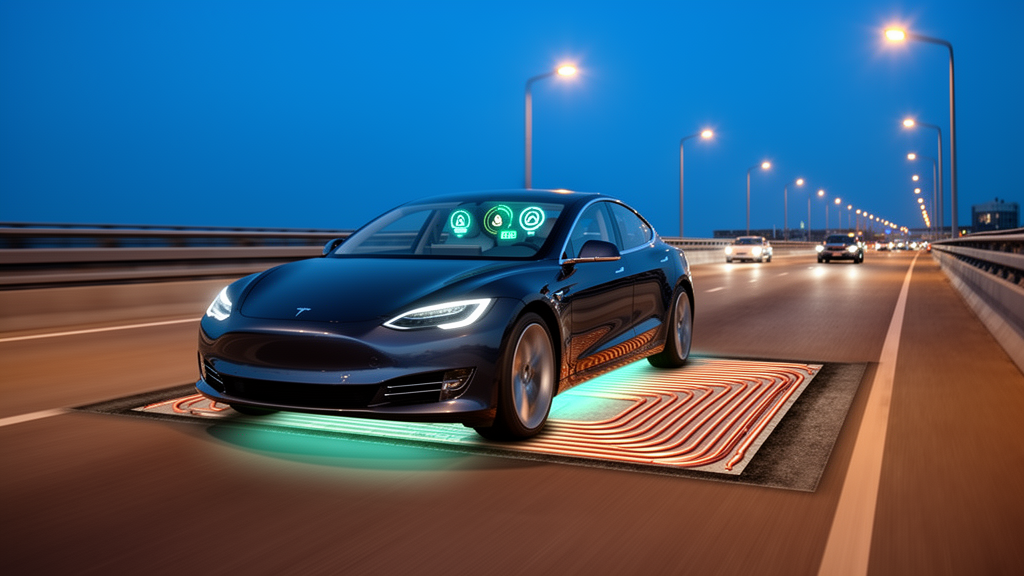
The core idea behind dynamic wireless charging is deceptively simple. Transmitter coils are embedded in the road surface and powered by an alternating current to direct current converter, which drives a high-frequency current that creates a time-varying magnetic field. A receiver coil mounted under the base of the vehicle couples magnetically with that field, inducing a voltage at its terminals. Onboard power electronics then control the induced current so that it flows into the battery. Because the transmitter coils are distributed continuously along a dedicated charging lane, the vehicle’s state of charge can be maintained along the motorway path, and the stored energy can be used once the car drives off the electrified section. In principle, the driver never stops at all.
The review frames this technology against a growing infrastructure problem. As electric vehicle numbers rise, charging point operators tend to install new static chargers only where demand is high enough to be economically attractive, which the author notes may have contributed to shortages of charging stations on motorways, particularly on less heavily used roads. Static charging works well for short urban trips, but for long-distance journeys electric vehicles must stop and charge, increasing loading times, travel times and, during high traffic, waiting times. Range anxiety, the fear of not reaching a planned destination, remains a documented barrier to adoption, and researchers cited in the review report that many users do not perceive electric vehicles as reliable precisely because the battery needs frequent recharging.
Electric road systems are presented as one answer. An electric road system is a transportation infrastructure that transmits electrical power to vehicles regardless of whether they are moving or stationary, using overhead catenary cables, ground-level conductive power supply, or ground inductive wireless transfer. The review categorises e-roads into two broad groups: roads that generate or harvest energy through piezoelectric, thermoelectric or photovoltaic technologies, and roads that transmit energy to vehicles. Overhead catenary systems are mostly used for heavy trucks, trams and trains, while ground conductive charging is typically used for static charging of electric cars operated by charging point operators. Wireless, or non-wired inductive, charging is the category that splits into stationary and dynamic variants, with dynamic wireless charging taking place while the vehicle is in motion along an e-road or e-motorway.
The technical details matter for how much energy actually reaches the battery. According to the review, the rate of power transferred from the transmitter coil to the receiver coil per kilometre is influenced by the vehicle’s average speed, acceleration, energy demand, driving efficiency, state of charge, vehicle weight, tyre condition, vehicle type and braking system. External variables also play a role, including traffic intensity on the road, the specific road stretch, the day of the week, the hour of the day and the season. European motorway driving codes permit speeds of 90 to 130 kilometres per hour, and the allowed speed helps determine the power absorbed by a vehicle charging through dynamic wireless power transfer. As one illustrative figure from the literature, an electric vehicle driving at 60 kilometres per hour on a charging lane could see its state of charge increase by roughly one percent per kilometre.
The review also surveys three techniques for generating energy from the roadway itself, which could in principle feed the road systems of the future. Piezoelectric technology, first proposed by Pierre and Jacques Curie in 1880, embeds piezoelectric materials in the asphalt so that mechanical energy from traffic loads is partially converted into electrical energy; an Israel-based company called Innowattech, working with the Israel Institute of Technology, created the first pavement-based power harvesting system of this kind in 2008. Thermoelectric approaches recover waste heat, either by absorbing heat from sun-irradiated asphalt through piped heat exchange or by using thermoelectric conversion materials that exploit thermal gradients to generate voltage. Photovoltaic roads embed solar cells in the pavement, an idea first proposed by American electrical engineer Scott Brusaw in 2009 using hexagonal solar paving tiles built up in five layers, from a toughened glass surface down to a base layer. The review notes that none of these approaches suits every roadway, and that solar radiation absorbed by road surfaces is still not widely used.
Deployment, however, faces a formidable list of barriers, which the review organises into economic, social, technological and environmental factors. On the technical side, electric vehicle batteries remain oversized, adding weight, volume and procurement cost, and they still suffer from short lifetimes, high cost, limited driving range and long charging times. Installing dynamic wireless power transfer infrastructure usually requires complete renovation of the road pavement and reconstruction of the lane housing the cabling and transmitter coils, and maintaining or upgrading electrical systems buried under the road may complicate future roadworks. Insufficient power grid capacity and the inefficiency of wireless power transfer itself could also impede full operation. Because vehicles do not remain in the charging lane for a whole journey, knowing the state of charge while on the lane is essential, and traffic planning analyses are needed on each motorway section to decide whether an e-motorway should be newly built or an existing road converted.
The economics are equally unsettled. Investment costs for large-scale e-road infrastructure are estimated in the literature at roughly 1.2 to 2.6 million euros per road kilometre, yet because no full-scale e-motorway network operates anywhere in the world, the investment costs of dynamic wireless power transfer remain uncertain, and few studies have assessed the irreversible investment and capital expenditure involved. Ownership and responsibility for maintenance costs need to be specified so that private operators of electric infrastructure on public roads can be regulated, and the review cites concerns that private shareholders may be unwilling to finance future maintenance. Taxation is unresolved too, with two possible mechanisms under discussion: a tax on electricity use and taxes that internalise external costs such as wear on the e-motorway and its charging infrastructure. Users of e-roads may also face relatively high pricing compared with conventional conductive and stationary charging, alongside low awareness and acceptance among road users.
Real-world demonstrations remain scarce because the technology is still in its early developmental stage. One of the best-known is the On-Line Electric Vehicle system developed by the Korea Advanced Institute of Science and Technology, which wirelessly charged electric buses on the institute campus using inductive power transfer from coils embedded under the road, ending prolonged charging stops and allowing smaller batteries for public transport. The review cautions, however, that the OLEV system’s power level and customised components are not compatible with the requirements of light-duty vehicles such as electric cars. In Sweden, two demonstration projects transmitted electricity to vehicles: the Elväg Gävle project, a two-kilometre track using overhead electric lines, and the e-road Arlanda project, which demonstrated conductive power transfer from the road surface over a two-kilometre test track. The Swedish government has stated a goal of developing a 3,000-kilometre e-road on motorways by 2035, positioned as one of the world’s first permanent e-motorways for trucks. Over the past five years, pilot projects have also begun in Germany, the United Kingdom, Norway, Italy, France and Austria in Europe; Japan, India and China in Asia; and the United States and Canada in North America.
What would success look like? The review cites findings from Börjesson and colleagues indicating that expanding e-roads in Sweden’s three biggest cities could contribute to a reduction in carbon emissions of nearly 1.2 million tonnes in 2030, corresponding to almost one-third of emissions from heavy vehicles such as trucks in the country. It also reports literature arguing that e-roads can offer a cost-effective method for reducing transport sector emissions, and that e-roads are preferred over static or conductive charging for heavier trucks because they avoid extra charging stops and detours, reducing hold-up costs that can exceed the transport costs themselves. Smaller batteries enabled by road charging would also lower the carbon footprint of battery production, use and disposal. The author concludes that dynamic wireless power transfer infrastructure could help electric vehicle users overcome range anxiety and support adoption, while acknowledging that the review rests entirely on qualitative secondary data. Future work, the paper notes, should survey users about their preferences, compare the efficiency, cost and technology readiness of different e-road categories, and explore how to improve piezoelectric, thermoelectric and solar energy generation in electric road systems.
Subject of Research: Dynamic wireless power transfer for charging electric vehicles on electric motorways as part of electric road systems
Article Title: Exploring the electrification of electric road systems for wireless electric vehicle charging on electric motorways
Article References: Bokolo, A. J. (2026). Exploring the electrification of electric road systems for wireless electric vehicle charging on electric motorways. Discover Vehicles, 2(1), Article 37. https://doi.org/10.1007/s44465-026-00044-x
Image Credits: AI Generated
DOI: 10.1007/s44465-026-00044-x
Keywords: electric vehicles, dynamic wireless charging, electric road systems, e-motorways, inductive power transfer, range anxiety, piezoelectric roads, solar roadways, charging infrastructure, transport decarbonisation, Sweden e-road, power transfer efficiency
Cite Scienmag News
Denise Maddox. (October 29, 2026). Wireless Charging Roads: How Electric Motorways Could Power EVs While Driving. Scienmag. https://scienmag.com/wireless-charging-roads-how-electric-motorways-could-power-evs-while-driving/
Denise Maddox. "Wireless Charging Roads: How Electric Motorways Could Power EVs While Driving." Scienmag, 29 October 2026, https://scienmag.com/wireless-charging-roads-how-electric-motorways-could-power-evs-while-driving/. Accessed 2 November 2026.
Denise Maddox. "Wireless Charging Roads: How Electric Motorways Could Power EVs While Driving." Scienmag. October 29, 2026. https://scienmag.com/wireless-charging-roads-how-electric-motorways-could-power-evs-while-driving/









