


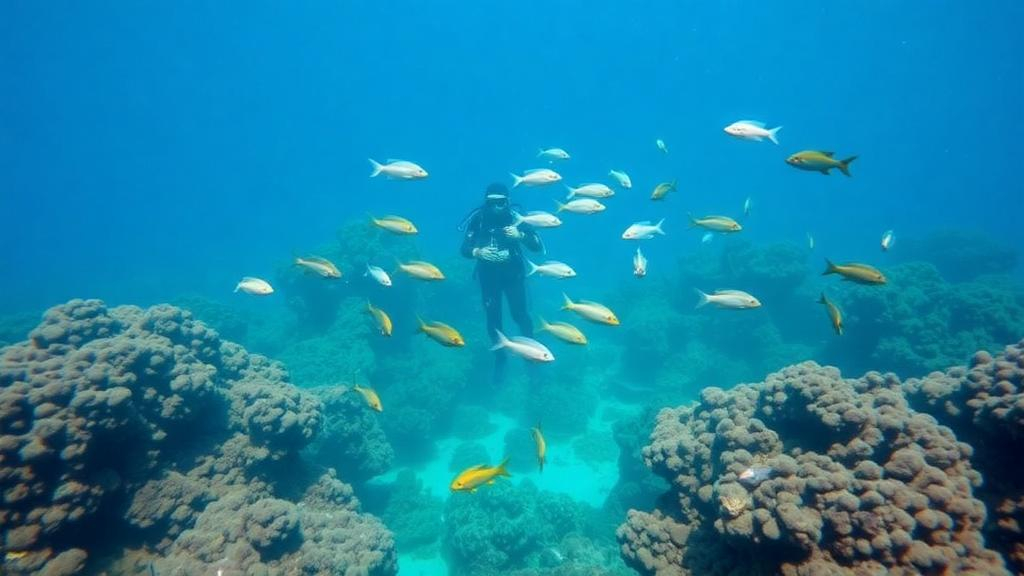
Off the industrial port city of Suhar, on the northern coast of the Sultanate of Oman, concrete and steel structures rest quietly on the seabed, doing the unglamorous work of rebuilding ocean life. These artificial reefs, deployed to mimic the shelter and complexity of natural coral formations, have become a living laboratory for scientists trying to answer one of marine ecology’s most practical questions: what actually determines how many fish species a reef can hold, and when? A new open-access study published in Discover Oceans by Abdullah Al Kindi and Sachinandan Dutta of Sultan Qaboos University offers one of the most detailed answers yet for the Sea of Oman, and its findings carry a counterintuitive twist. It is not the sun-drenched summer months that bring the richest, most balanced fish communities to these reefs, but the cooler, more turbulent waters of winter.
The research team surveyed nine sites in the waters off Suhar, dividing them into three depth categories: shallow artificial reefs at 11 to 13 meters, deep artificial reefs between 16 and 22 meters, and natural coral reef areas ranging from 21 to 23.5 meters. Data were collected during two contrasting cruises, one in July 2019 and one in January 2020, allowing a direct comparison between the peak of summer and the depths of winter. At each site, the researchers lowered a Conductivity, Temperature, Depth logger through the water column to record temperature, salinity, and dissolved oxygen continuously from surface to seafloor. Meanwhile, SCUBA divers swam transects with a diver-operated stereo-video rig, a pair of 4K cameras mounted on an 800-millimeter aluminum bar, filming just 30 centimeters above the seabed to capture every fish that crossed their path.
The stereo-video technique is one of the quiet revolutions of modern reef science. Unlike traditional visual censuses, which depend on a diver’s ability to identify and count fish in real time, stereo-video records everything and defers the analysis to the laboratory. The team imported their footage into EventMeasure software, which uses paired image coordinates from the left and right cameras to calculate the three-dimensional position of each fish, its distance from the cameras, and its size. That means abundance estimates are no longer distorted by the fact that some species flee divers while others curiously approach them, at least not in the same way, and body-length measurements come free with every count. The method is fast, relatively cheap, and simultaneously captures fish size, abundance, and habitat complexity, which is precisely why it has become a standard tool for reef monitoring worldwide.
What the footage revealed was a fish community with a stable core and a shifting periphery. Three species, the common snapper Lutjanus lutjanus, the variable-lined fusilier Caesio varilineata, and Ehrenberg’s snapper Lutjanus ehrenbergii, were present at every site in both seasons, forming what ecologists call a persistent assemblage. The Lutjanidae are no ecological footnote in Oman: this family of snappers yielded 7,150 tonnes in 2020, worth 2.7 million Omani Rials, making it one of the country’s most economically important benthic fish groups. Other species were far more seasonal. The grunter Pomadasys aheneus, for instance, showed a strong association with winter, appearing reliably in the cooler months and largely vanishing in summer. In total, the team recorded 15 species in summer and 12 in winter, a difference that sounds modest until you look at how those species were distributed.
That distribution is where the story gets interesting. Although summer hosted more species overall, the winter community was measurably more diverse and more evenly balanced. The Shannon-Wiener diversity index, which combines species richness with how equitably individuals are spread among those species, rose from 0.984 in summer to 1.124 in winter. Pielou’s evenness index climbed even more sharply, from 0.522 to 0.701, while Simpson’s dominance index fell from summer to winter, indicating that no single species monopolized the reef in the cooler season. Species richness, by contrast, was nearly identical across seasons, at 1.042 in summer and 1.047 in winter. In plain terms: summer reefs were dominated by a few abundant players, while winter reefs hosted a more democratic community in which no species towered over the rest. For fisheries managers, evenness matters, because communities with balanced abundances are generally considered more resilient and ecologically healthy.
Depth turned out to be the hidden hand shaping much of this pattern. The interaction plots in the study show that Shannon diversity at shallow artificial sites jumped from 0.84 in summer to 1.18 in winter, while deep sites stayed essentially flat year-round. Species richness told the mirror-image story: deep artificial sites were richer in summer, at 1.24, than in winter, at 0.81, while natural reef sites peaked in diversity and richness during winter. Statistical analysis confirmed that these season-by-depth interactions were significant, with non-parallel lines in the interaction plots and a three-way ANOVA yielding p-values below 0.05. In other words, the effect of season on fish diversity cannot be understood without also knowing the depth, and the effect of depth cannot be understood without knowing the season. Any attempt to design or site an artificial reef without accounting for both variables would be flying blind.
The physical chemistry of the water column explains why. The Sea of Oman is an extreme environment by reef standards, with surface temperatures swinging from roughly 35 degrees Celsius in summer to 23 degrees in winter, and strong seasonal upwelling that reverses the usual latitudinal temperature gradient. The CTD profiles showed that in summer, dissolved oxygen fell steeply with depth, producing a near-perfect negative correlation between depth and oxygen concentration of r = −0.985, statistically significant at p = 0.000. In winter, the relationship flipped: depth correlated positively with dissolved oxygen, at r = 0.828 with p = 0.010, and positively with evenness as well, at r = 0.704 with p = 0.030. The authors attribute this seasonal flip to differences in vertical mixing between the two seasons, with winter storms and cooling breaking down the stratification that traps oxygen near the surface in summer. Salinity, which varies only between about 35 and 37.4 parts per thousand in this sea, correlated strongly with depth in both seasons and with dissolved oxygen, negatively in summer and positively in winter.
A principal component analysis added a final layer of insight. Winter samples clustered tightly together across all depths, painting a picture of a well-mixed, homogeneous environment in which fish everywhere experienced similar conditions. Summer samples, by contrast, scattered widely along the second principal component, with shallow sites showing the greatest dispersion, evidence of depth-driven stratification and higher environmental unpredictability during the hot months. This makes ecological sense of the diversity numbers: when the environment is stable, as in winter, fish communities can spread their abundances more evenly because no species gains an overwhelming competitive edge. When the environment stratifies and fluctuates, as in summer, tolerant or dominant species take over, and dominance rises. The study also notes that competition for food and space between seasons, and the tendency of fish to migrate toward preferred conditions, likely contribute to the seasonal shifts in evenness.
The implications reach well beyond Suhar. Oman’s fisheries sector contributed 1.3 percent of national GDP in 2018 and remains a pillar of food security, while coral reefs in the wider region have suffered catastrophic bleaching events, including the 2017 bleaching in the southern Persian/Arabian Gulf. Artificial reefs are increasingly promoted as a tool to buffer these losses by providing alternative habitat and supporting fish populations, but this study shows they are not a one-size-fits-all solution. Their effectiveness depends on depth, season, and the oxygen dynamics of the water column above them. Natural reefs in the study proved more stable and more diverse in winter, reinforcing their value as reference ecosystems, while artificial reefs showed depth-specific seasonal responses that managers must plan around. The authors argue that their correlation and diversity data provide the foundation for future time-series models of fish abundance and water quality, the kind of predictive tooling that could transform reef deployment from an art into a science. For a region on the front line of ocean warming, that is not an academic luxury. It is a blueprint for keeping fish on the reef, and on the plate, for decades to come.
Subject of Research: Seasonal and depth-related effects of temperature, salinity, and dissolved oxygen on fish diversity in artificial reef ecosystems of the Sea of Oman
Article Title: Seasonal variability of physico-chemical parameters and their effects on fish diversity in artificial reefs of the Sea of Oman
Article References: Al Kindi, A., & Dutta, S. (2026). Seasonal variability of physico-chemical parameters and their effects on fish diversity in artificial reefs of the Sea of Oman. Discover Oceans, 3(1), Article 21. https://doi.org/10.1007/s44289-026-00133-5
Image Credits: AI Generated
DOI: 10.1007/s44289-026-00133-5
Keywords: artificial reefs, Sea of Oman, fish diversity, dissolved oxygen, temperature, salinity, Shannon diversity index, stereo-video, depth, seasonality, Oman, fisheries management
Cite Scienmag News
Violet Maxwell. (October 3, 2026). Winter Waters, Richer Reefs: How Season and Depth Shape Fish Life on Oman’s Artificial Reefs. Scienmag. https://scienmag.com/winter-waters-richer-reefs-how-season-and-depth-shape-fish-life-on-omans-artificial-reefs/
Violet Maxwell. "Winter Waters, Richer Reefs: How Season and Depth Shape Fish Life on Oman’s Artificial Reefs." Scienmag, 3 October 2026, https://scienmag.com/winter-waters-richer-reefs-how-season-and-depth-shape-fish-life-on-omans-artificial-reefs/. Accessed 5 October 2026.
Violet Maxwell. "Winter Waters, Richer Reefs: How Season and Depth Shape Fish Life on Oman’s Artificial Reefs." Scienmag. October 3, 2026. https://scienmag.com/winter-waters-richer-reefs-how-season-and-depth-shape-fish-life-on-omans-artificial-reefs/


