


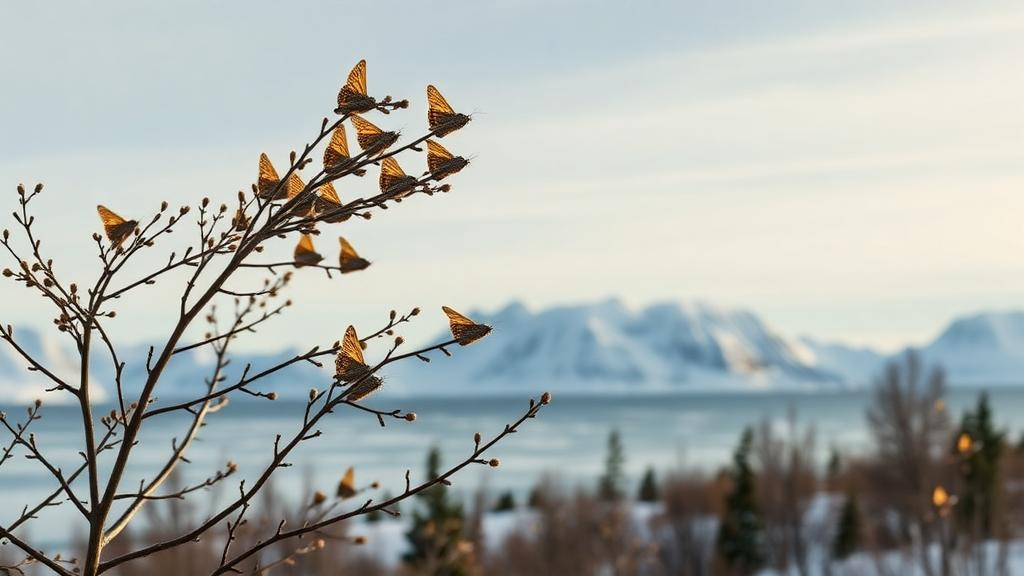
Hundreds of larch budmoths unexpectedly appeared on Vize Island, a bleak and previously invertebrate-free outpost in the Russian High Arctic, during an exceptionally warm summer in 2020. The insects, identified as the larch budmoth Zeiraphera griseana, were found alive or freshly dead between 16 July and 2 August along the sandy banks of ponds, rivers and streams. Their arrival was not the result of a local population: Vize Island lies about 575 kilometres from the nearest mainland and has no conifer forest suitable for the species’ larval host plants. Researchers concluded that strong winds blowing from the Siberian mainland carried the moths across the Kara Sea in a journey of at least 1,200 kilometres. The episode provides striking evidence that even the most isolated Arctic islands can receive large insect migrations, potentially opening a route for boreal species to colonize polar habitats as the climate warms.
Vize Island occupies the northern part of the Kara Sea at 79°30′N, 76°59′E. It covers 288 square kilometres and rises to only 22 metres above sea level, forming a low, hilly landscape of rivers, streams, sandy valleys and forb-and-cryptogam tundra. Vascular plants and lichens cover only a small fraction of the ground, and the island lies near the climatic boundary at which mean summer temperatures are barely above freezing. Before the 2020 expedition, no terrestrial invertebrates had been recorded there. By contrast, the wider High Arctic has a sparse but growing record of insect visitors. Ten Lepidoptera species, including residents and migrants, have been found in Svalbard, eight are known from the northern island of Novaya Zemlya, and four have been collected on Bolshevik Island in the Severnaya Zemlya Archipelago. Franz Josef Land had no reported Lepidoptera species.
The Arctic and Antarctic Research Institute expedition reached Vize Island on 9 July 2020 to study ivory gulls, whose scientific name is Pagophila eburnea. The researchers also conducted the island’s first systematic biodiversity survey. They searched vegetation with entomological nets, examined flowers and moss carpets, and recorded insects during broader faunistic surveys. Collected moths were preserved in paper envelopes, and their identification was confirmed through examination of male genitalia. Some specimens were later relaxed, pinned and deposited in the Zoological Institute in St. Petersburg and the Finnish Museum of Natural History in Helsinki. Despite the team’s broad effort, the larch budmoth was the only terrestrial invertebrate observed or collected during the expedition.
The first moths were seen on 16 July near a pond beside the island’s meteorological station. Three days later, investigators encountered multiple freshly dead individuals along the sandy banks of shallow streams across the tundra. In one surveyed section, they counted 215 dead moths within a 5-by-112-metre area, equivalent to roughly one moth per 2.6 square metres. Most lay at the water’s edge among fine floating debris. Individual flying moths were subsequently recorded near the station on 20 and 24 July, 27 July and 2 August, while another walked across grass, lichen and moss vegetation on 30 July. A final survey route on 2 August crossed 16 rivers and streams and revealed more dead moths, although none appeared along a one-kilometre section of the island’s northern beach.
Weather records helped link the unusual infestation to a specific atmospheric event. The summer was exceptionally warm, with mean July and August temperatures of 1.98 and 4.45 degrees Celsius, about 2.4 degrees above the climatic norm. The decisive feature, however, was wind. From 12 to 14 July, a moderate breeze of 9–10 metres per second, gusting to 15 metres per second, blew from the southeast, the direction of the nearest continental landmass. It was the only event of that kind recorded during July and August. The first moths appeared two days after the winds subsided, a sequence consistent with a long-distance transport event rather than emergence from a resident population.
The moth’s biology makes the source of the influx difficult to interpret in any other way. Zeiraphera griseana is widely distributed across the Palearctic and reaches or approaches the northern limit of coniferous forests in Finland, the Kola Peninsula and the Taymyr Peninsula. Its larvae feed on the needles of different conifers, including larch, making the trees themselves unsuitable hosts on windswept Vize Island. The species is also known for migratory behavior, usually at regional scales and in association with severe defoliation during outbreaks. Large Siberian outbreaks have caused extensive damage to larch forests since at least 1966, and an outbreak was reported in 2020 over more than 75,000 hectares in the northern Krasnoyarsk region, near Norilsk and the Taymyr Peninsula.
That northern Siberian outbreak was probably the source of the moths observed on Vize Island. The minimum distance from the affected area to the island was calculated at approximately 1,200 kilometres. The investigators proposed that the insects took flight during warm, dry conditions near Norilsk on 13 July, the only day between 7 and 14 July when winds in the region came from the south. If wind speed remained comparable to the 9–10 metres per second recorded at Vize, the journey could have taken about 34 to 38 hours. This estimated duration is shorter than the time previously calculated for diamondback moths to reach Svalbard in 2000. Although long-distance routes may vary in speed and direction, the weather observations and moth phenotype provide a coherent explanation for how such an unexpected concentration arose.
Many of the migrants were not merely airborne casualties. At least one remained alive and active for 20 days after arriving, and others were observed flying or walking in the island’s tundra. Their survival was notable because the local conditions remained difficult for a boreal insect despite the warm summer. The finding indicates that a flight of roughly 1,200 kilometres did not critically exhaust the moths’ stored resources. It also challenges the assumption that Arctic islands are effectively sealed from continental insect populations. Earlier records had shown that Z. griseana could reach isolated places: dozens were observed on sea ice in the East Siberian Sea in 1946, and large numbers were seen in tundra near Ust-Tareya in 1969, roughly 500 kilometres beyond continuous larch forest.
The broader implication is that physiological barriers do not necessarily prevent the first stage of colonization by southern insects. Movement of this magnitude can deliver multiple individuals directly from a continental outbreak, increasing the chance that some will encounter suitable food, shelter and reproductive conditions. Vize Island’s moths did not establish a local population, and the presence of host-free tundra does not mean they could reproduce there. Nevertheless, their arrival demonstrates that high-Arctic islands are less isolated from insect migrants than once thought. As Arctic temperatures rise and conditions become more favorable, repeated windborne arrivals could give boreal species opportunities to establish themselves, transforming the composition of polar ecosystems through long-distance dispersal rather than gradual movement across neighboring terrain.
Subject of Research: Long-distance wind transport of larch budmoths to Vize Island in the Russian High Arctic
Article Title: Carried with the wind: mass occurrence of Zeiraphera griseana (Hübner, 1799) ( Lepidoptera , Tortricidae ) on Vize Island (Russian High Arctic)
Article References: Gavrilo, M. V., Chupin, I. I., & Kozlov, M. V. (2021). Carried with the wind: mass occurrence of Zeiraphera griseana (Hübner, 1799) (Lepidoptera, Tortricidae) on Vize Island (Russian High Arctic). Nota Lepidopterologica, 44, 91-97. https://doi.org/10.3897/nl.44.63662
Image Credits: AI Generated
DOI: 10.3897/nl.44.63662
Keywords: Larch budmoth, Vize Island, Arctic migration, Insect dispersal, Strong winds, Kara Sea, High Arctic, Siberian larch, Climate change, Insect colonization, Carried, wind
Cite Scienmag News
Gavin Prescott. (October 19, 2026). Wind Carries Larch Budmoths to Remote Arctic Island. Scienmag. https://scienmag.com/wind-carries-larch-budmoths-to-remote-arctic-island/
Gavin Prescott. "Wind Carries Larch Budmoths to Remote Arctic Island." Scienmag, 19 October 2026, https://scienmag.com/wind-carries-larch-budmoths-to-remote-arctic-island/. Accessed 19 October 2026.
Gavin Prescott. "Wind Carries Larch Budmoths to Remote Arctic Island." Scienmag. October 19, 2026. https://scienmag.com/wind-carries-larch-budmoths-to-remote-arctic-island/


