


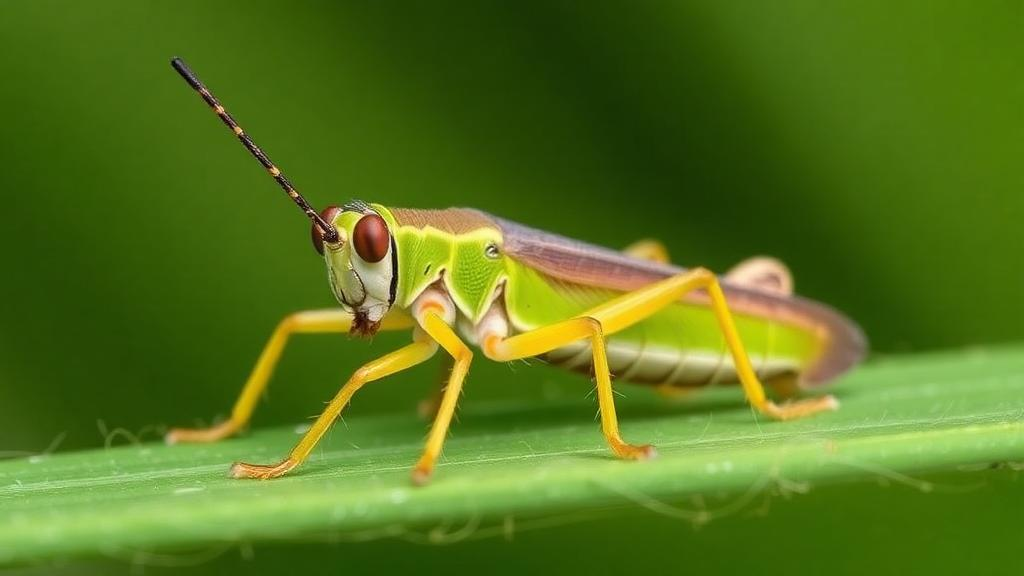
A grasshopper described as a distinct species in 1963 has turned out to be a duplicate of a better-known insect first named more than a century earlier. A team of orthopterists reached that conclusion after reexamining the preserved male type specimen of Acrida bara and comparing it with a broad series of Acrida sulphuripennis specimens from Africa. The study establishes A. bara as a junior synonym of A. sulphuripennis, reducing the number of recognized Acrida species and illustrating how isolated museum specimens can create misleadingly convincing evidence of biodiversity.
The investigation focused on the male holotype of A. bara, a single specimen collected at Lushoto in Tanzania’s West Usambara Mountains and deposited in the Natural History Museum Budapest, Hungary. Steinmann named the insect in 1963, but no additional examples had been reported during the following decades. Because the original description relied on one insect and did not directly compare it with A. sulphuripennis, the new study placed the type under close anatomical and visual scrutiny alongside specimens assembled from East Africa and other parts of the continent.
Acrida is a diverse genus of short-horned grasshoppers in the subfamily Acridinae. Its members occur across the Mediterranean region, Africa and Asia, and many live in grasslands, open fields and disturbed ground. A. sulphuripennis is especially associated with newly exposed habitats: it colonizes fallow land, roadside verges and other ruderal vegetation. It has been recorded from sea level to the lower edge of montane forest at about 1,800 metres on Mount Kilimanjaro and can occur alongside the closely related A. bicolor.
The most conspicuous field distinction between those two familiar species is the color of the hind wings. A. bicolor has matte yellow hind wings, whereas A. sulphuripennis carries vivid yellow-to-orange coloration. The original description of A. bara offered no information about its hind-wing color, probably because the holotype’s folded wings concealed that feature. More importantly, two anatomical statements in the 1963 description did not match the specimen as photographed in the new study: the tip of the tegmen was described as parabolic rather than straight and pointed, and the dorsal projection of the male subgenital plate was said to be markedly shorter than the plate’s apex.
When the holotype was compared directly with male A. sulphuripennis from Zanzibar, the species’ type locality, the researchers detected no meaningful differences in the form of the male abdominal apex, the wings, the pronotum, coloration or venation. The comparison also included specimens from the West and East Usambara Mountains, the vicinity of Kilimanjaro and other localities in Tanzania. Photographs of the types and comparison specimens show matching lateral profiles, head and pronotal structures, and terminal abdominal anatomy, allowing the investigators to test features that the original author had apparently misinterpreted.
Broader sampling did not reveal a consistent boundary between the two names. Specimens of A. sulphuripennis housed at the Natural History Museum in London and originating from Zambia and KwaZulu-Natal in South Africa, as well as other African countries, shared the diagnostic structure of the A. bara type. Some variation in body size and coloration was evident, but the researchers did not identify structural differences that could consistently separate the two nominal taxa. The evidence therefore supports treating A. bara and A. sulphuripennis as populations of one widespread species rather than as separate evolutionary lineages.
The result illustrates a familiar challenge in animal taxonomy. A species described from a single specimen may appear distinctive because there are no nearby populations available for comparison, while differences caused by individual variation, geographic conditions or preserved condition can be mistaken for stable anatomical characters. A. sulphuripennis itself was first described from Zanzibar by Gerstaecker in 1869 with a very brief account, and Steinmann later described A. bara from a distant site in the West Usambara Mountains without directly comparing his type with the earlier species. When specimens from intervening and widely separated localities became available, the apparent gap between the names disappeared.
This pattern is not unusual among grasshoppers, whose coloration, body size and external form can vary considerably across their ranges. The researchers noted that several widespread Acrida species have accumulated numerous synonyms after initially being described as separate taxa. Examples include A. bicolor, A. cinerea, A. exaltata and A. turrita. Similar consolidation has occurred in related grasshopper groups, including Acrotylus and Gastrimargus, where apparent geographic differences proved to represent variation within populations rather than separate species.
Museum specimens were central to resolving the case. The A. bara holotype provided the only direct link to the 1963 name, while series of A. sulphuripennis from Zanzibar, mainland Tanzania and other African regions supplied the population-level context that a lone type specimen could not provide. For Acrida, and for taxonomically difficult insects more generally, such collections function as more than archives of discovery: they are comparative evidence for testing whether a historically named form represents a genuine species or an isolated variant. The formal synonymy leaves A. sulphuripennis as the accepted name, while preserving the history of how its range and variation came to be understood.
Subject of Research: Morphological and museum-based reevaluation of the grasshopper species Acrida bara
Article Title: Acrida bara , synomymous with A. sulphuripennis ( Orthoptera , Acrididae , Acridinae )
Article References: Hemp, C. (2023). Acrida bara, synomymous with A. sulphuripennis (Orthoptera, Acrididae, Acridinae). Journal of Orthoptera Research, 32(2), 115-117. https://doi.org/10.3897/jor.32.93481
Image Credits: AI Generated
DOI: 10.3897/jor.32.93481
Keywords: Acrida bara, Acrida sulphuripennis, grasshoppers, taxonomic synonymy, museum specimens, species identification, African biodiversity, morphology, Orthoptera, Acrida, bara, synomymous
Cite Scienmag News
Gavin Prescott. (October 19, 2026). Grasshopper Type Found to Be a Duplicate Species. Scienmag. https://scienmag.com/grasshopper-type-found-to-be-a-duplicate-species/
Gavin Prescott. "Grasshopper Type Found to Be a Duplicate Species." Scienmag, 19 October 2026, https://scienmag.com/grasshopper-type-found-to-be-a-duplicate-species/. Accessed 13 November 2026.
Gavin Prescott. "Grasshopper Type Found to Be a Duplicate Species." Scienmag. October 19, 2026. https://scienmag.com/grasshopper-type-found-to-be-a-duplicate-species/




