


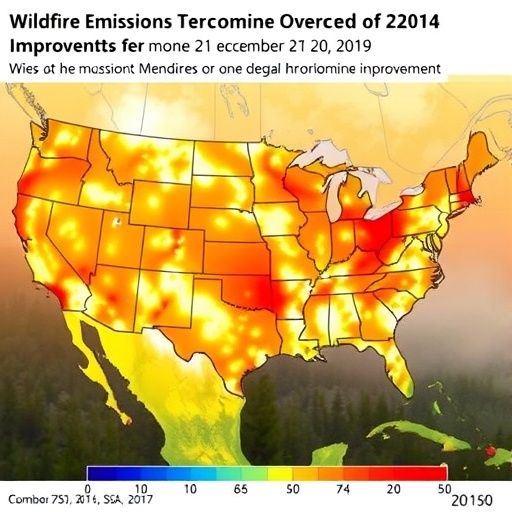
After a prolonged period of consistent decline spanning over a decade, surface ozone (O₃) levels in North America have undergone an unexpected reversal starting in 2015, a phenomenon that puzzles climate scientists and policymakers alike. Despite stringent regulatory efforts aimed at reducing anthropogenic emissions of ozone precursors, recent studies reveal that this decline has not only stalled but reversed, with surface ozone concentrations showing a disturbing upward trend. This counterintuitive shift raises key questions about the underlying factors responsible for this trend, with emerging evidence pointing towards wildfires as a significant and previously underestimated driver of changing atmospheric chemistry.
The intricacies of surface ozone formation involve complex interactions between nitrogen oxides (NOₓ), volatile organic compounds (VOCs), sunlight, and meteorological conditions. Historically, regulatory policies have focused on limiting industrial emissions, vehicular exhaust, and other anthropogenic sources of ozone precursors. Such interventions had yielded measurable successes, driving a steady decline in ground-level ozone. However, the data after 2015 indicate a plateauing and subsequent increase in ozone concentrations, suggesting that natural sources or shifting environmental dynamics might now be playing a dominant role.
A groundbreaking study by Weizhi Deng and colleagues harnesses the power of advanced deep learning algorithms to untangle this conundrum. Researchers synthesized sparse datasets from the Environmental Protection Agency (EPA), satellite observations, and meteorological models to generate a high-resolution, daily surface ozone dataset with 1-kilometer spatial granularity across North America, spanning from 2003 to 2024. This approach allowed an unprecedented spatial and temporal examination of ozone dynamics, providing fine-scale insights that were previously unattainable due to data sparsity and atmospheric complexity.
The analysis revealed a critical temporal inflection point: a consistent decrease in ozone levels at a rate of approximately 0.65 parts per billion (ppb) per year prior to 2015 reversed to an increase at 0.13 ppb annually subsequently. Further decomposition of trends indicated that, if it were not for emissions from wildfires, ozone levels would have continued to decline at a moderated rate of 0.25 ppb per year beyond 2015. These findings underscore the pivotal role wildfire emissions play in modulating regional and continental ozone concentrations in the context of a changing climate.
Wildfires contribute significantly to atmospheric chemistry through the release of precursors such as nitrogen oxides and volatile organic compounds, which facilitate the photochemical production of ozone. In years marked by extreme fire activity, particularly from 2022 to 2024 in Canada, these emissions spiked dramatically, exposing millions of North Americans to unhealthy levels of surface ozone exceeding the United States’ regulatory threshold of 70 ppb. The intensity and scale of these events are linked not only to natural variability but also to anthropogenic climate change, which has exacerbated fire frequency and intensity through rising temperatures and altered precipitation patterns.
The health consequences of rising wildfire-induced ozone exposure are profound. Deng et al. quantified the public health impact by correlating ozone trends with premature mortality rates, estimating that since 2013, wildfire-associated ozone emissions have contributed an additional 318 premature deaths annually in North America. This increase represents a concerning 46% rise in mortality rates attributable to wildfire-sourced ozone. These figures illuminate the broader societal implications of atmospheric chemistry shifts driven by natural but climate-amplified perturbations.
Furthermore, the study’s temporal scope encompasses recent wildfire extremes, particularly those observed in Canada, which have profoundly shaped air quality across North America. The data suggests that wildfire emissions alone have subjected over 43 million people to ozone concentrations that breach health-based air quality standards. The scale of these exposures has significant policy ramifications, especially concerning ongoing discussions about tightening air quality regulations. Deng and colleagues argue that the current wildfire-driven episodes pose formidable challenges to policymakers attempting to lower ozone standards.
Indeed, the notion of tightening the ozone standard faces practical obstacles given these wildfire influences. The authors model hypothetical scenarios where the ozone standard is reduced from 70 ppb to more stringent levels such as 65 ppb or even 60 ppb. Under these tightened standards, the number of individuals residing in areas that would be noncompliant (nonattainment) increases sharply—from 60% of the U.S. population (202 million people) at 65 ppb to 87% (294 million people) at 60 ppb. The data suggest that wildfire emissions undermine regulatory progress, complicating efforts to mitigate ozone pollution through anthropogenic emission controls alone.
This predicament highlights the emerging reality that natural and climate-driven sources of pollution, such as wildfires, have begun to dominate over traditional man-made sources in determining regional air quality. It calls for a paradigm shift in environmental policy, where wildfire management and climate adaptation strategies are integrated into air quality regulatory frameworks. Addressing these challenges requires coordinated efforts across federal, state, and local agencies, as well as innovative approaches to fire prevention, rapid response, and landscape management.
Moreover, the findings by Deng et al. accentuate the need for enhanced monitoring infrastructure and sophisticated modeling techniques. The incorporation of deep learning allowed extraction of nuanced signals from noisy and incomplete observational data, setting a new standard for air quality assessment. Such technological advancements are crucial for capturing real-time dynamics and informing public health advisories during wildfire events, thereby mitigating exposure risks for vulnerable populations.
In summary, the reversal of the long-standing decline in surface ozone concentrations across North America since 2015 elucidates the profound influence of wildfires, amplified by climate change, on atmospheric chemistry and public health. This phenomenon spotlights the intricate interplay between natural systems and human activity, demanding a reevaluation of air quality governance in an era of escalating wildfire frequency and intensity. The path forward necessitates integrating interdisciplinary scientific insights with adaptive policy frameworks to sustain air quality gains and protect public health amidst mounting environmental challenges.
News Publication Date: 4-Jun-2026
Web References: DOI:10.1126/science.aed3197
Cite Scienmag News
Russell Cooper. (June 4, 2026). Wildfire Emissions Undermine Over a Decade of Ozone Improvement. Scienmag. https://scienmag.com/wildfire-emissions-undermine-over-a-decade-of-ozone-improvement/
Russell Cooper. "Wildfire Emissions Undermine Over a Decade of Ozone Improvement." Scienmag, 4 June 2026, https://scienmag.com/wildfire-emissions-undermine-over-a-decade-of-ozone-improvement/. Accessed 4 September 2026.
Russell Cooper. "Wildfire Emissions Undermine Over a Decade of Ozone Improvement." Scienmag. June 4, 2026. https://scienmag.com/wildfire-emissions-undermine-over-a-decade-of-ozone-improvement/


