


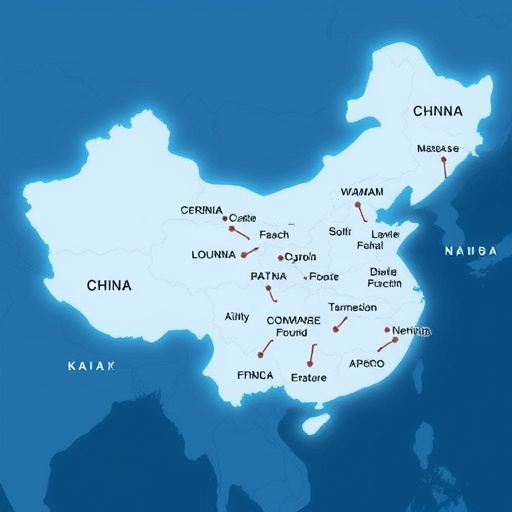
China’s hydrogen ambitions are moving from isolated demonstration projects toward a nationwide logistics challenge: how to produce hydrogen in the right places, move it across enormous distances and deliver it reliably to factories, vehicles and energy systems. A new study by C. Bi, F. Guo and N. Zhang examines this challenge across Chinese provinces, focusing on the links between hydrogen production and transportation. Published in Communications Earth & Environment, the research addresses a question that could determine whether hydrogen becomes a practical low-carbon fuel or remains a collection of expensive regional experiments.
Hydrogen is often described as a clean energy carrier, but its climate value depends on how it is made. When produced by splitting water with renewable electricity, it can have very low operational emissions. Hydrogen made from natural gas or coal, however, can carry substantial carbon dioxide emissions unless carbon capture is used effectively. China’s provincial energy systems differ sharply in their access to renewable power, coal, natural gas, water resources, industrial demand and transport infrastructure. These differences make a single national hydrogen strategy difficult to design and raise the importance of coordinating production and transportation across provincial boundaries.
The study’s central focus is the hydrogen supply chain: the connected system that begins with energy and feedstocks, continues through hydrogen production and storage, and ends with delivery to users. Production technologies can include electrolysis, in which electricity separates water into hydrogen and oxygen, as well as processes based on fossil fuels. Transportation can involve compressed hydrogen gas, liquid hydrogen or chemical carriers such as ammonia and liquid organic hydrogen compounds. Each pathway has different energy requirements, costs, infrastructure needs and safety considerations, meaning that the cheapest production site is not necessarily the best location for supplying consumers.
Electrolysis illustrates why geography matters. An electrolyzer can convert electricity into hydrogen, but its environmental performance depends on the electricity source and the amount of time the equipment operates. Using surplus wind or solar power may reduce emissions, yet variable generation can leave electrolyzers underused. In regions with abundant renewable resources, hydrogen production may be attractive but far from major industrial centers. Conversely, provinces with steel mills, chemical plants, ports or heavy-duty transport fleets may have strong demand but limited local clean-energy potential. Moving hydrogen between these regions introduces additional energy losses and infrastructure costs.
Transportation is particularly complex because hydrogen has a low volumetric energy density in its gaseous form. Compressing it requires energy and specialized equipment, while liquefying hydrogen requires extremely low temperatures and consumes a significant share of the energy contained in the fuel. Hydrogen can also be converted into carriers that are easier to transport, but those carriers add conversion steps and may require energy-intensive processes to release the hydrogen at its destination. Pipelines could provide efficient large-scale delivery along stable routes, yet building them requires substantial investment and depends on sustained demand. A supply-chain analysis must therefore compare not only production costs but also distance, capacity, conversion losses and infrastructure timing.
By examining Chinese provinces as connected components of a larger system, the research speaks to the country’s uneven energy landscape. Northern and western areas possess major wind, solar and sometimes hydropower resources, while eastern and coastal provinces contain dense manufacturing networks, ports and urban markets. This creates the possibility of a national division of labor in which hydrogen is produced where low-carbon energy is plentiful and transported to areas where demand is concentrated. But such a model also exposes the system to bottlenecks, including limited transmission capacity, storage requirements, water availability and the challenge of coordinating investments across administrative regions.
The analysis is also relevant to sectors that are difficult to electrify directly. Passenger cars can often use batteries, but heavy trucks, shipping, aviation fuels, steelmaking and chemical production may require hydrogen or hydrogen-derived fuels. In steelmaking, hydrogen can replace coal as a reducing agent in some production routes. In the chemical industry, it is already an essential feedstock for products such as ammonia and methanol. These applications could create large, relatively stable demand, helping justify pipelines, storage facilities and specialized terminals. At the same time, uncertain demand and rapidly changing technology costs could make premature infrastructure investment financially risky.
The broader message is that hydrogen policy cannot be reduced to building more electrolyzers. It requires coordinated planning across electricity generation, water management, industrial policy, storage, transport and carbon accounting. A province that produces hydrogen with renewable electricity may still depend on carbon-intensive equipment or long-distance transport, while a hydrogen project labeled “green” may deliver limited climate benefits if it draws electricity that would otherwise displace fossil-fuel generation. Comparing complete supply chains, rather than evaluating individual facilities in isolation, can reveal where hydrogen offers genuine emissions reductions and where direct electrification may be more efficient.
As China expands its hydrogen economy, the provincial connections mapped by Bi, Guo and Zhang provide a framework for understanding the country’s next energy transition. The decisive competition may not be between hydrogen producers alone, but between entire supply-chain designs: local production versus long-distance delivery, pipelines versus chemical carriers, centralized renewable hubs versus distributed facilities, and rapid construction versus carefully matched demand. The outcome will influence costs, emissions and energy security well beyond China’s borders, making the architecture of its hydrogen network a major test of how a continental-scale economy can turn a promising molecule into a working climate technology.
Cite Scienmag News
Faith Mcneil. (August 4, 2026). China’s Provincial Hydrogen Supply Chains for Production and Transportation. Scienmag. https://scienmag.com/chinas-provincial-hydrogen-supply-chains-for-production-and-transportation/
Faith Mcneil. "China’s Provincial Hydrogen Supply Chains for Production and Transportation." Scienmag, 4 August 2026, https://scienmag.com/chinas-provincial-hydrogen-supply-chains-for-production-and-transportation/. Accessed 5 September 2026.
Faith Mcneil. "China’s Provincial Hydrogen Supply Chains for Production and Transportation." Scienmag. August 4, 2026. https://scienmag.com/chinas-provincial-hydrogen-supply-chains-for-production-and-transportation/


