


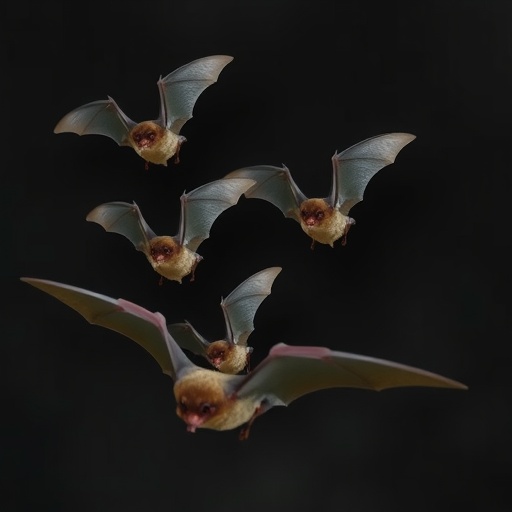
In the intricate dance of nature, gray bats exhibit a remarkable ability to modulate their echolocation calls dynamically as they navigate through their environment. Recent research focusing on a colony of these bats in Virginia has unveiled that their acoustic signaling adapts not only to the distribution and density of conspecifics within the flying group but also to the spatial complexities posed by environmental obstacles. This nuanced adaptation highlights an advanced level of acoustic plasticity, underpinning how sensory modalities evolve in response to both social and physical ecological pressures.
Echolocation, the biological sonar used by bats, relies on emitting ultrasonic calls and interpreting the returning echoes to construct a spatial map of their surroundings. For gray bats (Myotis grisescens), the ability to adjust echolocation parameters such as call frequency, pulse interval, and amplitude is critical for effective navigation and foraging in cluttered environments. The complexity of the environment, inclusive of obstacles like vegetation, cave formations, or man-made structures, imposes acoustic challenges that bats must overcome to avoid collisions and successfully locate prey.
The social context of echolocation also cannot be overlooked. As gray bats frequently fly in groups that can range in size, the acoustic environment becomes crowded with overlapping biosonar signals. This raises the challenge of signal interference, where the sonar pulses of one bat might mask or distort those of another, thereby potentially reducing echolocation effectiveness. The recent study utilized a data-driven analytical framework to quantify how varying group sizes influence call parameters, illuminating the behavioral strategies bats adopt to mitigate acoustic jamming and optimize spatial perception.
Key findings reveal that as group size increases, gray bats employ more distinctive acoustic call adjustments. Specifically, alterations in call repetition rate, call intensity, and frequency modulation patterns were observed, suggesting an active tuning mechanism to reduce signal overlap with nearby conspecifics. These findings illustrate a sophisticated level of sensory crowd management that promotes cohesive group flight without compromising individual spatial awareness or prey detection capabilities.
Equally compelling is the bats’ dynamic response to environmental obstacles. As the complexity and density of obstacles increase within a bat’s flight path, echolocation calls are fine-tuned—often becoming shorter, higher in frequency, and more frequent. Shorter calls reduce echo overlap with previous pulses, while higher frequencies offer better spatial resolution, enabling bats to discern finer details in cluttered spaces. This modulation facilitates real-time navigation adjustments and underscores the flexibility of the gray bat’s auditory processing system.
The interplay between social and environmental acoustic challenges is especially intricate. The study found that bats prioritize obstacle detection in highly cluttered environments but concurrently maintain strategies to distinguish their calls from those of others in the group. This suggests a hierarchical adaptation mechanism where the urgency of obstacle avoidance can override concerns about acoustic interference, highlighting the prioritization within the bats’ sensory processing and behavioral response repertoire.
These insights were obtained through meticulous field recordings combined with advanced computational modeling approaches. By employing autonomous recording units in natural cave exit flights and applying machine learning algorithms to analyze call structure changes, the research team could dissect the influence of external factors on bat acoustic behavior with unprecedented resolution. This methodology sets a new standard for studying echolocating animals in complex, real-world contexts.
From an ecological perspective, understanding how gray bats dynamically adjust their echolocation in response to social and environmental pressures carries significant implications. Given that these bats are federally endangered, insights into their sensory ecology could inform conservation strategies, particularly in managing habitats where human-made structures or activities might introduce novel acoustic or physical obstacles. Maintaining flight corridors that facilitate optimal echolocation use is crucial for their survival and reproductive success.
Furthermore, the findings contribute broadly to sensory biology and bioacoustics by illustrating how animals balance individual perceptual demands with group living constraints. This research expands our understanding of animal communication systems and their plasticity, offering analogs for designing artificial sonar and communication systems that must operate reliably in crowded, noisy environments.
In practical terms, the knowledge gleaned from this study also has potential applications in technology fields such as robotics and autonomous navigation. By mimicking the adaptive echolocation strategies of gray bats, engineers could improve the design of sonar systems in drones or underwater vehicles, enhancing their ability to navigate complex environments while avoiding signal interference in group scenarios.
The complexity and emergent properties observed in gray bat echolocation exemplify the intricate evolutionary solutions animals develop to survive and thrive. The integration of sensory, cognitive, and social processes manifested in flexible call adjustments epitomizes the intersection of natural history and advanced biological science. Continued exploration of these mechanisms promises to uncover further mysteries of animal behavior and sensory function.
Ultimately, this study enriches our comprehension of biological sonar’s sophistication. It challenges simplistic views of animal navigation and communication by demonstrating how multi-dimensional factors such as group size and environmental habitat shape the sensory outputs of individual animals. This holistic perspective paves the way for deeper insights into both the neural and ecological facets of echolocation.
As the research community advances, the use of interdisciplinary approaches blending field ecology, acoustics, data science, and conservation biology will be paramount. The story of gray bats’ echolocation adaptation is emblematic of the dynamic environmental interactions that mold animal behavior, emphasizing the necessity for integrative efforts to unravel life’s complex biological narratives.
In summary, the ability of wild gray bats to adjust their echolocation calls dynamically based on flying group composition and environmental obstacles reveals a sophisticated sensory adaptation. This flexibility enables effective navigation and group coordination within cluttered habitats, underscoring evolutionary pressures that mold acoustic communication systems. Such discoveries not only deepen our understanding of bat biology but also inspire innovations across scientific and technological domains.
News Publication Date: 22-Apr-2026
Web References: http://dx.doi.org/10.1371/journal.pcsy.0000100
Cite Scienmag News
Gavin Prescott. (April 22, 2026). Wild gray bats modify their echolocation calls in response to group dynamics during flight. Scienmag. https://scienmag.com/wild-gray-bats-modify-their-echolocation-calls-in-response-to-group-dynamics-during-flight/
Gavin Prescott. "Wild gray bats modify their echolocation calls in response to group dynamics during flight." Scienmag, 22 April 2026, https://scienmag.com/wild-gray-bats-modify-their-echolocation-calls-in-response-to-group-dynamics-during-flight/. Accessed 5 September 2026.
Gavin Prescott. "Wild gray bats modify their echolocation calls in response to group dynamics during flight." Scienmag. April 22, 2026. https://scienmag.com/wild-gray-bats-modify-their-echolocation-calls-in-response-to-group-dynamics-during-flight/


