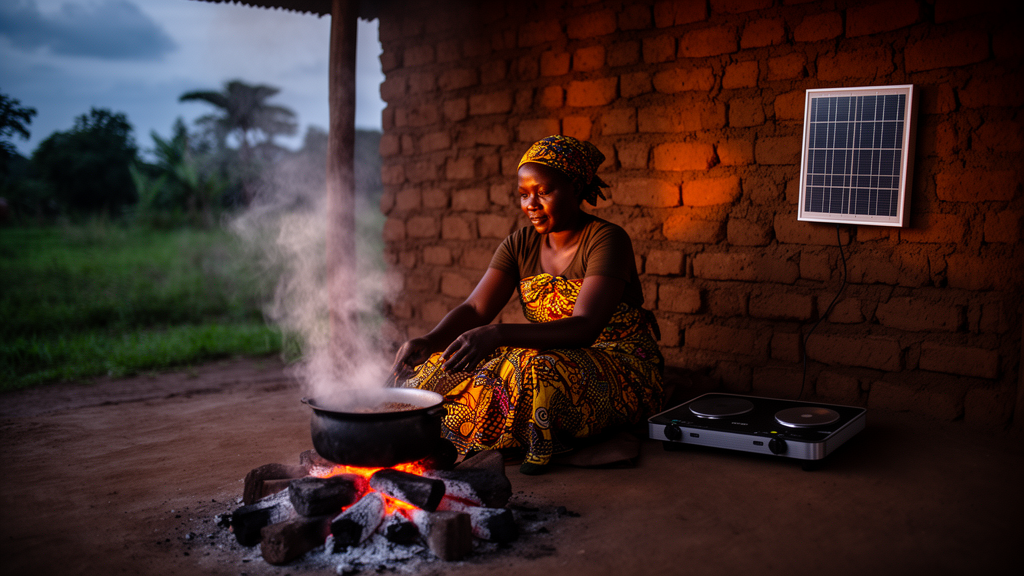
Uganda has spent years trying to persuade its households to abandon firewood and charcoal, and the numbers show how stubborn the problem remains. Roughly 89 percent of Ugandan households still relied on solid biomass for cooking in 2025, while only about a quarter had access to modern cooking solutions. The government has committed to raising that figure to 50 percent by 2030 through liquefied petroleum gas, electric cooking, bioethanol, biogas, and improved cookstoves, anchored in the National Integrated Clean Cooking Strategy 2023 to 2038. Yet awareness campaigns alone have not moved the needle. One recent study found that 78 percent of Ugandans knew about improved cookstoves, but uptake stayed limited. Only 1.7 percent of households cook with electricity, and 73 percent of electric pressure cooker recipients were unaware of the cooking tariff. A new qualitative study from Makerere University Business School, published in Frontiers in Sustainability, argues that the missing ingredient is not more information but adequate information, meaning information that is sufficient, credible, understandable, and locally relevant.
The research team, led by Florence Nakajubi, interviewed 20 participants, comprising 15 household heads and 5 policymakers drawn from institutions involved in renewable energy promotion and clean cooking initiatives. Using semi-structured interviews and the Gioia methodology, a rigorous qualitative coding approach, the researchers moved iteratively between participants’ accounts and emerging categories. The analysis generated seven first-order concepts, which the team organised into two second-order themes, information quantity and information quality, and one aggregate dimension of information adequacy. Three concepts captured information quantity, while four captured information quality. The household heads had all been exposed to low-carbon energy solutions such as improved cookstoves, briquettes, and solar cooking systems, and their varied backgrounds in gender, age, education, income, and residential setting allowed the researchers to capture both shared and contrasting experiences of how information reaches households.
The distinction between quantity and quality turned out to be crucial. Information quantity refers to whether households receive enough relevant information to understand and evaluate available low-carbon energy alternatives, not merely the volume of messages they encounter. Information quality concerns whether that information is clear, credible, accurate, accessible, and contextually relevant. The study frames these findings through Diffusion of Innovations theory, which proposes that adoption progresses through knowledge, persuasion, decision, implementation, and confirmation stages. The researchers found that information quantity primarily supports the knowledge stage, during which potential adopters become aware of an innovation and learn how it functions, whereas information quality strengthens the persuasion stage, during which households evaluate the technology and develop favourable or unfavourable attitudes towards it.
Participants’ accounts showed how exposure to more information broadened their knowledge beyond conventional energy sources. One household head described how training sessions transformed their understanding: before the sessions, they only knew about firewood and charcoal, but afterwards they started carbonising agricultural waste to produce briquettes. Others explained that greater exposure to information enabled them to reconsider earlier assumptions that clean energy technologies were very technical and expensive. Sufficient information helped reduce uncertainty surrounding technologies that households initially perceived as complicated or out of reach. The researchers note that insufficient information may sustain misconceptions about cost and technological complexity even where alternative technologies are physically available, meaning that awareness campaigns that simply repeat general messages about clean energy may do little to close the knowledge gaps that constrain meaningful consideration.
But the study adds an important qualification: more information is not necessarily more useful unless it addresses the questions households need answered before considering adoption. Participants valued concrete information concerning costs, suppliers, operation, and practical use when assessing the feasibility of low-carbon energy alternatives. One policymaker explained how a project tackled gaps by giving households actual cost figures, supplier contacts, and short videos. Households may be aware that an alternative exists while still lacking the practical information required to assess whether it is affordable, accessible, or suitable for their circumstances. The researchers therefore argue that informational sufficiency involves access to a range of decision-relevant details rather than repeated exposure to general awareness messages.
Information quality emerged as equally decisive. Participants considered information particularly useful when it was clear, credible, accessible, and relevant to their circumstances. Clear and understandable communication was especially important when households encountered unfamiliar technologies. Participants valued information presented in familiar language and supported by practical demonstrations and visual materials because these approaches made technical information easier to understand and apply. Differences in participants’ educational and livelihood backgrounds influenced the form and content that households considered useful, but practical demonstrations, local-language explanations, visual materials, and opportunities to seek clarification made unfamiliar technologies more understandable regardless of these differences.
Peer experiences proved particularly powerful in enhancing the credibility and relevance of information. One participant described how a video showing another family using a solar cooker really touched them, reasoning that if that family could do it, so could they. Observing other households successfully using low-carbon technologies made the information more relatable and reduced uncertainty about whether similar technologies could work in their own circumstances. The researchers note that social influence does not constitute a separate dimension of information adequacy; rather, peer experiences strengthen information quality by providing credible and observable evidence through which households assess the practical usefulness of an unfamiliar technology. Contextual relevance mattered too: information about low-carbon technologies was more useful when households could relate it to locally available resources, household practices, costs, and everyday economic circumstances. One participant pointed out that their community even burns coffee stems for charcoal, suggesting that if they had known how to make briquettes earlier, they would not be suffering.
The study’s theoretical contribution lies in clarifying the informational conditions associated with the knowledge and persuasion stages of Diffusion of Innovations theory. Information quantity supports the knowledge stage by increasing awareness and practical understanding of available low-carbon energy alternatives, whereas information quality strengthens the persuasion stage by enabling households to assess characteristics such as relative advantage, compatibility, complexity, and practical usefulness. Peer experiences further support this evaluative process by increasing observability and providing socially credible information about technology use. The researchers do not propose additional stages to the theory but demonstrate how the sufficiency and quality of information can facilitate households’ movement through its early adoption stages.
The practical implications are significant for policymakers, energy agencies, and development partners. Information interventions should extend beyond general awareness campaigns and provide households with sufficient and practical information on technology costs, expected savings, suppliers, availability, operation, maintenance, and everyday use. Communication should also be adapted to household circumstances through clear language, locally accessible channels, demonstrations, visual materials, opportunities for clarification, and relatable experiences from existing users. Such approaches can reduce uncertainty and enable households to make more informed assessments of available energy alternatives.
However, the researchers caution that information adequacy should not be regarded as sufficient on its own to produce household energy transition. Although adequate information can strengthen knowledge and evaluation of low-carbon energy alternatives, adoption may still be constrained by affordability, technology availability, infrastructure, and other socioeconomic conditions. Policies seeking to accelerate household energy transition should therefore combine effective information provision with interventions that address the broader economic and technological barriers affecting households’ capacity to adopt and sustain low-carbon energy solutions. The study is limited by its qualitative case-study design and its relatively small sample of 20 participants within the Ugandan context, so future research could examine information adequacy across larger and more diverse household populations and test quantitatively the relationships between information quantity, information quality, and adoption of specific low-carbon energy technologies. Comparative studies across different geographical and socioeconomic settings could also establish how the role of information adequacy varies across household energy-transition contexts.
Subject of Research: Information adequacy and household transition to low-carbon energy solutions: a qualitative case study from Uganda
Article Title: Information adequacy and household transition to low-carbon energy solutions: a qualitative case study from Uganda
Article References: Nakajubi, F., Ntayi, J. M., Bashir, H., Senyonga, L., Adaramola, M. S., & Atukunda, R. (2026). Information adequacy and household transition to low-carbon energy solutions: a qualitative case study from Uganda. Frontiers in Sustainability, 7, Article 1913290. https://doi.org/10.3389/frsus.2026.1913290
Image Credits: AI Generated
DOI: 10.3389/frsus.2026.1913290
Keywords: Information, adequacy, household, transition, low-carbon, energy, solutions, qualitative, case, Uganda, scientific research
Cite Scienmag News
Faith Mcneil. (October 15, 2026). Why Ugandan households ignore clean energy despite knowing it exists. Scienmag. https://scienmag.com/why-ugandan-households-ignore-clean-energy-despite-knowing-it-exists/
Faith Mcneil. "Why Ugandan households ignore clean energy despite knowing it exists." Scienmag, 15 October 2026, https://scienmag.com/why-ugandan-households-ignore-clean-energy-despite-knowing-it-exists/. Accessed 15 October 2026.
Faith Mcneil. "Why Ugandan households ignore clean energy despite knowing it exists." Scienmag. October 15, 2026. https://scienmag.com/why-ugandan-households-ignore-clean-energy-despite-knowing-it-exists/